
The Farm Has Always Been the Business. We Are Just Giving It the Software to Prove It.
Africa employs 60% of its working population in agriculture. It holds 60% of the world’s uncultivated arable land. Its farming sector feeds over a billion people — and yet, by almost every productivity metric, it operates far below its potential. The reasons are well-documented: limited access to finance, absence of reliable market linkages, low technology adoption, and — perhaps most consequentially — the near-total absence of documented farm performance data that would allow banks to confidently lend to farmers and farmers to confidently borrow. A farmer in Uganda with five acres of maize, fifteen goats, and ten years of farming experience has an asset. What they almost universally lack is the documented evidence of that asset’s performance — the records of yield per season, cost per unit of production, revenue per harvest, and livestock health trajectory that would allow a bank to assess creditworthiness with confidence rather than guesswork. This is the gap that Soillx is being built to close. What Soillx Is Soillx is a startup being developed at the intersection of agricultural technology, financial inclusion, and market access — built on a partnership with Farmbrite, one of the world’s most comprehensive farm management software platforms, and designed specifically for farmers across Africa and Asia. The model is not complicated. But its simplicity is deceptive, because each component solves a problem that has historically required a different organisation, a different platform, and a different conversation. Soillx brings all four into one system: Farm Management Software — Farmbrite’s platform, adapted and supported for African and Asian farming contexts, giving farmers the tools to record, track, and analyse every aspect of their operation. Bank Financing — partnerships with African and Asian banks that use Soillx’s platform data as the evidence base for agricultural loan decisions, connecting capable farmers to the capital they need to improve productivity. Market Access — a Shopify-backed e-commerce platform and app that allows farmers to sell their produce directly to buyers, removing the intermediary margin that currently captures value from both ends of the agricultural supply chain. Equipment Supply — sourcing from China through established supply relationships to deliver the farming equipment that productivity improvements require, at accessible prices. All four components are connected through the Farmbrite platform — which means the data generated by farm management flows directly into the financial reporting that banks use for loan decisions, and the revenue data from market sales flows back into the farm’s financial records, creating a complete, auditable picture of farm performance. Why Farmbrite Is the Right Foundation Farmbrite is an all-in-one farm management software for modern farmers and ranchers — designed to help farmers know more, grow more, and sell more, all from one easy-to-use place. It covers livestock management, crop planning, task management, financial tracking, equipment records, and customer management — all accessible through a cloud-based platform with native mobile apps for iOS and Android. Farmbrite provides tools for managing farm operations, planning and optimising production, scheduling tasks and activities, tracking finances, managing customers, and more — with native mobile apps that facilitate on-the-go data access and input. The financial tracking capability is particularly significant for the Soillx model. Users consistently highlight the ease of keeping track of accounting including uploading pictures of each receipt — and the all-inclusive nature of livestock information including pedigree, breeding, and medical records. Farmbrite works for global customers from all around the world, offering localised currency, measurement, and language support directly within the platform — currently supporting farmers from over 100 countries. For a startup being built to serve farmers in Uganda, Kenya, Tanzania, Rwanda, and across Asia, this global localisation capability is not a feature — it is a prerequisite. A farm management platform that cannot handle Ugandan shillings, Kenyan acres, or the specific livestock categories relevant to East African animal husbandry is not useful to the farmers Soillx is being built to serve. Farmbrite’s pricing starts at $35/month for the Grower plan, which includes 25 users, unlimited acreage, unlimited plantings and varieties, crop record keeping, and advanced crop planning. For small and medium farming operations across Africa, this price point — particularly with Soillx’s membership subscription model subsidising or bundling the software cost — makes enterprise-grade farm management accessible at a fraction of what comparable Western agtech platforms charge. The Bank Financing Model: Solving Agriculture’s Oldest Problem Many smallholder farmers lack the collateral to access traditional bank loans — one of the most critical constraints on farm productivity and food security across Africa. The conventional bank loan assessment model requires documented evidence of income, assets, and repayment capacity. Most African smallholder farmers cannot provide this documentation — not because the evidence does not exist, but because it has never been captured in a format that a bank can assess. A farmer who has been growing maize for fifteen years has fifteen years of production history. They know which seasons were good and which were poor. They know their input costs, their yields, and their revenue. But none of it is documented in a way that a credit officer can evaluate. Farmbrite’s farm management software changes this. A farmer who uses Soillx’s platform for one growing season generates a complete, time-stamped, auditable record of their farm’s performance — planting dates, input applications, yield measurements, livestock health events, equipment maintenance, revenue from sales, and expense records. This data, flowing into Farmbrite’s integrated accounting system, becomes the credit evidence that banks have historically lacked. A bank partner working with Soillx does not need to assess a farmer’s creditworthiness through the traditional collateral model. They can assess it through the platform data — which tells them, with precision, what the farm produces, what it costs to produce it, and what the revenue trajectory looks like. The loan proceeds flow back into the farm — into improved seed, into equipment, into expanded livestock — and the platform continues to track the productivity impact of that investment. The bank can monitor, in real time, whether the loan is being used as intended and
From a Family Electronics Business to Digital Strategy: My View of Africa’s Tech Evolution
For more than two decades, our family business has operated within one of the most important economic shifts in African history: the rise of affordable mobile technology powered largely by Chinese manufacturing. Long before “digital transformation” became a global policy phrase, Chinese electronics brands were already transforming everyday African life from the ground up. In Uganda and across Africa, brands like Tecno, Itel, Infinix, and Redmi did something many Western companies failed to understand at the time: they built for the realities of the African consumer. They developed devices with: This was not simply about selling phones. It was the beginning of Africa’s modern digital infrastructure. China’s Role in Africa’s Digital Transformation The impact of China on Africa’s digital economy goes far beyond manufacturing. Chinese technology ecosystems accelerated: For millions of Africans, the first internet experience did not happen on a desktop computer. It happened on a Chinese-made smartphone. That single shift changed consumer behavior, communication patterns, business models, and even political discourse across the continent. Today, Africa’s digital economy is one of the fastest-growing in the world because mobile technology became accessible to ordinary people — not just elites. Watching Consumer Behavior Changed My Perspective Growing up around the electronics business exposed me to something deeper than retail. I became fascinated not only by the devices people bought, but by what happened after they turned them on. I started observing: That curiosity pushed me beyond phone sales. I wanted to understand the systems behind digital growth. I wanted to understand: That journey led me into web development, SEO, digital marketing, sales funnels, and startup advisory. Building Digital Infrastructure Beyond Hardware Over the years, I transitioned from simply participating in Africa’s electronics economy to helping businesses build their digital presence and growth infrastructure. Today, my work spans multiple areas of digital transformation. Website Development and Digital Presence I have spent years building and managing websites for businesses across different sectors, helping organizations move from offline visibility into fully functional digital ecosystems. This includes: I learned early that in Africa’s mobile-first economy, websites are no longer optional. They are commercial infrastructure. SEO and Search Visibility As smartphone usage increased, search behavior became one of the most powerful economic drivers in Africa. I specialized in SEO to help businesses: My work in SEO expanded into: This became especially important as African businesses increasingly sought visibility beyond local markets. Paid Media and Digital Advertising With over five years of experience in paid media and more than $12,000 spent in advertising campaigns, I have worked extensively with: This work helped businesses understand not only how to get traffic — but how to convert attention into revenue. Supporting African Entrepreneurship and Startups My involvement in digital transformation also expanded into startup ecosystems across Africa and the Middle East. Through engagements connected to organizations such as Doola based in USA and Flat6Labs, Startup Uganda, and International Trade Centre, I gained exposure to how emerging markets are building innovation ecosystems. This experience reinforced something important: Africa’s future will not only be shaped by technology consumers. It will be shaped by African builders. The Next Phase of Africa’s Digital Economy The next decade of African digital transformation will likely move beyond smartphone access into: China will continue to play a major role in this transformation through: But Africa itself is also evolving from being only a consumer market into a producer of digital innovation. Why This Matters Personally For me, this journey started in a phone business. But the phones became a gateway into understanding how technology reshapes human behavior, commerce, and opportunity. Watching customers move from: gave me a front-row seat to Africa’s digital evolution. That evolution inspired me to build skills and businesses that contribute directly to digital transformation rather than remaining only in retail distribution. Today, whether through SEO, web infrastructure, startup advisory, digital advertising, e-commerce systems, or content strategy, my work is centered around one idea: Helping African businesses and entrepreneurs compete effectively in a global digital economy. And in many ways, that journey began with a simple observation inside a family electronics business: Technology does not only change devices. It changes behavior, markets, industries, and the future of entire continents.
Your Startup Doesn’t Have Borders. Your Advisor Shouldn’t Either
Most startup advisors work in one market. They understand Silicon Valley or they understand Lagos or they understand the Gulf. They have one network, one mental model of how startups get built and funded, and one set of assumptions about what founders need to succeed. I have spent the last several years building something different — not by design at first, but by the accumulation of real relationships, real presence, and real work across three of the world’s most consequential emerging startup ecosystems: Africa, the Middle East, and America. This is the story of how that happened — and why the three-market startup advisory practice I am building from Austin, Texas is the model that the next generation of global founders actually needs. The Three Markets — And Why Each One Matters 🌍 Africa — The Demographic Engine Africa has 1.4 billion people. By 2050 it will have 2.5 billion — the youngest, fastest-growing population on the planet. Its digital economy is accelerating at 17% annually. Its mobile money infrastructure has leapfrogged banking systems that took Western markets a century to build. Its startup ecosystem has produced unicorns in fintech, logistics, healthcare, and agriculture across Nigeria, Kenya, South Africa, and Egypt. But Africa’s startup ecosystem has a persistent structural problem: most of its most promising founders cannot access the capital, the market validation, or the global distribution networks that would allow their businesses to scale beyond their home markets. My entry into Africa’s startup ecosystem came through direct, operational involvement — not observation from the outside. During Kampala Innovation Week — Uganda’s first hybrid event, which I was consulted to launch for Talent Africa Group — I encountered and engaged with three of the continent’s most significant startup infrastructure organisations: the International Trade Center, Startup Uganda, and Startup Africa. The International Trade Center connects African SMEs and startups to global trade networks. Startup Uganda is the national backbone for Uganda’s entrepreneurship ecosystem. Startup Africa, convened during Kampala Innovation Week, brings together founders, investors, and ecosystem builders from across the continent. Being physically present at this convergence — not as an observer but as the person who built the digital campaign that put 1,000+ people in the room — gave me a specific kind of access to Africa’s startup community that most international advisors do not have. I understand what Ugandan and East African founders are building, what they need, and what the gap is between where they are and where they want to go. 🏙️ Middle East — The Capital Gateway The Gulf is one of the world’s most underappreciated startup ecosystems — not because the ecosystem is weak, but because Western media has been slow to recognise what has been built. Flat6Labs is the leading entrepreneurship platform in emerging markets, empowering entrepreneurs to build, launch, and grow transformative ideas through acceleration programs, ecosystem development, and tailored innovation services. Flat6Labs Bahrain is a seed program supported by Tamkeen that accelerates and launches both local and international startups in the Kingdom of Bahrain — each cycle selecting 8–10 promising teams to receive cash funding, strategic mentorship, office space, and a multitude of partner perks and services. Flat6Labs Bahrain was created in partnership with Tamkeen — the Labour Fund — with the aim of fostering a dynamic and sustainable entrepreneurship environment, supporting job creation, and helping position Bahrain as an innovation leader in the Arabian Gulf region and MENA at large. My relationship with the Gulf’s startup ecosystem was built during the years I spent working in Bahrain — attending Flat6Labs events, engaging with Startup Bahrain, and operating inside the Tamkeen-backed entrepreneurship infrastructure that the Bahraini government has deliberately constructed to attract and develop founders from across the region and beyond. Flat6Labs invests $30,000 to $250,000 in startups and has helped hundreds of companies scale, with cohorts that are highly competitive but provide unmatched investor network and mentorship access. The Gulf’s startup ecosystem has three things that Africa’s ecosystem frequently lacks: sovereign wealth fund capital, regulatory clarity for fintech and digital businesses, and proximity to the global financial infrastructure that allows startups to scale internationally. Gulf-backed startups can access Saudi Arabia’s Vision 2030 investment, the UAE’s global connectivity, and Bahrain’s fintech regulatory sandbox — infrastructure that most African startups have to route through European or American intermediaries to access. 🇺🇸 America — The Scale Infrastructure The American market is not where most startups begin. It is where the ones that want to scale globally need to arrive. Doola is a YCombinator-backed (YC S20) “Business-in-a-Box” platform that empowers global founders by helping them set up a US business without handling complex paperwork — today, people on every continent have launched companies with doola. Doola has launched its Business-in-a-Box for E-Commerce — the first solution that brings the entire back-end of e-commerce into one place: LLC formation, compliance, multi-state tax rules, bookkeeping, financials, and business analytics across Shopify, Amazon, and beyond. It has already helped 10,000+ entrepreneurs from 175+ countries scale to seven figures. My engagement with Doola is not simply about having registered amdan.pro LLC in Austin, Texas. It is a strategic partnership built around a shared understanding of what globally-minded founders — particularly those from Africa and the Gulf — need when they decide to build for the American market. Doola’s AI Co-Founder is built for global e-commerce entrepreneurs and automates tasks that usually drain founders’ time — banking and payments, compliance and filings, bookkeeping, and US tax guidance — with no US Social Security Number required, fluent in 175+ countries’ unique challenges. For an African or Gulf founder who wants to launch a Shopify store, an Amazon FBA business, or a US-registered SaaS company, Doola removes the back-office complexity that would otherwise require a US-based lawyer, accountant, and compliance specialist. For my startup advisory practice, the Doola partnership means I can walk a Ugandan e-commerce founder or a Bahraini SaaS company directly into the American market without the infrastructure friction that has historically been a barrier. Why Three Markets Is
The $14,400 Question Every Service Business Needs to Answer About Their Software Stack
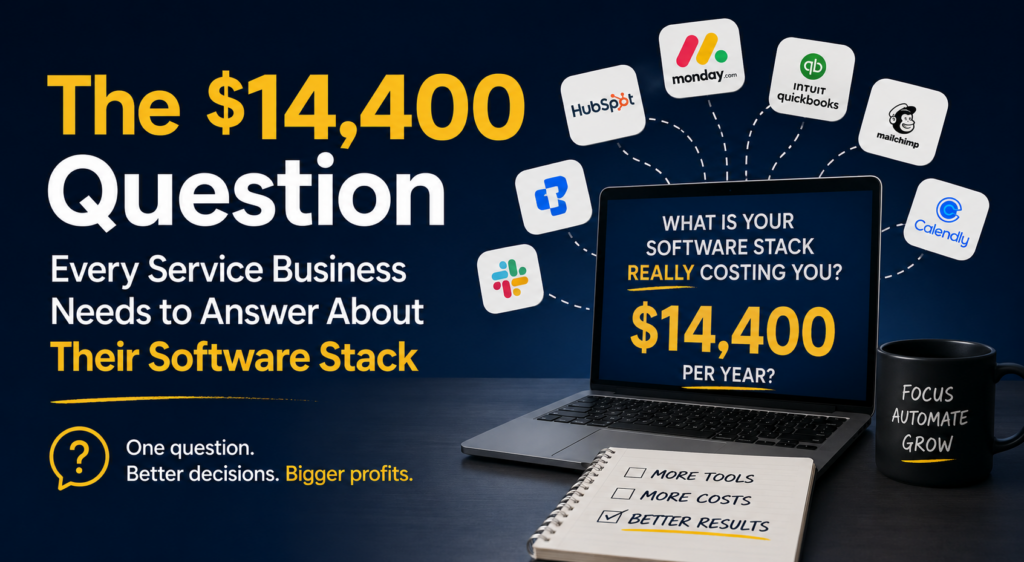
The Marketing Stack Audit: How to Calculate ROI & ROMI on Every Tool You Pay For .Most businesses have a software problem they don’t know they have. They are paying for 8, 10, sometimes 15 tools every month. Some of those tools are generating significant revenue. Some are sitting largely unused. Some are duplicating functions that another tool in the stack already covers. And almost none of the businesses paying for these tools have done the calculation that would tell them which category each tool falls into. The result: the average SaaS company uses 91+ tools in 2026, with at least 50% of SaaS licences underutilised or unused. Money that should be compounding into revenue is funding software subscriptions that are delivering no measurable return. This article is the framework for fixing that — specifically applied to the growth intelligence stack we use in every client audit: SEMrush, HubSpot, ClickFunnels, Leadpages, Apollo, Google Analytics, Google Tag Manager, Google Search Console, Hotjar, QuickBooks, and Kit (ConvertKit). Each tool has a job. Each tool has a cost. And each tool should be generating a return that justifies that cost — or it should be cut. The Two Metrics That Matter: ROI vs ROMI Before calculating anything, the definitions matter — because ROI and ROMI are measuring different things, and confusing them produces misleading conclusions. ROI (Return on Investment) measures the total return on any investment relative to its cost: ROI = (Revenue Generated − Total Investment) ÷ Total Investment × 100 If your total revenue is $200,000 and marketing spending is $50,000, then: $200,000 − $50,000 = $150,000 net profit. ROI = $150,000 ÷ $50,000 × 100 = 300%. For each dollar you spend on marketing, you earn $3 in profit. ROMI (Return on Marketing Investment) focuses specifically on marketing activities — isolating the return from marketing spend versus overall business investment: ROMI = (Revenue Attributable to Marketing − Marketing Investment) ÷ Marketing Investment × 100 ROMI focuses specifically on marketing activities and provides a more granular view of marketing effectiveness. If your company spent $50,000 on a campaign that generated $200,000 in revenue, ROMI = [($200,000 − $50,000) / $50,000] × 100% = 300%. For software stack analysis, you need both: The Full Software Cost Audit: What You Are Actually Spending Before calculating returns, you need an honest inventory of costs. Most businesses underestimate their software spend because they look at individual tools in isolation rather than the cumulative stack. Here is the Growth Intelligence Stack we use in client audits — with approximate monthly costs at standard tiers: Tool Function Est. Monthly Cost SEMrush SEO, keyword intelligence, competitive analysis $140–$500 HubSpot CRM, email marketing, sales pipeline $50–$800 ClickFunnels Funnel building, landing pages $97–$297 Leadpages Landing pages, lead capture $37–$99 Apollo Lead generation, prospecting, outreach $49–$99 Kit (ConvertKit) Email marketing, sequences, automation $29–$99 Hotjar Website heatmaps, session recordings $32–$80 Google Analytics Website traffic analysis Free Google Tag Manager Tag and tracking management Free Google Search Console Search performance monitoring Free QuickBooks Accounting, invoicing, financial tracking $30–$90 AWS / GoDaddy / Shopify / WordPress Hosting, e-commerce infrastructure $20–$300 Total (mid-tier estimate) ~$561–$2,463/mo At a mid-tier stack running $1,200/month, your software costs $14,400 per year before a single dollar of ad spend, freelancer cost, or your own time. That $14,400 is an investment. It needs to produce a return that justifies it — ideally a ROMI of at least 300%, which means $43,200+ in attributable revenue from that investment. The question every business should be asking: is it? How to Calculate ROI Per Tool The framework for calculating ROI on each tool in your stack has three steps: Step 1 — Assign Each Tool a Revenue Function Every tool in a growth stack should have a specific, measurable role in generating or protecting revenue. If you cannot articulate what revenue function a tool serves, that is a problem. SEMrush → Organic traffic growth → leads from organic search → revenue HubSpot → Lead capture, nurturing, CRM → conversion of leads to clients → revenue ClickFunnels/Leadpages → Paid traffic conversion → leads from paid ads → revenue Apollo → Outbound prospecting → booked calls → revenue Kit/ConvertKit → Email sequences → lead nurture → revenue Hotjar → Conversion rate optimisation → improved checkout/funnel performance → revenue QuickBooks → Financial management → invoicing accuracy, tax compliance → cost avoidance Google tools → Traffic measurement, search visibility → optimisation decisions → revenue Step 2 — Measure the Revenue Each Tool Contributes This requires attribution — connecting the revenue you generate to the tools that contributed to generating it. There are several approaches: multi-touch attribution assigns value to each marketing touchpoint in the customer journey. In practice, for most small and medium businesses, a simplified attribution model works: For SEMrush: Track organic traffic in Google Analytics. Calculate what percentage of your leads come from organic search. Apply that percentage to your revenue to get organic revenue. Compare to SEMrush’s monthly cost. For HubSpot: Track leads captured through HubSpot forms and sequences. Track which leads converted to paying clients. Calculate revenue from HubSpot-sourced clients. Compare to HubSpot’s monthly cost. For ClickFunnels/Leadpages: Track leads generated per landing page using UTM parameters and Google Analytics. Calculate conversion rate and revenue from those leads. Compare to platform cost. For Apollo: Track outbound sequences sent, replies received, calls booked, and clients closed. Calculate revenue from Apollo-sourced clients. Compare to Apollo’s monthly cost. For Kit/ConvertKit: Track email open rates, click rates, and — most importantly — revenue from email-triggered purchases or bookings. Compare to platform cost. For Hotjar: Calculate improvement in conversion rate since implementation. Apply conversion rate uplift to your traffic volume and average transaction value to estimate revenue impact. Compare to Hotjar’s monthly cost. Step 3 — Apply the ROI Formula Per Tool Tool ROI = (Revenue Attributed to Tool − Tool Monthly Cost) ÷ Tool Monthly Cost × 100 Example — SEMrush at $140/month: Example — Apollo at $49/month: These numbers illustrate why high-performing tools deserve more investment
The African Investor’s Guide to Bitcoin: Complete allocation calculator and market cycle tactics included

African investors face unique challenges: volatile local currencies, high inflation, expensive cross-border transfers, and limited access to stable global assets. Bitcoin and complementary tools like stablecoins offer powerful solutions for hedging risks, facilitating payments, and building long-term wealth. This guide provides a practical Bitcoin Strategy Framework tailored for African investors, with a USD-focused approach. It leverages platforms like Noones for P2P trading and access to local payment methods across Africa, alongside Blockchain.com‘s robust wallet, exchange, and investment tools. 1. Understanding Currency Risk in Africa — Why Bitcoin Matters Now Many African currencies have faced significant devaluation and high inflation. Nigeria’s naira, for example, has lost substantial value in recent years, while other nations grapple with similar pressures. Holding savings solely in local fiat exposes investors to erosion of purchasing power. Bitcoin as a hedge: Often called “digital gold,” Bitcoin has a fixed supply of 21 million coins, making it resistant to the inflationary printing common in fiat systems. It has historically performed well as a store of value during periods of currency instability. Stablecoins for stability: USD-pegged assets like USDT and USDC act as a bridge. They offer dollar-like stability while enabling fast on-chain transfers. In Africa, stablecoins now dominate many P2P trades, serving as a practical USD proxy. Actionable tip: Diversify holdings — e.g., 40-60% in Bitcoin for growth potential, 30-50% in stablecoins for stability, and the rest in local assets or cash for liquidity. 2. Cross-Border Payments: From Expensive and Slow to Instant and Affordable Traditional remittances and business payments in Africa often incur 6-10%+ fees, take days to settle, and involve multiple intermediaries. Crypto changes this. How Bitcoin and stablecoins help: Noones advantage: Peer-to-peer marketplace with escrow protection, direct fiat-to-crypto ramps using popular African payment options, and strong support for stablecoins. Ideal for remittances, trade invoices, or diaspora payments. Open Noones account here ……… Blockchain.com tools: Secure wallets for holding and sending BTC or stablecoins, with easy tracking and institutional-grade features. Framework step: Use stablecoins for day-to-day cross-border needs and Bitcoin for larger, longer-term transfers or savings. 3. Long-Term Wealth Building: A USD-Denominated Bitcoin Strategy Treat Bitcoin as a core portfolio asset rather than pure speculation. Core Bitcoin Strategy Framework (USD Edition): Integration with Noones × Blockchain.com: Buy/ trade P2P on Noones with local currency, transfer to Blockchain.com for secure storage, advanced charting, or institutional services. This creates a seamless on-ramp, custody, and strategy engine. 4. Practical Steps to Get Started as an African Investor // Bitcoin Strategy Framework — USD Edition Noones × Blockchain.comInvestment Engine Buy on P2P → Store safely → Earn passively. Don’t trust either platform with everything. NOONES — ENTRY/EXIT BLOCKCHAIN.COM — HOLD/EARN // 01 — Platform Roles Noones Access Gateway Peer-to-peer marketplace for buying BTC with cash or bank transfer. Your fiat ↔ crypto bridge. Buy BTC with USD via P2P Fiat ↔ crypto conversion Only escrow-enabled traders Move funds immediately after purchase Entry Only Blockchain.com Storage + Yield Tool Wallet, optional exchange, and earn feature. Use for holding and generating passive income. Hold BTC long-term Earn ~8% APY on a portion Not a full custodial trust platform Keep earn % low — platform risk is real Hold + Earn // 02 — Three-Step Flow 1 NOONES Buy BTC via P2P Use Noones to purchase Bitcoin with USD. Trade ONLY with high-rated vendors, escrow always ON. Never leave funds sitting on the P2P platform — withdraw immediately after every trade. 2 BLOCKCHAIN Split & Secure Your Stack Transfer your BTC to Blockchain.com wallet (or ideally a private wallet). Separate your “wealth core” from your yield portion. This separation is the foundation of the entire strategy. 3 BOTH Allocate: Hold vs. Earn 70–80% stays in cold/warm storage for long-term appreciation. 20–30% goes into Blockchain.com Earn at your chosen APY. This creates monthly income without gambling your wealth core on platform risk. // 03 — USD Investment Calculator Monthly Investment Planner Enter your monthly USD amount, adjust the hold/earn split and yield rate to see projected returns. Monthly investment $ USD / month Earn APY rate 5% 8% 10% 12% Hold allocation 75% HOLD / 25% EARN HOLD — 75% EARN — 25% HOLD EARN Hold Amount $3,750 USD / month→ BTC long-term storage Earn Amount $1,250 USD / month→ Blockchain.com Earn Monthly Yield $8.33 USD passive income→ from earn portion Annual Yield $100 USD / year→ from earn portion 12-Month Hold Stack $45,000 USD in BTC→ pre-growth value Bull Case (2× BTC) $90,000 USD at 2× BTC growth→ cycle dependent ★ Hold stack over 12 months: $45,000 in BTC. At 2× BTC growth = $90,000+. Yield adds $100/yr passive income on top. // 04 — Market Cycle Strategy 🐻 Bear Market Accumulation Mode → Buy heavily via Noones (prices cheap) → Keep yield earn active for income → Stack aggressively into hold wallet → Yield supplements lost upside 🐂 Bull Market Growth Mode → Move OUT of earn, keep BTC liquid → Price growth far exceeds any APY → Watch for exit signals at cycle peaks → Use Noones to convert BTC → USD if needed // 05 — Risk Flags ⚠ Critical Mistakes to Avoid ✕Leaving BTC on Noones after a trade — P2P platforms are not wallets ✕Putting 100% of BTC into yield — platform risk is real, Blockchain.com has had issues ✕Trading with low-rated vendors or skipping escrow on P2P — scams are common ✕Staying in yield during a bull run — you’ll underperform vs simply holding BTC // 06 — The One-Line Strategy // Final Truth Buy cheap on Noones →Store safely on Blockchain wallet →Use small % for yield to earn monthly income Noones = Access (buy/sell) Blockchain.com = Tool (hold/earn) Bitcoin = Wealth Engine Risks and Responsible Investing Bitcoin is volatile. Regulatory changes, security threats, and market cycles exist. Always DYOR (Do Your Own Research), diversify, and consider professional advice. Start small and scale responsibly. Conclusion: Bitcoin as Financial Sovereignty for African Investors For African investors, Bitcoin isn’t just
I used Bitcoin for 5 Years: Why Digital Payments and Blockchain Are Africa’s Most Underestimated Financial Revolution

In 2019, I attended the PayTabs event at Unbound Bahrain — the anchor event of StartUp Bahrain week, celebrating the Kingdom’s commitment to fuelling a digital future for the MENA region. PayTabs demonstrated its online, mobile, social, and next-generation payment processing capabilities across MENA to a room of founders, investors, merchants, and financial technology operators. The energy was specific: this was not a theoretical conversation about the future of money. It was a practical one about the infrastructure being built right now to power digital commerce across one of the world’s fastest-growing economic regions. That same year, I was listed as an investor at the World Blockchain Roadshow Middle East — organised by the International Decentralized Association on Cryptocurrency and Blockchain (IDACB), covering five Arabian countries: Abu Dhabi, Dubai, Muscat, Manama, and Kuwait City, connecting more than 90 verified blockchain investors with perspective startups. And for the past five years, I have transacted in Bitcoin — not as a speculative bet on a chart, but as a genuine financial instrument: a store of value, a cross-border payment mechanism, and a hedge against the currency volatility that every African entrepreneur operating across multiple markets understands intimately. This article is the synthesis of those three threads — payment gateways, blockchain investment, and five years of Bitcoin experience — applied to the specific realities of Africa and the Middle East in 2026. What the PayTabs Event Revealed About Payment Infrastructure PayTabs was founded in 2014 by Saudi entrepreneur Abdulaziz Al Jouf with a vision to help merchants across the MENA region access a secure way to get paid online — and by 2019, it had become one of the region’s most consequential fintech companies. PayTabs became a founding partner of Bahrain Fintech Bay — the largest dedicated fintech hub in the Middle East and Africa. Speaking at the event, PayTabs Chief Digital Officer Philippe Berard said: “Bahrain’s central location in the Middle East makes it a critical online payments hub. Internet penetration in the kingdom is over 90% — one of the highest in the world — and it is only natural that e-commerce thrives against this backdrop.” What I observed at that event was not just a payment company demonstrating its product. It was an ecosystem in action — regulators, merchants, banks, and payment infrastructure providers working inside a framework that Bahrain had deliberately constructed to accelerate fintech adoption. The contrast with Africa’s payment landscape could not have been starker. While Bahrain was building a regulated, interoperable, multi-currency digital payment ecosystem in 2019 — with PayTabs enabling 130+ alternative payments to help merchants reach their online business’ full global potential — most African businesses were still collecting cash, processing payments through disconnected mobile money systems that couldn’t talk to each other, or navigating the complexity of cross-border transactions that took days and cost significant margin. Seven years later, the gap has narrowed — but it has not closed. Payment Gateways: Where Africa Stands in 2026 Africa’s payment gateway landscape in 2026 is more developed than it was in 2019, but it remains fragmented, expensive, and inaccessible for many of the businesses that need it most. The Major Players — Africa Flutterwave — Nigeria-founded, now pan-African and global. Processes payments across 34+ African countries, supports 30+ currencies, and provides APIs for e-commerce, marketplace, and subscription billing. The closest Africa has to a PayTabs equivalent in terms of breadth of service. Paystack — Acquired by Stripe in 2020 for $200 million. Operates primarily in Nigeria, Ghana, Kenya, and South Africa. Known for developer-friendly integration and clean checkout experience. Strong for SMEs and SaaS businesses. Chipper Cash — Cross-border mobile money transfer across Africa. Operates in Uganda, Kenya, Ghana, Tanzania, Rwanda, and beyond. Strong for peer-to-peer and business-to-business transfers at lower cost than traditional remittance. MTN Mobile Money / Airtel Money — The dominant payment infrastructure across East and West Africa at the consumer level. Ubiquitous for local transactions but limited for international payments, e-commerce integration, and subscription billing. DPO Group (now Network International) — One of the most established payment processors in sub-Saharan Africa, with operations in Uganda, Kenya, Tanzania, Rwanda, and beyond. Strong for hospitality, tourism, and enterprise merchants. The Major Players — Middle East PayTabs — An award-winning payment infrastructure company powering the future of fintech, with an AI-powered payment orchestration platform that empowers banks, fintech players, enterprises, and government institutions. Now operating across MENA with white-label capabilities for banks and governments. Telr — UAE-based payment gateway serving the Gulf, with strong Shopify and WooCommerce integration. HyperPay — Saudi Arabia-headquartered, operating across the Arab world. Strong for Arabic-language checkout experiences and local payment method support. Noon Payments — Backed by Noon.com, growing rapidly across the UAE and Saudi Arabia. The Comparison: What African Businesses Are Missing Feature Middle East (PayTabs/HyperPay) Africa (Flutterwave/Paystack) Multi-currency ✅ 168+ currencies ✅ 30+ currencies Arabic/local language checkout ✅ Native ⚠️ Limited Regulatory clarity ✅ CBB, UAE Central Bank ⚠️ Varies by country Cross-border B2B payments ✅ Strong ⚠️ Improving Subscription/recurring billing ✅ Full ✅ Growing White-label for banks ✅ Available ⚠️ Limited Government integration ✅ Active ⚠️ Emerging Settlement speed 1–2 days 2–5 days The gap is narrowing. But the Middle East’s payment infrastructure — built on clearer regulation, deeper banking integration, and a higher-value merchant base — remains more mature and more capable for businesses operating at scale. The Blockchain Layer: What I Witnessed at the World Blockchain Roadshow The World Blockchain Roadshow Middle East by IDACB was the first of its kind — connecting prominent blockchain investors and top ICO projects across five Arabian countries, with the aim of establishing links between crypto entrepreneurs worldwide. Being listed as an investor at that event in 2019 gave me a specific vantage point. I was not in the room as a spectator. I was in the room as someone with a stake in how blockchain technology would develop — and specifically, how it would interact with the payment and financial infrastructure of the markets I operated
Dubai vs Bahrain: Where Should You Buy Property in 2026 — And Which Gets You a Golden Visa?

Two properties. Two Gulf markets. Two completely different investment outcomes. The first is a furnished 1-bedroom apartment in Hamza Tower, Dubai Sports City — 873 square feet, already tenanted, listed at AED 820,000 ($223,000). The second is a 1-bedroom apartment in Al Juffair, Bahrain’s Capital Governorate — 657 square feet, listed by ERA Real Estate at 41,000 BHD ($108,730). Both are in freehold zones. Both are in USD-pegged currency markets. Both are in established residential areas with consistent expat demand. But when you run the full comparison — purchase price, rental yield, net return, Golden Visa eligibility, and 10-year investor outcome — the picture is considerably more nuanced than the headline numbers suggest. This is the comparison every East African, South Asian, and emerging market investor looking at Gulf real estate needs to read before committing capital in 2026. The Properties: What You Are Actually Buying Property A — Hamza Tower, Dubai Sports City, UAE Hamza Tower is a completed 16-storey residential building in Dubai Sports City, DubaiLand. The specific unit — an upgraded, furnished 1-bedroom on a mid-floor — is listed at AED 820,000 ($223,000) and is already rented, meaning day-one rental income for the buyer. Hamza Tower carries an 8.9% rental yield according to Property Finder data, one of the stronger yield profiles in Dubai Sports City. Real estate in Dubai Sports City has a return on investment rate of 8.4%, which is competitive compared to premium Dubai locations like Downtown or Palm Jumeirah that offer 4–6% but stronger capital appreciation. Average rental value of Hamza Tower apartments is AED 72,124 per annum, translating to approximately AED 6,010 ($1,635) per month — with new rentals averaging AED 55,108/year and renewed rentals averaging AED 43,881/year. Property B — Al Juffair, Capital Governorate, Bahrain The Bahrain property is a 1-bedroom apartment of 657 square feet in Al Juffair — Manama’s most consistently performing residential district — listed by ERA Real Estate at 41,000 BHD ($108,730) at a price per square foot of 62 BHD. Al Juffair’s structural advantage is well-documented: it sits adjacent to the US Naval Support Activity Bahrain — the largest American military installation in the Middle East — creating permanent, structural demand from military personnel, contractors, and the expat professional community. Demand in this district replenishes regardless of broader economic cycles. Estimated monthly rent for a standard long-term tenancy: 300 BHD ($795). Annual income: 3,600 BHD ($9,540). Gross yield: 8.78%. The ROI Comparison: Running the Real Numbers Purchase Price The most important number in any yield comparison is the denominator — what you paid. Dubai Hamza Tower Bahrain Al Juffair Purchase price AED 820,000 ($223,000) 41,000 BHD ($108,730) Price gap Dubai costs $114,270 more The Dubai property costs more than twice what the Bahrain property costs. Every yield percentage is calculated against that base — which means the absolute capital at risk is fundamentally different. Rental Income Metric Dubai Bahrain Monthly rent ~AED 6,010 ($1,635) 300 BHD ($795) Annual rent ~$19,620 $9,540 Already tenanted ✅ Yes ❌ No Dubai generates more absolute rental income — approximately double Bahrain’s monthly figure. This is the Dubai property’s primary advantage. If your objective is maximum rental income from a single asset, Dubai delivers more cash. Yield Analysis Metric Dubai Bahrain Gross yield 8.7% (DLD-registered data) 8.78% DLD transfer fee 4% ($8,920) ~1.7% ($1,848) Agency commission ~2% ($4,460) ~2% ($2,175) Annual service charge AED 10–50/sqft/year Lower Net yield (after costs) ~5.5–6.5% ~7–8% Currency peg ✅ AED/USD ✅ BHD/USD Both currencies are USD-pegged — zero currency conversion risk for dollar-benchmarked investors. On gross yield, the properties are virtually identical at approximately 8.7–8.78%. On net yield, Bahrain pulls ahead because its transaction costs are significantly lower — Dubai’s 4% DLD transfer fee alone costs $8,920 on this property, versus approximately $1,848 in Bahrain’s equivalent fees. 10-Year Projection Dubai Bahrain Capital invested $223,000 $108,730 Annual net rental income ~$13,000 ~$8,200 10-year rental total ~$130,000 ~$82,000 Capital saved vs Dubai — +$114,270 Total 10-year position $130,000 income $82,000 income + $114,270 saved Net advantage — +$66,270 ahead The capital efficiency calculation flips the comparison entirely. The $114,270 you don’t spend buying Bahrain instead of Dubai — invested conservatively at 6% annually — compounds to approximately $204,000 over 10 years. The rental income gap ($130,000 vs $82,000) is $48,000 in Dubai’s favour. But the capital efficiency advantage of $114,270 more than compensates — leaving the Bahrain investor materially ahead over a 10-year horizon. The Golden Visa: Where the Real Difference Is This is where the comparison fundamentally changes — and where every investor needs to pay close attention to what has changed in 2026. Dubai Golden Visa — What This Property Actually Qualifies For Dubai has reset criteria for its two-year property-linked residency visa, removing the minimum property value requirement for sole owners. This means the AED 820,000 Hamza Tower apartment qualifies for a 2-year investor visa — renewable, but requiring reapplication every two years. The 10-year Golden Visa requires a minimum AED 2 million investment — approximately $545,000. At AED 820,000, this property falls significantly short. To qualify for Dubai’s 10-year Golden Visa through property, you would need to purchase approximately 2.4 additional properties of this value — a combined investment of approximately $535,000. Dubai Golden Visa summary for this property: Bahrain Golden Residency — What This Property Qualifies For Bahrain reduced its minimum real estate investment for the Golden Residency visa to BHD 130,000 ($345,000), down from BHD 200,000. The programme, launched in 2022, offers a 10-year renewable residence permit with work rights and family reunification. The Al Juffair apartment at 41,000 BHD ($108,730) does not on its own meet the BHD 130,000 threshold. However — and this is the critical investment insight — purchasing three apartments of this type (3 × 41,000 BHD = 123,000 BHD) comes within reach of the threshold, and combining with any additional qualifying property crosses it. Alternatively, the BHD 130,000 threshold can be met through a single higher-value property or a portfolio of properties whose combined value
The Best Marketing Education I Ever Got Was Working for the US Navy — Not a University

I have never had a formal marketing degree. What I have had is something considerably harder to replicate — a front-row seat to how the world’s most disciplined, most strategically precise organisation on the planet thinks about leadership, decision-making, and the delivery of outcomes under pressure. In 2019, while working in Bahrain, I served as Executive Assistant to the Commander of the US Navy. The US Naval Support Activity Bahrain is the largest American military installation in the Middle East — a hub of strategic operations that coordinates across the Gulf, the Indian Ocean, and beyond. The Commander I worked under operated at a level of clarity, precision, and strategic intentionality that I had not encountered anywhere in the business world. And in the margins of that role — in the reading I was given, the conversations I had, and the framework I was asked to internalise — I received the best marketing education of my career. The book at the centre of it was not a marketing textbook in the conventional sense. It was Strategy from the Outside In: Profiting from Customer Value by George S. Day and Christine Moorman. Winner of the American Marketing Association Foundation’s Berry-AMA 2011 Book Prize for the best book in marketing — written by professors from The Wharton School and Duke University’s Fuqua School of Business. I had been running my web design, development, and hosting business since 2017. I had built websites, run Facebook ads, integrated payment systems, and generated leads for clients across Uganda and Bahrain. I thought I understood marketing. The book — and the mentorship that accompanied it — showed me how much I didn’t. The Problem With Inside-Out Thinking The central argument of Strategy from the Outside In is deceptively simple: most businesses approach strategy from the inside out — starting with what they have, what they can make, and what they want to sell — and then go looking for customers to buy it. These influential strategy ideas have lured many companies into a dangerous internal focus, viewing the world from the inside out. As a result, companies lose sight of the market, which leads to poor results over the long run. Inside-out thinking distracts companies from the core purpose of a business: to create and serve customers. This is the default mode of almost every small business and startup I have ever worked with. They build the product, then look for the market. They design the service, then look for the client. They set the price, then explain why it is justified. The Navy does not operate this way. The Commander I worked under was relentlessly external in his orientation. Every decision, every resource allocation, every communication was evaluated against a single standard: what does the operating environment actually require? Not what do we have. Not what do we prefer. What does the situation demand? That outside-in orientation — applied to a military command — is the same outside-in orientation that Day and Moorman argue produces superior business results. Start with the customer. Start with the market. Start with the external reality. Then build your strategy to meet it. What the Outside-In Framework Actually Means In Strategy from the Outside In, Day and Moorman explain that the key to lasting and highly profitable success is the ability to compete on and profit from customer value. Customer value is not customer satisfaction. It is not a good product. It is the specific combination of performance, price, and relationship that makes a customer choose you — repeatedly — over every alternative available to them. The outside-in framework asks four questions that most businesses never seriously answer: What do customers actually value — not what we think they value? Most businesses assume they know. The ones that have genuinely researched this, mapped it, and built their offer around the answer are the minority — and they consistently outperform the majority. Where are we delivering superior value — and where are we not? Not across the board. Specifically, by customer segment, by product or service line, by market. The honest answer to this question reveals where to invest and where to stop. What does the competitive landscape look like from the customer’s perspective? Not from ours. A competitor that feels insignificant from inside our organisation may be winning the comparison that matters most to the buyer. Outside-in thinking forces you to see the landscape through the eyes of the person making the purchase decision. Are we building capabilities that create future customer value — or just serving today’s demand? The businesses that endure are the ones that anticipate what customers will value next and build toward it ahead of the market. These are not abstract questions. They are the questions I now ask at the beginning of every client engagement — because they reveal the gap between where a business thinks it is positioned and where it actually is in the mind of its customers. What the Navy Taught Me That the Book Confirmed Working as Executive Assistant to the Commander was not a passive role. It required understanding the Commander’s priorities well enough to manage them — which meant understanding not just what he was doing, but why, and how each decision connected to the broader strategic objective. The discipline I observed was not military in the way most people imagine — rigid hierarchy, blind obedience, command and control. It was strategic in the deepest sense: clear objectives, honest assessment of current reality, disciplined allocation of resources toward the highest-leverage actions, and constant feedback loops that updated the strategy as the environment changed. That is precisely what Strategy from the Outside In describes as the outside-in operating system. Day and Moorman take you from theory to practice, with an emphasis on real world stories, practical models, and useable metrics so that you can profit from customer value — from the outside in. What the Navy added to the book’s framework was the lived experience of seeing it applied
I Was in the Room When Amazon Built Its First Middle East Data Centre. Here’s What Africa Missed.
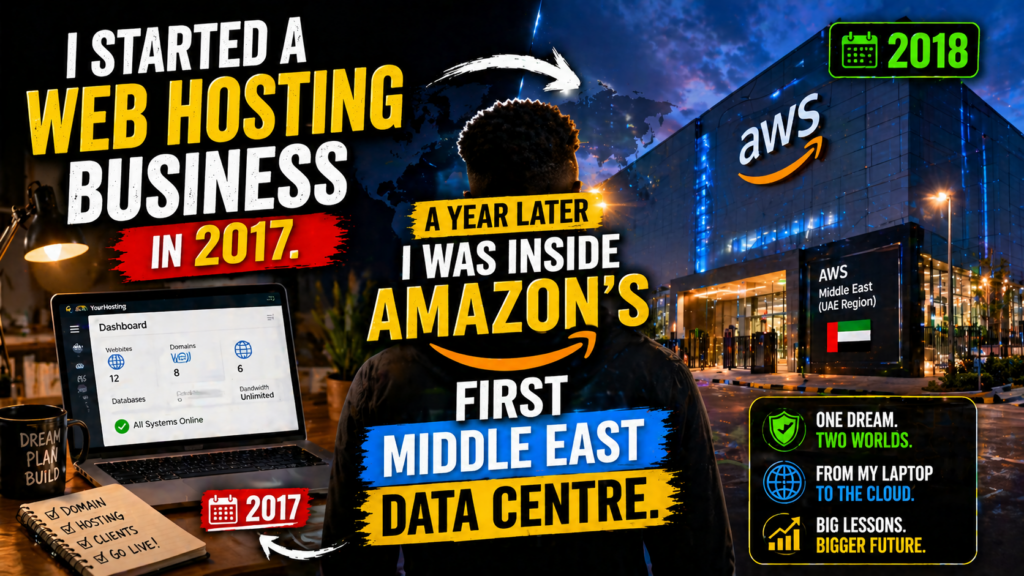
In 2018, I was working with Cebarco — Bahrain’s leading Grade AA construction contractor — on one of the most consequential infrastructure projects the Gulf had seen in years. Amazon Web Services was building its first data centre region in the Middle East. Bahrain had been selected as the location. And the construction work that would house the servers, the cooling systems, the power infrastructure, and the fibre connections that would bring hyperscale cloud computing to the Arab world for the first time was happening on a site in Manama — while I attended the AWS summits and events that were mapping out the vision for what this region would become. I returned in 2019 as the project progressed. The AWS Middle East (Bahrain) Region launched that year with three availability zones and 46 cloud services — the first of its kind in the entire region. What I watched being built in Bahrain in 2018 and 2019 is what Africa is still waiting for today. And the gap between those two realities is the most important infrastructure story on the continent. Why Amazon Chose Bahrain — and What It Signals AWS does not choose data centre locations casually. The selection of Bahrain for the Middle East’s first cloud region was the result of years of evaluation across multiple factors: regulatory environment, renewable energy availability, political stability, connectivity infrastructure, and the size and sophistication of the enterprise market it would serve. AWS chose Bahrain in part due to the country’s focus on executing renewable energy goals and its proposal to construct a new solar power facility to meet AWS’s power needs. The Bahrain Electricity and Water Authority expected to bring a 100MW solar farm online in 2019 — making it the country’s first utility-scale renewable energy project. The renewable energy requirement was not incidental. It was a signal of how seriously AWS was approaching long-term infrastructure investment — building not just for current demand but for the regulatory and environmental expectations of the next decade. When the region launched, it offered 46 different cloud services for businesses as well as government, education, and nonprofit organisations — with three availability zones enabling Middle East organisations to meet business continuity and disaster recovery requirements and build highly available, fault-tolerant, and scalable applications. What that meant in practice: every bank, every hospital, every government ministry, every logistics company, every e-commerce platform in the Gulf could now run enterprise-grade cloud infrastructure without routing their data through European or American servers. The latency dropped. The compliance barriers fell. And the digital economy of the region accelerated. I watched the physical precondition for all of that being built — the foundations, the power systems, the security perimeter, the connectivity infrastructure — from inside Cebarco’s project operations. Cebarco is the focal point of the KAR Group and has built some of Bahrain’s most significant landmarks, including the Bahrain Formula One Racing Circuit, the Sheikh Isa bin Salman Library, Citibank Headquarters, and major infrastructure projects across the Kingdom. Their infrastructure portfolio includes data centres, roads, bridges, substations, and sewage treatment plants — making them one of the few contractors in Bahrain with the depth of experience to handle a project of this technical complexity. Being inside that project gave me a perspective that most observers of the Gulf’s digital transformation never get: I understood what it actually takes to build the physical infrastructure that makes a digital economy function. Not the software. Not the platforms. The concrete, the power, the cooling, the connectivity — the unglamorous, invisible, essential foundation. What the AWS Events Taught Me About Infrastructure Thinking Alongside the construction work, I attended the AWS summits and events in Bahrain in 2018 and 2019. What struck me was the sophistication of the vision being articulated — and how far ahead of current reality the planning was. AWS was not building for the cloud adoption rate of 2018. It was building for the cloud adoption rate of 2025 and 2030. The three availability zones, the direct connect locations, the edge network infrastructure — all of it was sized and positioned for a demand that did not yet fully exist. That is what serious infrastructure investment looks like. It anticipates. It builds ahead of the curve. It accepts years of underutilisation as the price of being in position when the inflection point arrives. The Gulf understood this. Bahrain’s government had structured the regulatory environment, secured the renewable energy commitments, and partnered with a Grade AA contractor capable of delivering to hyperscale specifications — all before the first enterprise customer had signed an AWS contract in the region. The result: when Middle East enterprises were ready to move to the cloud, the infrastructure was there. The adoption curve accelerated faster than it would have if businesses had been forced to wait for the infrastructure to be built in response to their demand. Africa is making the opposite mistake. And the cost of that mistake is compounding every year. The Infrastructure Gap Africa Cannot Afford to Ignore In 2026, Africa has one AWS region — Cape Town, South Africa, launched in 2020. One Google Cloud region, also in South Africa. Microsoft Azure has regions in South Africa. Beyond that, the hyperscale cloud infrastructure that powers modern digital economies — the data centres, the availability zones, the direct connect locations — is almost entirely absent from the continent. What this means in practice for a business in Kampala, Nairobi, or Lagos: Cloud latency is higher. Data sovereignty is complicated. Compliance with local data regulations requires routing through non-local infrastructure. Enterprise-grade cloud services cost more because of the distance from the nearest region. And the digital products and services that assume low-latency cloud access — real-time payments, video streaming, AI-powered applications, IoT platforms — either don’t work as well or don’t work at all. Africa’s digital economy is being built on infrastructure borrowed from other continents. And borrowed infrastructure creates dependency, cost, and fragility that local infrastructure does not. The businesses, entrepreneurs, and
Africa’s Energy Transition Is Not a Future Event. The Infrastructure Is Being Built Right Now
In 2019, I attended a cybersecurity conference hosted by Saudi Aramco — one of the world’s largest energy companies and one of the most significant players in the global oil economy. The conversation was not what you might expect from an oil giant. Aramco’s leadership spoke at length about the energy transition — not as a distant threat to their business model, but as a transformation they were actively preparing for. The world’s largest oil producer was thinking seriously about what comes after oil, and investing accordingly. When a company that pumps 9.2 million barrels of crude per day is allocating resources to post-carbon infrastructure, the signal is impossible to ignore. Africa’s energy transition is not a philanthropic project or a climate talking point. It is an economic reality being accelerated by policy, investment, and the improving unit economics of electric vehicles. And the businesses that build the infrastructure now — before the mass-market inflection point arrives — are the ones that will define what that transition looks like on this continent. The Numbers That Define the Moment 2026 is the year electric mobility in Africa becomes a strategic reality — not a projection, not potential, but measurable deployment at scale. The data behind that shift: Ethiopia banned non-electric private vehicle imports in 2024, backed by affordable hydropower. Morocco’s $5.6 billion battery gigafactory is opening in 2026, with EV sales climbing 80.4% in 2025. Kenya’s EV registrations surged 2,700% from 2022 to 2025. Just 1% of new cars sold across Africa in 2025 were electric — but a new analysis published in Nature Energy finds that with solar off-grid charging, EVs could be cheaper to own than gas vehicles by 2040. Battery electric vehicles would appear cost competitive by 2030 were it not for elevated financing costs — under a cash-purchase scenario, they would already present a financially viable option today. These are not advocacy numbers. They are market signals — and they describe a transition that is accelerating faster than most African business leaders currently appreciate. The Infrastructure Gap Is the Business Opportunity Here is the contradiction that defines Africa’s EV moment in 2026: the vehicles are coming, but the charging infrastructure is not keeping pace. Only 8 African countries currently meet high standards for grid reliability, and around 600 million people still do not have access to electricity. Urban hubs like Nairobi, Lagos, and Johannesburg benefit from relatively reliable power supplies and established charging networks. But the majority of the continent’s commercial corridors — the highways, logistics routes, and secondary cities where transport electrification matters most — have almost no public charging infrastructure. The scarcity of public e-charging stations is one of the primary impediments obstructing the EV transition in Sub-Saharan Africa. This is not a problem to complain about. It is a market to build. The businesses, entrepreneurs, and investors who are deploying EV charging infrastructure in Africa today are not chasing a market that exists — they are creating the conditions for a market that is arriving. The economics of that position are compelling: first movers in infrastructure-dependent markets hold structural advantages that are extremely difficult for later entrants to overcome. You cannot outspend a charging network that is already installed across every major commercial corridor. What the Charging Infrastructure Market Actually Looks Like Afax Power — the manufacturer whose African distribution I hold — produces a range of EV charging solutions that span the full commercial spectrum. The AC Wallbox starts from approximately 3,000,000 UGX ($820). It is designed for residential installation, hotel car parks, office complexes, and any commercial location that wants to offer EV charging as a service or amenity. The DC Fast Charger and DC Max Charging Station reach up to 40,000,000 UGX ($11,000) at the commercial end — designed for petrol station operators, logistics hubs, transport operators, and any location that needs to charge multiple vehicles rapidly as part of a commercial operation. Afax Power supports all major connector types — Type 1, Type 2, CCS1, CCS2, CHAdeMO, GB/T, and Tesla — covering every EV brand currently operating or entering African markets. This is not a niche product for a niche market. It is infrastructure designed for the full range of vehicles that are arriving on African roads right now. The product range creates three distinct market entry points: Residential and SME — the AC Wallbox at 3–8 million UGX. Hotels, apartment complexes, office parks, shopping centres. The business case is simple: EV drivers seek locations that offer charging. A hotel with a working charger attracts EV-driving guests. A shopping centre with chargers has longer dwell times. Commercial and transport operators — the DC Compact and DC Fast Charger at 8–25 million UGX. Logistics companies, corporate fleets, boda boda operators transitioning to electric, taxi aggregators, bus operators. The operational case is even simpler: every kilometre driven on electricity costs less than every kilometre driven on petrol. Infrastructure hubs — the DC Max Charging Station at 25–40 million UGX. Petrol stations, highway rest stops, border crossings, freight terminals. Petrol stations are strategically located along highways and urban corridors, have established grid connections, and are trusted service points for motorists. Integrating EV charging within these stations could significantly accelerate the development of a nationwide charging network. Why the Gulf Understands This Before Africa Does My experience at the Aramco cybersecurity conference illuminated something important about how the world’s largest energy economy thinks about the transition. Gulf states are not waiting for the energy transition. They are funding it. Saudi Arabia’s Vision 2030, the UAE’s net-zero commitments, and Bahrain’s economic diversification agenda all include explicit investment in clean energy infrastructure — not as climate compliance, but as strategic economic positioning. The Gulf understands something that Africa’s business community has been slow to internalise: the energy transition creates infrastructure demand that is independent of ideology. Whether you believe in climate change or not, EVs are getting cheaper, governments are mandating them, and the businesses that own the charging infrastructure when mass adoption arrives will