
The Farm Has Always Been the Business. We Are Just Giving It the Software to Prove It.

Africa employs 60% of its working population in agriculture. It holds 60% of the world’s uncultivated arable land. Its farming sector feeds over a billion people — and yet, by almost every productivity metric, it operates far below its potential. The reasons are well-documented: limited access to finance, absence of reliable market linkages, low technology adoption, and — perhaps most consequentially — the near-total absence of documented farm performance data that would allow banks to confidently lend to farmers and farmers to confidently borrow. A farmer in Uganda with five acres of maize, fifteen goats, and ten years of farming experience has an asset. What they almost universally lack is the documented evidence of that asset’s performance — the records of yield per season, cost per unit of production, revenue per harvest, and livestock health trajectory that would allow a bank to assess creditworthiness with confidence rather than guesswork. This is the gap that Soillx is being built to close. What Soillx Is Soillx is a startup being developed at the intersection of agricultural technology, financial inclusion, and market access — built on a partnership with Farmbrite, one of the world’s most comprehensive farm management software platforms, and designed specifically for farmers across Africa and Asia. The model is not complicated. But its simplicity is deceptive, because each component solves a problem that has historically required a different organisation, a different platform, and a different conversation. Soillx brings all four into one system: Farm Management Software — Farmbrite’s platform, adapted and supported for African and Asian farming contexts, giving farmers the tools to record, track, and analyse every aspect of their operation. Bank Financing — partnerships with African and Asian banks that use Soillx’s platform data as the evidence base for agricultural loan decisions, connecting capable farmers to the capital they need to improve productivity. Market Access — a Shopify-backed e-commerce platform and app that allows farmers to sell their produce directly to buyers, removing the intermediary margin that currently captures value from both ends of the agricultural supply chain. Equipment Supply — sourcing from China through established supply relationships to deliver the farming equipment that productivity improvements require, at accessible prices. All four components are connected through the Farmbrite platform — which means the data generated by farm management flows directly into the financial reporting that banks use for loan decisions, and the revenue data from market sales flows back into the farm’s financial records, creating a complete, auditable picture of farm performance. Why Farmbrite Is the Right Foundation Farmbrite is an all-in-one farm management software for modern farmers and ranchers — designed to help farmers know more, grow more, and sell more, all from one easy-to-use place. It covers livestock management, crop planning, task management, financial tracking, equipment records, and customer management — all accessible through a cloud-based platform with native mobile apps for iOS and Android. Farmbrite provides tools for managing farm operations, planning and optimising production, scheduling tasks and activities, tracking finances, managing customers, and more — with native mobile apps that facilitate on-the-go data access and input. The financial tracking capability is particularly significant for the Soillx model. Users consistently highlight the ease of keeping track of accounting including uploading pictures of each receipt — and the all-inclusive nature of livestock information including pedigree, breeding, and medical records. Farmbrite works for global customers from all around the world, offering localised currency, measurement, and language support directly within the platform — currently supporting farmers from over 100 countries. For a startup being built to serve farmers in Uganda, Kenya, Tanzania, Rwanda, and across Asia, this global localisation capability is not a feature — it is a prerequisite. A farm management platform that cannot handle Ugandan shillings, Kenyan acres, or the specific livestock categories relevant to East African animal husbandry is not useful to the farmers Soillx is being built to serve. Farmbrite’s pricing starts at $35/month for the Grower plan, which includes 25 users, unlimited acreage, unlimited plantings and varieties, crop record keeping, and advanced crop planning. For small and medium farming operations across Africa, this price point — particularly with Soillx’s membership subscription model subsidising or bundling the software cost — makes enterprise-grade farm management accessible at a fraction of what comparable Western agtech platforms charge. The Bank Financing Model: Solving Agriculture’s Oldest Problem Many smallholder farmers lack the collateral to access traditional bank loans — one of the most critical constraints on farm productivity and food security across Africa. The conventional bank loan assessment model requires documented evidence of income, assets, and repayment capacity. Most African smallholder farmers cannot provide this documentation — not because the evidence does not exist, but because it has never been captured in a format that a bank can assess. A farmer who has been growing maize for fifteen years has fifteen years of production history. They know which seasons were good and which were poor. They know their input costs, their yields, and their revenue. But none of it is documented in a way that a credit officer can evaluate. Farmbrite’s farm management software changes this. A farmer who uses Soillx’s platform for one growing season generates a complete, time-stamped, auditable record of their farm’s performance — planting dates, input applications, yield measurements, livestock health events, equipment maintenance, revenue from sales, and expense records. This data, flowing into Farmbrite’s integrated accounting system, becomes the credit evidence that banks have historically lacked. A bank partner working with Soillx does not need to assess a farmer’s creditworthiness through the traditional collateral model. They can assess it through the platform data — which tells them, with precision, what the farm produces, what it costs to produce it, and what the revenue trajectory looks like. The loan proceeds flow back into the farm — into improved seed, into equipment, into expanded livestock — and the platform continues to track the productivity impact of that investment. The bank can monitor, in real time, whether the loan is being used as intended and
From a Family Electronics Business to Digital Strategy: My View of Africa’s Tech Evolution

For more than two decades, our family business has operated within one of the most important economic shifts in African history: the rise of affordable mobile technology powered largely by Chinese manufacturing. Long before “digital transformation” became a global policy phrase, Chinese electronics brands were already transforming everyday African life from the ground up. In Uganda and across Africa, brands like Tecno, Itel, Infinix, and Redmi did something many Western companies failed to understand at the time: they built for the realities of the African consumer. They developed devices with: This was not simply about selling phones. It was the beginning of Africa’s modern digital infrastructure. China’s Role in Africa’s Digital Transformation The impact of China on Africa’s digital economy goes far beyond manufacturing. Chinese technology ecosystems accelerated: For millions of Africans, the first internet experience did not happen on a desktop computer. It happened on a Chinese-made smartphone. That single shift changed consumer behavior, communication patterns, business models, and even political discourse across the continent. Today, Africa’s digital economy is one of the fastest-growing in the world because mobile technology became accessible to ordinary people — not just elites. Watching Consumer Behavior Changed My Perspective Growing up around the electronics business exposed me to something deeper than retail. I became fascinated not only by the devices people bought, but by what happened after they turned them on. I started observing: That curiosity pushed me beyond phone sales. I wanted to understand the systems behind digital growth. I wanted to understand: That journey led me into web development, SEO, digital marketing, sales funnels, and startup advisory. Building Digital Infrastructure Beyond Hardware Over the years, I transitioned from simply participating in Africa’s electronics economy to helping businesses build their digital presence and growth infrastructure. Today, my work spans multiple areas of digital transformation. Website Development and Digital Presence I have spent years building and managing websites for businesses across different sectors, helping organizations move from offline visibility into fully functional digital ecosystems. This includes: I learned early that in Africa’s mobile-first economy, websites are no longer optional. They are commercial infrastructure. SEO and Search Visibility As smartphone usage increased, search behavior became one of the most powerful economic drivers in Africa. I specialized in SEO to help businesses: My work in SEO expanded into: This became especially important as African businesses increasingly sought visibility beyond local markets. Paid Media and Digital Advertising With over five years of experience in paid media and more than $12,000 spent in advertising campaigns, I have worked extensively with: This work helped businesses understand not only how to get traffic — but how to convert attention into revenue. Supporting African Entrepreneurship and Startups My involvement in digital transformation also expanded into startup ecosystems across Africa and the Middle East. Through engagements connected to organizations such as Doola based in USA and Flat6Labs, Startup Uganda, and International Trade Centre, I gained exposure to how emerging markets are building innovation ecosystems. This experience reinforced something important: Africa’s future will not only be shaped by technology consumers. It will be shaped by African builders. The Next Phase of Africa’s Digital Economy The next decade of African digital transformation will likely move beyond smartphone access into: China will continue to play a major role in this transformation through: But Africa itself is also evolving from being only a consumer market into a producer of digital innovation. Why This Matters Personally For me, this journey started in a phone business. But the phones became a gateway into understanding how technology reshapes human behavior, commerce, and opportunity. Watching customers move from: gave me a front-row seat to Africa’s digital evolution. That evolution inspired me to build skills and businesses that contribute directly to digital transformation rather than remaining only in retail distribution. Today, whether through SEO, web infrastructure, startup advisory, digital advertising, e-commerce systems, or content strategy, my work is centered around one idea: Helping African businesses and entrepreneurs compete effectively in a global digital economy. And in many ways, that journey began with a simple observation inside a family electronics business: Technology does not only change devices. It changes behavior, markets, industries, and the future of entire continents.
Your Startup Doesn’t Have Borders. Your Advisor Shouldn’t Either
Most startup advisors work in one market. They understand Silicon Valley or they understand Lagos or they understand the Gulf. They have one network, one mental model of how startups get built and funded, and one set of assumptions about what founders need to succeed. I have spent the last several years building something different — not by design at first, but by the accumulation of real relationships, real presence, and real work across three of the world’s most consequential emerging startup ecosystems: Africa, the Middle East, and America. This is the story of how that happened — and why the three-market startup advisory practice I am building from Austin, Texas is the model that the next generation of global founders actually needs. The Three Markets — And Why Each One Matters 🌍 Africa — The Demographic Engine Africa has 1.4 billion people. By 2050 it will have 2.5 billion — the youngest, fastest-growing population on the planet. Its digital economy is accelerating at 17% annually. Its mobile money infrastructure has leapfrogged banking systems that took Western markets a century to build. Its startup ecosystem has produced unicorns in fintech, logistics, healthcare, and agriculture across Nigeria, Kenya, South Africa, and Egypt. But Africa’s startup ecosystem has a persistent structural problem: most of its most promising founders cannot access the capital, the market validation, or the global distribution networks that would allow their businesses to scale beyond their home markets. My entry into Africa’s startup ecosystem came through direct, operational involvement — not observation from the outside. During Kampala Innovation Week — Uganda’s first hybrid event, which I was consulted to launch for Talent Africa Group — I encountered and engaged with three of the continent’s most significant startup infrastructure organisations: the International Trade Center, Startup Uganda, and Startup Africa. The International Trade Center connects African SMEs and startups to global trade networks. Startup Uganda is the national backbone for Uganda’s entrepreneurship ecosystem. Startup Africa, convened during Kampala Innovation Week, brings together founders, investors, and ecosystem builders from across the continent. Being physically present at this convergence — not as an observer but as the person who built the digital campaign that put 1,000+ people in the room — gave me a specific kind of access to Africa’s startup community that most international advisors do not have. I understand what Ugandan and East African founders are building, what they need, and what the gap is between where they are and where they want to go. 🏙️ Middle East — The Capital Gateway The Gulf is one of the world’s most underappreciated startup ecosystems — not because the ecosystem is weak, but because Western media has been slow to recognise what has been built. Flat6Labs is the leading entrepreneurship platform in emerging markets, empowering entrepreneurs to build, launch, and grow transformative ideas through acceleration programs, ecosystem development, and tailored innovation services. Flat6Labs Bahrain is a seed program supported by Tamkeen that accelerates and launches both local and international startups in the Kingdom of Bahrain — each cycle selecting 8–10 promising teams to receive cash funding, strategic mentorship, office space, and a multitude of partner perks and services. Flat6Labs Bahrain was created in partnership with Tamkeen — the Labour Fund — with the aim of fostering a dynamic and sustainable entrepreneurship environment, supporting job creation, and helping position Bahrain as an innovation leader in the Arabian Gulf region and MENA at large. My relationship with the Gulf’s startup ecosystem was built during the years I spent working in Bahrain — attending Flat6Labs events, engaging with Startup Bahrain, and operating inside the Tamkeen-backed entrepreneurship infrastructure that the Bahraini government has deliberately constructed to attract and develop founders from across the region and beyond. Flat6Labs invests $30,000 to $250,000 in startups and has helped hundreds of companies scale, with cohorts that are highly competitive but provide unmatched investor network and mentorship access. The Gulf’s startup ecosystem has three things that Africa’s ecosystem frequently lacks: sovereign wealth fund capital, regulatory clarity for fintech and digital businesses, and proximity to the global financial infrastructure that allows startups to scale internationally. Gulf-backed startups can access Saudi Arabia’s Vision 2030 investment, the UAE’s global connectivity, and Bahrain’s fintech regulatory sandbox — infrastructure that most African startups have to route through European or American intermediaries to access. 🇺🇸 America — The Scale Infrastructure The American market is not where most startups begin. It is where the ones that want to scale globally need to arrive. Doola is a YCombinator-backed (YC S20) “Business-in-a-Box” platform that empowers global founders by helping them set up a US business without handling complex paperwork — today, people on every continent have launched companies with doola. Doola has launched its Business-in-a-Box for E-Commerce — the first solution that brings the entire back-end of e-commerce into one place: LLC formation, compliance, multi-state tax rules, bookkeeping, financials, and business analytics across Shopify, Amazon, and beyond. It has already helped 10,000+ entrepreneurs from 175+ countries scale to seven figures. My engagement with Doola is not simply about having registered amdan.pro LLC in Austin, Texas. It is a strategic partnership built around a shared understanding of what globally-minded founders — particularly those from Africa and the Gulf — need when they decide to build for the American market. Doola’s AI Co-Founder is built for global e-commerce entrepreneurs and automates tasks that usually drain founders’ time — banking and payments, compliance and filings, bookkeeping, and US tax guidance — with no US Social Security Number required, fluent in 175+ countries’ unique challenges. For an African or Gulf founder who wants to launch a Shopify store, an Amazon FBA business, or a US-registered SaaS company, Doola removes the back-office complexity that would otherwise require a US-based lawyer, accountant, and compliance specialist. For my startup advisory practice, the Doola partnership means I can walk a Ugandan e-commerce founder or a Bahraini SaaS company directly into the American market without the infrastructure friction that has historically been a barrier. Why Three Markets Is
The African Investor’s Guide to Bitcoin: Complete allocation calculator and market cycle tactics included

African investors face unique challenges: volatile local currencies, high inflation, expensive cross-border transfers, and limited access to stable global assets. Bitcoin and complementary tools like stablecoins offer powerful solutions for hedging risks, facilitating payments, and building long-term wealth. This guide provides a practical Bitcoin Strategy Framework tailored for African investors, with a USD-focused approach. It leverages platforms like Noones for P2P trading and access to local payment methods across Africa, alongside Blockchain.com‘s robust wallet, exchange, and investment tools. 1. Understanding Currency Risk in Africa — Why Bitcoin Matters Now Many African currencies have faced significant devaluation and high inflation. Nigeria’s naira, for example, has lost substantial value in recent years, while other nations grapple with similar pressures. Holding savings solely in local fiat exposes investors to erosion of purchasing power. Bitcoin as a hedge: Often called “digital gold,” Bitcoin has a fixed supply of 21 million coins, making it resistant to the inflationary printing common in fiat systems. It has historically performed well as a store of value during periods of currency instability. Stablecoins for stability: USD-pegged assets like USDT and USDC act as a bridge. They offer dollar-like stability while enabling fast on-chain transfers. In Africa, stablecoins now dominate many P2P trades, serving as a practical USD proxy. Actionable tip: Diversify holdings — e.g., 40-60% in Bitcoin for growth potential, 30-50% in stablecoins for stability, and the rest in local assets or cash for liquidity. 2. Cross-Border Payments: From Expensive and Slow to Instant and Affordable Traditional remittances and business payments in Africa often incur 6-10%+ fees, take days to settle, and involve multiple intermediaries. Crypto changes this. How Bitcoin and stablecoins help: Noones advantage: Peer-to-peer marketplace with escrow protection, direct fiat-to-crypto ramps using popular African payment options, and strong support for stablecoins. Ideal for remittances, trade invoices, or diaspora payments. Open Noones account here ……… Blockchain.com tools: Secure wallets for holding and sending BTC or stablecoins, with easy tracking and institutional-grade features. Framework step: Use stablecoins for day-to-day cross-border needs and Bitcoin for larger, longer-term transfers or savings. 3. Long-Term Wealth Building: A USD-Denominated Bitcoin Strategy Treat Bitcoin as a core portfolio asset rather than pure speculation. Core Bitcoin Strategy Framework (USD Edition): Integration with Noones × Blockchain.com: Buy/ trade P2P on Noones with local currency, transfer to Blockchain.com for secure storage, advanced charting, or institutional services. This creates a seamless on-ramp, custody, and strategy engine. 4. Practical Steps to Get Started as an African Investor // Bitcoin Strategy Framework — USD Edition Noones × Blockchain.comInvestment Engine Buy on P2P → Store safely → Earn passively. Don’t trust either platform with everything. NOONES — ENTRY/EXIT BLOCKCHAIN.COM — HOLD/EARN // 01 — Platform Roles Noones Access Gateway Peer-to-peer marketplace for buying BTC with cash or bank transfer. Your fiat ↔ crypto bridge. Buy BTC with USD via P2P Fiat ↔ crypto conversion Only escrow-enabled traders Move funds immediately after purchase Entry Only Blockchain.com Storage + Yield Tool Wallet, optional exchange, and earn feature. Use for holding and generating passive income. Hold BTC long-term Earn ~8% APY on a portion Not a full custodial trust platform Keep earn % low — platform risk is real Hold + Earn // 02 — Three-Step Flow 1 NOONES Buy BTC via P2P Use Noones to purchase Bitcoin with USD. Trade ONLY with high-rated vendors, escrow always ON. Never leave funds sitting on the P2P platform — withdraw immediately after every trade. 2 BLOCKCHAIN Split & Secure Your Stack Transfer your BTC to Blockchain.com wallet (or ideally a private wallet). Separate your “wealth core” from your yield portion. This separation is the foundation of the entire strategy. 3 BOTH Allocate: Hold vs. Earn 70–80% stays in cold/warm storage for long-term appreciation. 20–30% goes into Blockchain.com Earn at your chosen APY. This creates monthly income without gambling your wealth core on platform risk. // 03 — USD Investment Calculator Monthly Investment Planner Enter your monthly USD amount, adjust the hold/earn split and yield rate to see projected returns. Monthly investment $ USD / month Earn APY rate 5% 8% 10% 12% Hold allocation 75% HOLD / 25% EARN HOLD — 75% EARN — 25% HOLD EARN Hold Amount $3,750 USD / month→ BTC long-term storage Earn Amount $1,250 USD / month→ Blockchain.com Earn Monthly Yield $8.33 USD passive income→ from earn portion Annual Yield $100 USD / year→ from earn portion 12-Month Hold Stack $45,000 USD in BTC→ pre-growth value Bull Case (2× BTC) $90,000 USD at 2× BTC growth→ cycle dependent ★ Hold stack over 12 months: $45,000 in BTC. At 2× BTC growth = $90,000+. Yield adds $100/yr passive income on top. // 04 — Market Cycle Strategy 🐻 Bear Market Accumulation Mode → Buy heavily via Noones (prices cheap) → Keep yield earn active for income → Stack aggressively into hold wallet → Yield supplements lost upside 🐂 Bull Market Growth Mode → Move OUT of earn, keep BTC liquid → Price growth far exceeds any APY → Watch for exit signals at cycle peaks → Use Noones to convert BTC → USD if needed // 05 — Risk Flags ⚠ Critical Mistakes to Avoid ✕Leaving BTC on Noones after a trade — P2P platforms are not wallets ✕Putting 100% of BTC into yield — platform risk is real, Blockchain.com has had issues ✕Trading with low-rated vendors or skipping escrow on P2P — scams are common ✕Staying in yield during a bull run — you’ll underperform vs simply holding BTC // 06 — The One-Line Strategy // Final Truth Buy cheap on Noones →Store safely on Blockchain wallet →Use small % for yield to earn monthly income Noones = Access (buy/sell) Blockchain.com = Tool (hold/earn) Bitcoin = Wealth Engine Risks and Responsible Investing Bitcoin is volatile. Regulatory changes, security threats, and market cycles exist. Always DYOR (Do Your Own Research), diversify, and consider professional advice. Start small and scale responsibly. Conclusion: Bitcoin as Financial Sovereignty for African Investors For African investors, Bitcoin isn’t just
Dubai vs Bahrain: Where Should You Buy Property in 2026 — And Which Gets You a Golden Visa?

Two properties. Two Gulf markets. Two completely different investment outcomes. The first is a furnished 1-bedroom apartment in Hamza Tower, Dubai Sports City — 873 square feet, already tenanted, listed at AED 820,000 ($223,000). The second is a 1-bedroom apartment in Al Juffair, Bahrain’s Capital Governorate — 657 square feet, listed by ERA Real Estate at 41,000 BHD ($108,730). Both are in freehold zones. Both are in USD-pegged currency markets. Both are in established residential areas with consistent expat demand. But when you run the full comparison — purchase price, rental yield, net return, Golden Visa eligibility, and 10-year investor outcome — the picture is considerably more nuanced than the headline numbers suggest. This is the comparison every East African, South Asian, and emerging market investor looking at Gulf real estate needs to read before committing capital in 2026. The Properties: What You Are Actually Buying Property A — Hamza Tower, Dubai Sports City, UAE Hamza Tower is a completed 16-storey residential building in Dubai Sports City, DubaiLand. The specific unit — an upgraded, furnished 1-bedroom on a mid-floor — is listed at AED 820,000 ($223,000) and is already rented, meaning day-one rental income for the buyer. Hamza Tower carries an 8.9% rental yield according to Property Finder data, one of the stronger yield profiles in Dubai Sports City. Real estate in Dubai Sports City has a return on investment rate of 8.4%, which is competitive compared to premium Dubai locations like Downtown or Palm Jumeirah that offer 4–6% but stronger capital appreciation. Average rental value of Hamza Tower apartments is AED 72,124 per annum, translating to approximately AED 6,010 ($1,635) per month — with new rentals averaging AED 55,108/year and renewed rentals averaging AED 43,881/year. Property B — Al Juffair, Capital Governorate, Bahrain The Bahrain property is a 1-bedroom apartment of 657 square feet in Al Juffair — Manama’s most consistently performing residential district — listed by ERA Real Estate at 41,000 BHD ($108,730) at a price per square foot of 62 BHD. Al Juffair’s structural advantage is well-documented: it sits adjacent to the US Naval Support Activity Bahrain — the largest American military installation in the Middle East — creating permanent, structural demand from military personnel, contractors, and the expat professional community. Demand in this district replenishes regardless of broader economic cycles. Estimated monthly rent for a standard long-term tenancy: 300 BHD ($795). Annual income: 3,600 BHD ($9,540). Gross yield: 8.78%. The ROI Comparison: Running the Real Numbers Purchase Price The most important number in any yield comparison is the denominator — what you paid. Dubai Hamza Tower Bahrain Al Juffair Purchase price AED 820,000 ($223,000) 41,000 BHD ($108,730) Price gap Dubai costs $114,270 more The Dubai property costs more than twice what the Bahrain property costs. Every yield percentage is calculated against that base — which means the absolute capital at risk is fundamentally different. Rental Income Metric Dubai Bahrain Monthly rent ~AED 6,010 ($1,635) 300 BHD ($795) Annual rent ~$19,620 $9,540 Already tenanted ✅ Yes ❌ No Dubai generates more absolute rental income — approximately double Bahrain’s monthly figure. This is the Dubai property’s primary advantage. If your objective is maximum rental income from a single asset, Dubai delivers more cash. Yield Analysis Metric Dubai Bahrain Gross yield 8.7% (DLD-registered data) 8.78% DLD transfer fee 4% ($8,920) ~1.7% ($1,848) Agency commission ~2% ($4,460) ~2% ($2,175) Annual service charge AED 10–50/sqft/year Lower Net yield (after costs) ~5.5–6.5% ~7–8% Currency peg ✅ AED/USD ✅ BHD/USD Both currencies are USD-pegged — zero currency conversion risk for dollar-benchmarked investors. On gross yield, the properties are virtually identical at approximately 8.7–8.78%. On net yield, Bahrain pulls ahead because its transaction costs are significantly lower — Dubai’s 4% DLD transfer fee alone costs $8,920 on this property, versus approximately $1,848 in Bahrain’s equivalent fees. 10-Year Projection Dubai Bahrain Capital invested $223,000 $108,730 Annual net rental income ~$13,000 ~$8,200 10-year rental total ~$130,000 ~$82,000 Capital saved vs Dubai — +$114,270 Total 10-year position $130,000 income $82,000 income + $114,270 saved Net advantage — +$66,270 ahead The capital efficiency calculation flips the comparison entirely. The $114,270 you don’t spend buying Bahrain instead of Dubai — invested conservatively at 6% annually — compounds to approximately $204,000 over 10 years. The rental income gap ($130,000 vs $82,000) is $48,000 in Dubai’s favour. But the capital efficiency advantage of $114,270 more than compensates — leaving the Bahrain investor materially ahead over a 10-year horizon. The Golden Visa: Where the Real Difference Is This is where the comparison fundamentally changes — and where every investor needs to pay close attention to what has changed in 2026. Dubai Golden Visa — What This Property Actually Qualifies For Dubai has reset criteria for its two-year property-linked residency visa, removing the minimum property value requirement for sole owners. This means the AED 820,000 Hamza Tower apartment qualifies for a 2-year investor visa — renewable, but requiring reapplication every two years. The 10-year Golden Visa requires a minimum AED 2 million investment — approximately $545,000. At AED 820,000, this property falls significantly short. To qualify for Dubai’s 10-year Golden Visa through property, you would need to purchase approximately 2.4 additional properties of this value — a combined investment of approximately $535,000. Dubai Golden Visa summary for this property: Bahrain Golden Residency — What This Property Qualifies For Bahrain reduced its minimum real estate investment for the Golden Residency visa to BHD 130,000 ($345,000), down from BHD 200,000. The programme, launched in 2022, offers a 10-year renewable residence permit with work rights and family reunification. The Al Juffair apartment at 41,000 BHD ($108,730) does not on its own meet the BHD 130,000 threshold. However — and this is the critical investment insight — purchasing three apartments of this type (3 × 41,000 BHD = 123,000 BHD) comes within reach of the threshold, and combining with any additional qualifying property crosses it. Alternatively, the BHD 130,000 threshold can be met through a single higher-value property or a portfolio of properties whose combined value
Bahrain vs Kampala: Where Should East Africans Invest in Property in 2026?
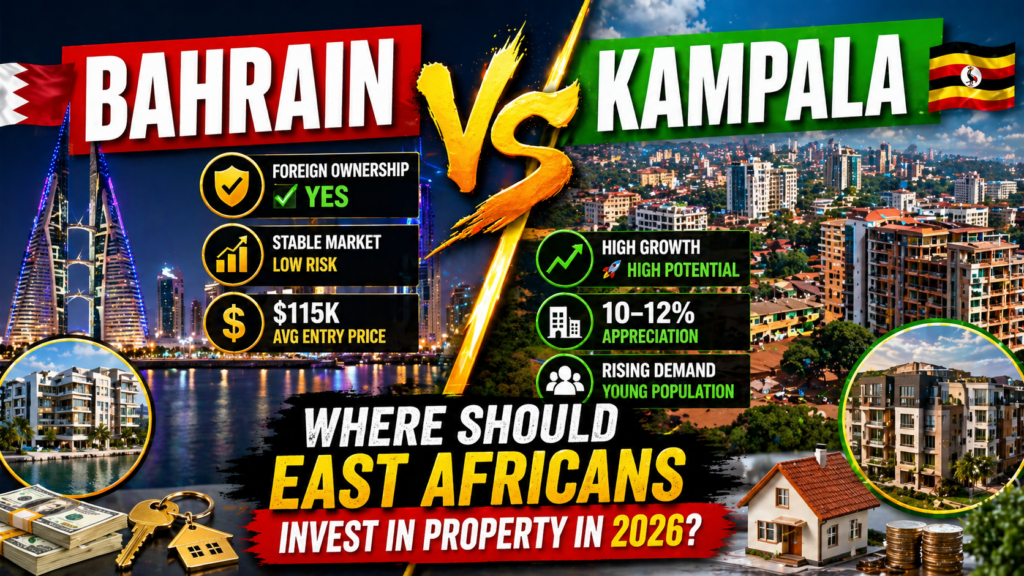
A growing number of East African investors are asking the same question in 2026: should I buy property at home or in the Gulf? It is a legitimate question. Kampala’s luxury residential market is attracting serious international developers. VAAL Real Estate — a Turkish-Egyptian firm with projects in Kenya, Ghana, the UK, and the Middle East — has committed $30 million to Cadenza Residence, a 24-storey tower in Nakasero that will be one of the tallest buildings in Uganda when it completes in July 2027. At the same time, Bahrain’s Al Juffair district is offering 1-bedroom apartments at 41,000 BHD — approximately $108,730 — in a market with proven yields, dollar-pegged currency, and one of the most liquid residential markets in the Gulf. Both look compelling on paper. The numbers, however, tell a more specific story. This is an honest, data-driven comparison of two real properties currently available to investors — not a promotional piece for either market. The Properties Property A — Bahrain, Al Juffair Property B — Uganda, VAAL Cadenza Residence The first and most significant data point: Uganda costs $35,270 more for a comparable 1-bedroom unit — before a single month of rent is collected. The Rental Income Reality Bahrain — Al Juffair Al Juffair is one of Bahrain’s most consistently performing rental districts. It sits adjacent to the US Naval Support Activity base — the largest US military installation in the Middle East — which creates permanent, high-quality tenant demand from military personnel, contractors, and the expat professional community that clusters around it. The rental market here is not speculative. It is structural. Demand replenishes itself regardless of broader economic cycles because the base and Bahrain’s financial sector create a continuous inflow of tenants. For the 41,000 BHD 1-bedroom apartment: monthly rent of 300 BHD ($795) is the market-rate figure for this property type and location — conservative relative to what fully furnished units achieve, but realistic for a standard long-term tenancy. Annual rental income: 3,600 BHD ($9,540)Gross yield on purchase price: 8.78%Net yield after costs and 10% municipal tax: ~7–8% Uganda — VAAL Cadenza Nakasero is Kampala’s most prestigious address. Neighbouring several embassies, the Parliament, State House, and the United Nations offices, it commands the highest rents in the city for luxury residential stock. The market data for prime Kampala 1-bedrooms in early 2026 shows a realistic range of 2,500,000 to 4,500,000 UGX per month ($685–$1,245) for fully serviced furnished units targeting expats and diplomats. For a luxury new-build like Cadenza — with amenities including a heated swimming pool, gym, business centre, and full generator backup — the upper end of this range is achievable in the right conditions. However, two market realities temper this optimism: First, prime Kampala has a vacancy rate of 15–22% in the luxury segment. Tenants in Nakasero and Kololo have strong negotiating power because supply has outpaced demand in recent years. A unit that achieves 4,500,000 UGX when occupied may sit empty for two to three months per year. Second, Cadenza does not complete until July 2027. An investor purchasing today earns zero rental income for at least 14 months — while the Bahrain apartment generates returns from day one. Using a realistic furnished rate of 3,500,000 UGX ($960/month) with an 18% vacancy adjustment: Effective monthly income: ~$787Annual rental income: ~$9,444Gross yield on $144,000: ~6.6%Net yield after vacancy, tax (12% on gross above threshold), and costs: ~4–5% The 10-Year Numbers Conservative Projection Metric Bahrain 41K BHD VAAL Cadenza Uganda Purchase price $108,730 $144,000 Monthly rent $795 $960 (optimistic) Vacancy adjustment 0% (structural demand) 18% (market rate) Effective monthly income $795 $787 Annual income $9,540 $9,444 10-year gross rent $95,400 $94,440 Capital saved vs Uganda +$35,270 — 10-year total advantage +$36,230 ahead — The result is striking: even taking Uganda’s best-case furnished rent — higher than Bahrain’s monthly figure — Bahrain still produces a superior 10-year outcome because the $35,270 price difference never closes. That $35,270 invested separately at a conservative 6% annual return compounds to approximately $63,000 over 10 years. The capital efficiency gap between these two investments is not marginal. The Risk Factors Nobody Puts in the Brochure Currency Risk Bahrain’s dinar is pegged to the US dollar at a fixed rate of 0.376 BHD to $1 — a peg that has held since 1987 and is backed by Gulf Cooperation Council reserves. An East African investor buying in Bahrain has zero currency conversion risk on their dollar-denominated returns. Uganda’s shilling has depreciated against the dollar consistently over the past decade. A rental income of 3,500,000 UGX that translates to $960 today may translate to $880 in three years and $800 in five if historical depreciation trends continue. The investment thesis that looks compelling in UGX terms erodes in USD terms over time — which matters enormously for any investor benchmarking returns in dollars. Vacancy Risk Juffair’s vacancy rate for 1-bedroom apartments is structurally low. The combination of US Navy presence, corporate expat demand from Bahrain’s financial sector, and proximity to Manama’s central business district creates consistent occupancy. Units in well-maintained buildings here lease within days, not months. Prime Kampala luxury stock, by contrast, has vacancy rates of 15–22%. This is not a temporary market condition — it reflects the fundamental affordability constraint of the Ugandan market. The pool of tenants who can afford $900–$1,200 per month in Kampala is small and highly competitive to access. Cadenza will compete with every other premium development in Nakasero for a limited number of qualifying tenants. Completion Risk VAAL Cadenza is scheduled to complete in July 2027. Construction timelines in emerging markets carry inherent risk. A delay of six to twelve months — not uncommon in large-scale residential developments — extends the period of zero rental income and increases carrying costs for investors who have borrowed to finance the purchase. Bahrain carries no completion risk. The property is built, titled, and available to lease immediately. Resale Liquidity Bahrain’s property market is one of the most liquid in the Gulf for foreign
Why Gulf Real Estate Companies Are Losing Leads Online in 2026(And How to Fix It)

Gulf real estate businesses spend more on digital marketing per lead than almost any other sector in the region. They run Google Ads. They post on Instagram. They sponsor influencers. They list on every property portal. Some of them have marketing budgets that would be considered generous by international standards. And yet — most of them are converting a fraction of the leads they should be generating. This is not a spend problem. It is a system problem. And it repeats across the GCC with enough consistency that the leaks are identifiable, predictable, and fixable. Why Gulf Real Estate Is Different Before diagnosing the leaks, it is worth understanding why real estate in the Gulf creates a uniquely complex digital marketing challenge. The buyer journey is long. A client buying a property in Bahrain, Dubai, or Riyadh may research for weeks or months before making first contact. They visit multiple platforms, compare multiple developments, engage with multiple agents — and then go quiet. Re-engaging them requires a system. Most agencies don’t have one. The transaction value is high. A single closed deal in Gulf real estate can be worth tens or hundreds of thousands of dollars. This means the economics of lead generation are entirely different from a business selling a $50 product. A $200 cost per lead that produces one $200,000 sale is exceptional ROI. Most real estate marketing teams are not thinking about it this way — they are focused on volume rather than quality. Trust is the primary conversion driver. Gulf buyers — particularly for high-value residential and commercial property — do not make decisions based on an ad alone. They make decisions based on a combination of brand trust, agent credibility, local market knowledge, and peer validation. Digital marketing that doesn’t build trust — that focuses only on driving enquiries — produces low-quality leads that rarely convert. The 5 Biggest Revenue Leaks in Gulf Real Estate Marketing Leak 1: Ads Driving Traffic to Generic Portals Instead of Owned Landing Pages Many Gulf real estate agencies run Google Ads or social media campaigns that direct traffic to property portals — Bayut, Property Finder, or similar — rather than to their own website or landing pages. This is an expensive mistake. When you pay for a click that lands on a portal, you are paying to drive traffic to a platform that also shows your competitors’ listings. The buyer may submit an enquiry — but it goes to multiple agents simultaneously. Your paid traffic is subsidising your competition. Owned landing pages — specifically designed for the property or development being advertised, with a single clear call to action — consistently outperform portal referrals for quality of lead. The buyer who submits their details on your landing page is contacting you. Not three other agents. Leak 2: No Conversion Tracking on Ad Spend This is the most expensive and most common leak. Gulf real estate businesses spending $5,000–$20,000/month on Google Ads frequently have no reliable conversion tracking in place. Without conversion tracking, you do not know which campaigns, which keywords, and which ad creatives are generating actual leads versus just clicks. You are making budget decisions based on assumptions — and those assumptions are almost always wrong. The fix requires Google Tag Manager, properly configured conversion events, and integration with your CRM. Once you can see which keyword or ad produced each lead, optimisation becomes straightforward. Without it, you are optimising blind. This is covered in full as part of a proper digital marketing diagnostic. Leak 3: Leads Falling Into a CRM Black Hole A lead that is not followed up within 30 minutes in Gulf real estate is significantly less likely to convert. Buyers who enquire — particularly on a property portal or via a paid ad — are often simultaneously submitting enquiries to multiple agents. The first credible, professional response has a disproportionate conversion advantage. Most Gulf real estate agencies do not have an automated lead follow-up sequence. A lead comes in by email or WhatsApp, gets manually forwarded to an agent, and the response time depends entirely on whether that agent is available and diligent. A properly configured CRM — with automated WhatsApp or email responses sent within minutes of lead submission, followed by a structured nurturing sequence — can recover a significant percentage of leads that currently go cold. The revenue sitting in unconfigured CRM systems in Gulf real estate agencies is substantial. For a broader look at what a revenue leak is and how to find yours, the principles apply directly here. Leak 4: Instagram and Facebook Ads Targeting the Wrong Audience Social media advertising for Gulf real estate is often targeted too broadly or with the wrong creative-to-audience match. A common mistake: running the same luxury property ad creative to a broad UAE or Bahrain audience regardless of income signal, purchase intent, or nationality. Gulf real estate buyers are highly segmented. An off-plan investment buyer has entirely different motivations and triggers than an expatriate family searching for a rental. A GCC national buying a primary residence behaves differently from a foreign investor seeking yield. Segmented campaigns — with creatives, messaging, and calls to action tailored to each audience type — consistently outperform broad targeting approaches. This requires more upfront creative work but delivers materially better CPLs and conversion rates. Leak 5: SEO Completely Neglected in Favour of Paid Channels Paid ads produce immediate visibility. This makes them psychologically satisfying and easy to justify in a budget conversation. But they stop working the moment the budget stops. Gulf real estate agencies that invest exclusively in paid channels and neglect organic search are building on rented land. A competitor who invests consistently in SEO — building topical authority around property types, locations, and buyer questions — will accumulate a compounding visibility advantage that cannot be easily replicated or outspent. In most Gulf property categories, organic search competition is still low enough that a 12–18 month SEO investment can establish a position that generates leads
How East African Businesses Can Compete Online Using SEO and Paid Ads
East Africa’s digital economy is not emerging. It has emerged. Nigeria, Kenya, Uganda, Tanzania, and Rwanda have collectively produced some of the fastest-growing internet user bases on the planet. Mobile money transformed financial access. Affordable smartphones brought hundreds of millions of new users online. And yet — the vast majority of established businesses in these markets are still treating digital marketing as a secondary channel, a nice-to-have that sits beneath traditional media and word-of-mouth referrals. That gap is a competitive opportunity. The businesses that understand how to build genuine online visibility in East Africa in 2026 — not just a Facebook page that gets occasional boosted posts — are outcompeting larger, better-funded rivals for the same customers. This guide is about how to build that advantage. The East African Digital Landscape in 2026 Understanding the landscape before building a strategy is not optional. East Africa is not a monolithic market, and the channels, behaviours, and competitive dynamics vary significantly across countries. Mobile-first, always. The majority of internet access in East Africa is through smartphones, not desktops. If your website is not optimised for mobile — fast-loading, clean navigation, thumb-friendly forms — you are losing the majority of your potential traffic before a single word is read. Facebook and WhatsApp dominate social. Unlike the Gulf where Instagram and Snapchat command significant attention, Facebook remains the primary social platform across much of East Africa — particularly for businesses reaching broader consumer audiences. WhatsApp functions as both a communication tool and a sales channel, often the final step before a purchase decision. Google search is growing fast. Search behaviour is maturing across the region. More consumers and B2B buyers are using Google to research products, services, and providers before making contact. Businesses with strong local SEO foundations are capturing this intent. Those without it are invisible to buyers who have already decided they want what you offer. Competition in search is still low. This is the most important strategic fact about East African digital markets in 2026. For most industries and most keywords in Nairobi, Kampala, Dar es Salaam, or Kigali, the organic search results are poorly optimised. Landing on page one for competitive commercial keywords — a multi-year investment in Western markets — can often be achieved in months in East Africa with a disciplined SEO approach. SEO in East Africa: The Opportunity Nobody Is Talking About In Nairobi, search for “corporate event management company Kenya” or “real estate agent Kampala” or “private school admissions Uganda.” Look at the results. Most page-one results are either directories, poorly formatted single-page websites, or businesses whose last blog post was published in 2021. This is not an exception. It is the norm across most commercial categories in East Africa. What this means for your business: the barrier to organic visibility is dramatically lower here than in comparable Western markets. A consistent content and SEO strategy — properly structured, targeting the right keywords, built on a technically sound website — can produce first-page rankings within three to six months in most categories. The foundation of East African SEO: Your website must be technically clean — fast page speed (critical on mobile), proper heading structure, meta titles and descriptions on every page, and a sitemap submitted to Google Search Console. These basics are missing from the majority of East African business websites, which means simply having them gives you a structural advantage. Content depth matters. Publishing three blog posts and expecting to rank is not a strategy. Topical authority — owning a subject area with comprehensive, specific, well-structured content — is how Google’s algorithm identifies which sites deserve to rank. A business that publishes 20 useful, well-written articles about property investment in Nairobi will outrank a competitor who has one generic homepage paragraph about the same topic. Local signals are powerful. Google My Business profiles, local citations, reviews, and location-specific landing pages all contribute to local search visibility. Most East African businesses have unclaimed or poorly optimised Google Business profiles — a five-minute fix that has a measurable impact on local search rankings. For a comprehensive look at how local SEO works in 2026 and how small businesses consistently outrank larger brands, that guide covers the principles that apply directly to East African markets. Google Ads in East Africa: High Intent, Low Cost The other side of the digital visibility equation is paid search. Google Ads in East Africa offers something increasingly rare in global markets: genuinely low cost per click for commercial intent keywords. CPCs for business services, education, real estate, and healthcare keywords in Nairobi, Kampala, or Dar es Salaam are a fraction of what the same intent costs in London or Dubai. A business with a $300/month Google Ads budget in East Africa — the kind of budget that barely registers in a Western market — can generate meaningful lead volume when the campaign is properly structured. The critical requirement is conversion tracking. Without knowing which keywords, which ads, and which landing pages are generating actual leads — not just clicks — you cannot optimise. And without optimisation, even low-cost traffic becomes expensive relative to what it produces. The Growth Intelligence Audit includes a full paid media review that covers conversion tracking setup, campaign structure, and CPA benchmarking — the foundation any East African business needs before scaling ad spend. What performs well in East Africa on Google Ads: High-intent, specific search terms. “Private primary school fees Nairobi 2026” outperforms “school Kenya” because the searcher is at a decision point. The more specific the keyword, the higher the intent, and the lower the wasted spend. Landing pages in the local language of the buyer. An ad that sends a Kenyan buyer to a generic English homepage converts significantly worse than one that sends them to a page written specifically for their context — their city, their concern, their decision. WhatsApp as the conversion action. As with Gulf markets, WhatsApp integration in East African campaigns consistently outperforms email forms as a conversion mechanism. Buyers
Digital Marketing in Bahrain: What Works and What Doesn’t in 2026
Most digital marketing guides are written for London, New York, or Sydney. They assume broad broadband penetration, mature e-commerce behaviour, high ad platform competition, and audiences who are accustomed to clicking on organic search results. They assume your competitors are already running sophisticated funnels and that your audience has been retargeted a hundred times before. Bahrain is different. The Gulf is different. And the businesses that copy the Western playbook without adapting it to this market consistently underperform — not because digital marketing doesn’t work here, but because they’re running the wrong version of it. This is the guide that should exist for Bahrain and the broader GCC. What works, what doesn’t, and what the data actually shows about digital behaviour in this market. The Bahrain Digital Landscape in 2026 Bahrain has one of the highest internet penetration rates in the Arab world — consistently above 98%. Smartphone usage is near-universal. Social media adoption is among the highest globally, with platforms like Instagram, Snapchat, and YouTube commanding significant daily attention. What this means: your audience is online. The question is not whether digital marketing works in Bahrain — it does. The question is which channels, which formats, and which messages actually move this specific audience. Key characteristics of the Bahrain digital market: Search behaviour leans heavily toward Arabic and bilingual queries. A business running only English keyword campaigns is invisible to a significant portion of the market. WhatsApp is not just a messaging app — it is a business communication channel. Buyers in Bahrain research online but frequently convert through WhatsApp. A marketing strategy that doesn’t account for this conversion path is leaking leads. Trust signals matter more here than in many Western markets. Personal referrals, visible client logos, and demonstrable local presence carry significant weight. A website without Arabic content, local case studies, or regional credentials loses deals to competitors who have these signals — regardless of ad spend. What Works in Bahrain Google Search Ads — High Intent, Lower Competition Than You Think Search intent in Bahrain is strong, and competition for many commercial keywords remains significantly lower than in comparable Western markets — meaning your cost per click is often lower and your quality score can be built faster. The key is keyword strategy. Generic English terms like “marketing agency” face moderate competition. But specific, intent-rich phrases — particularly those mixing English and Arabic service terms — are frequently underpriced and under-targeted. For service businesses, real estate, healthcare, and education, Google Search Ads at even modest budgets of $300–$600/month can generate qualified leads at a cost per acquisition that produces strong ROMI when the account is properly structured. The critical mistake most businesses make: running Google Ads without conversion tracking. Without knowing which keywords are generating actual leads — not just clicks — you are optimising blind. A proper analytics and Search Console setup is non-negotiable before spending a single dollar. Instagram and Snapchat — Not Optional for B2C Instagram and Snapchat are not secondary platforms in Bahrain. They are primary discovery channels — particularly for consumer brands, real estate, hospitality, and lifestyle services. Instagram’s visual format performs well for property showcases, product launches, and brand storytelling. Snapchat, which maintains unusually high penetration in the Gulf compared to most global markets, is effective for reaching younger audiences and driving awareness at low CPMs. The businesses winning on these platforms are not running generic ad creatives. They are producing content that reflects Gulf aesthetics, speaks to local aspirations, and uses Arabic alongside English — not as an afterthought but as the primary voice. WhatsApp Business Integration Any lead generation campaign in Bahrain that doesn’t connect to WhatsApp is leaving conversions on the table. The typical customer journey looks like this: a prospect sees your Instagram ad or Google result, visits your website, and then — rather than filling in a contact form — searches for your WhatsApp number. If they can’t find it within seconds, they leave. Embedding WhatsApp click-to-chat links in your ads, landing pages, and website is not a nice-to-have in this market. It is a fundamental conversion path. Arabic SEO — The Underutilised Advantage The vast majority of businesses in Bahrain with an English-only web presence are surrendering organic visibility to the portion of the market that searches in Arabic or bilingual terms. Arabic SEO requires more than running your English content through a translation tool. It requires understanding how Gulf Arabic speakers phrase search queries, which terms are used versus which are technically correct but never searched, and how to structure content for bilingual audiences. Businesses that invest in genuine Arabic SEO content — not machine-translated pages — consistently outrank larger competitors for high-value local queries. This is one of the clearest competitive advantages available in this market and one of the most underused. For a deeper look at local SEO principles that apply across the region, this guide to local SEO in 2026 is worth reading. What Doesn’t Work in Bahrain Copying Western Ad Creatives Directly Ad creative that performs in the US or UK frequently underperforms in the Gulf — not because the quality is poor, but because the cultural references, imagery, and tone don’t resonate. Stock photography featuring Western faces and settings in a Bahrain-targeted campaign signals inauthenticity to a local audience that is highly attuned to whether a brand understands their context. Gulf audiences respond to local imagery, regional case studies, and messaging that acknowledges their specific circumstances. Lead Forms Without WhatsApp Follow-Up Generating form fills and then following up only by email is a leak that costs most Bahrain businesses a significant proportion of their leads. Email open rates in the Gulf are lower than in Western markets. WhatsApp messages, by contrast, have near-universal open rates. If your CRM follow-up sequence relies on email only, you are losing leads to competitors who respond on WhatsApp within minutes. A well-configured HubSpot CRM with WhatsApp integration closes this gap. High-Budget Campaigns Without a Diagnostic Foundation The most expensive mistake in
What Does a Growth Intelligence Audit Actually Include?
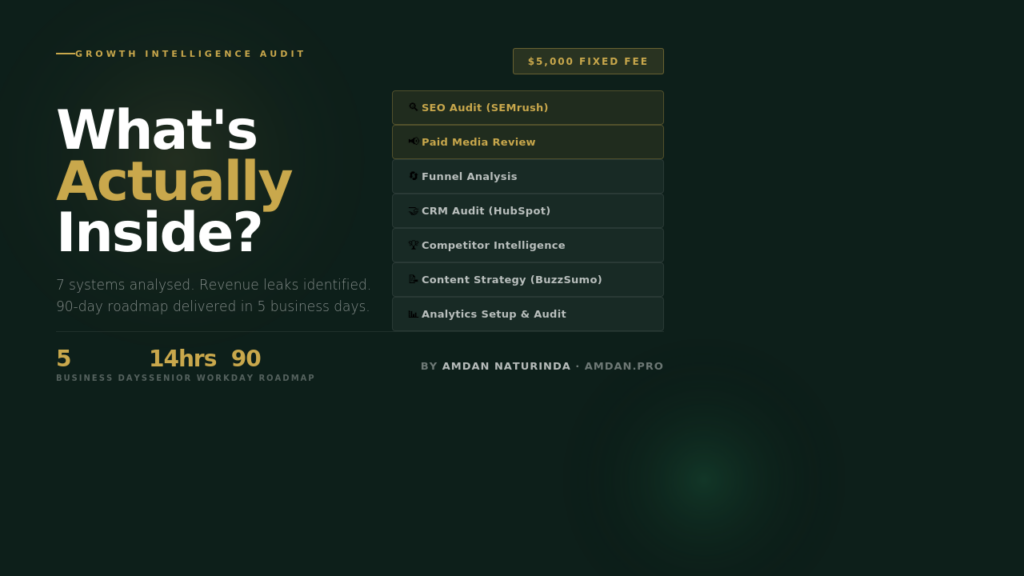
Most business owners who contact me have already tried something. They ran Google Ads that burned through budget with no leads. They hired an SEO agency that delivered a traffic report but no revenue. They built a website that looked good and converted nobody. The problem is almost never a lack of marketing activity. It is a lack of diagnostic clarity. Nobody sat down and mapped the actual system — where leads come from, where they drop off, what the data says versus what the team believes. That is exactly what the Growth Intelligence Audit is designed to fix. What the Growth Intelligence Audit Is Not Before explaining what is included, it is worth being clear about what this is not. It is not a generic SEO report generated by a tool and repackaged as strategy. It is not a surface-level website review. It is not a list of recommendations without data to support them. It is a multi-system diagnostic — covering SEO, paid media, funnels, CRM, and content — conducted by a senior consultant who has worked across Gulf, African, and international markets, using professional-grade tools and over seven years of pattern recognition. The output is a Revenue Leak Report and a 90-Day Growth Roadmap. Not a slide deck full of observations — a prioritised action plan tied to measurable revenue outcomes. What the Audit Covers 1. SEO Performance Analysis (via SEMrush) We begin with a full crawl of your website and a keyword position audit using SEMrush. This covers your current organic visibility — which keywords you rank for, which you should rank for but don’t, where your competitors are outranking you, and what technical issues are suppressing your performance. In 2026, SEO analysis also includes AI visibility — whether your content is being cited in Google AI Overviews, ChatGPT, and Perplexity. Ranking on page one is no longer sufficient if 60% of searches end without a click. We assess your AI citation presence and identify the gaps. Deliverable: Keyword gap report, technical SEO issue list, AI visibility assessment. 2. Paid Media Audit (Google Ads & Facebook/Instagram) If you are running paid ads, we audit the full account structure — campaign architecture, targeting, ad copy, landing page alignment, conversion tracking, and cost per acquisition. The most common finding: ad spend is generating clicks but the conversion tracking is broken or missing entirely, so the business has no reliable data on which campaigns are actually producing leads. We fix this before recommending any budget changes. If you are not yet running paid ads, we assess the opportunity — what a $300–$600/month Google Search and Facebook campaign could realistically return in your market, based on current CPA benchmarks and ROMI modelling. Deliverable: Ad account audit report, conversion tracking assessment, channel recommendation. 3. Funnel & Landing Page Review We map your full customer journey — from first touchpoint to closed deal — and identify where prospects are dropping off. This includes a review of your key landing pages, lead capture forms, follow-up sequences, and the alignment between your ad messaging and your on-page offer. Misalignment between what an ad promises and what a landing page delivers is one of the most common and costly revenue leaks we find. We also assess your offer clarity. Can a prospect who lands on your page immediately understand what you do, who it is for, and what to do next? If the answer requires more than five seconds, revenue is leaking. Deliverable: Funnel map, drop-off identification, landing page recommendations. 4. CRM & Lead Nurturing Audit (via HubSpot) If you use a CRM — particularly HubSpot — we audit how leads are being captured, segmented, and followed up. The most expensive revenue leak in most businesses is not at the top of the funnel. It is in the middle: leads that expressed interest, were never properly followed up, and went cold or chose a competitor. A well-configured CRM and nurturing sequence can recover a significant percentage of these leads at zero additional ad spend. If you are not using a CRM, we assess whether HubSpot or an alternative is appropriate for your volume and team structure, and what a basic implementation would look like. Deliverable: CRM audit, nurturing sequence review, lead recovery recommendations. 5. Competitor Intelligence Analysis We analyse your top three to five competitors — their keyword strategies, ad activity, content approach, and estimated traffic — to identify where they are winning and where the gaps are. This is not about copying competitors. It is about understanding the competitive landscape so your strategy is built with full visibility of the terrain. Markets where competitors have weak content or thin SEO coverage are opportunities. Markets where competitors have invested heavily in specific channels are signals to differentiate. Deliverable: Competitor matrix, opportunity identification. 6. Content Strategy Assessment (via BuzzSumo) We review your existing content — blog posts, social media, lead magnets — against what is actually performing in your category using BuzzSumo data. This identifies which topics your audience engages with, which content formats drive shares and backlinks, and whether your current content is aligned with the search intent of your target clients. Deliverable: Content gap analysis, topic opportunity list. 7. Google Analytics & Search Console Setup and Audit We verify that your measurement infrastructure is correctly configured — that Google Analytics and Search Console are tracking the right events, that conversion goals are set up, and that the data you are making decisions from is actually accurate. Businesses that have been running for years often discover during this audit that key pages were excluded from tracking, that form submissions were not counted as conversions, or that referral traffic was being misattributed. You cannot improve what you cannot measure accurately. Deliverable: Analytics audit report, configuration fixes if required. What You Walk Away With After five business days, you receive two documents: Revenue Leak Report — a prioritised list of where your business is losing revenue across every system we audited, with the data that supports each