
From a Family Electronics Business to Digital Strategy: My View of Africa’s Tech Evolution

For more than two decades, our family business has operated within one of the most important economic shifts in African history: the rise of affordable mobile technology powered largely by Chinese manufacturing. Long before “digital transformation” became a global policy phrase, Chinese electronics brands were already transforming everyday African life from the ground up. In Uganda and across Africa, brands like Tecno, Itel, Infinix, and Redmi did something many Western companies failed to understand at the time: they built for the realities of the African consumer. They developed devices with: This was not simply about selling phones. It was the beginning of Africa’s modern digital infrastructure. China’s Role in Africa’s Digital Transformation The impact of China on Africa’s digital economy goes far beyond manufacturing. Chinese technology ecosystems accelerated: For millions of Africans, the first internet experience did not happen on a desktop computer. It happened on a Chinese-made smartphone. That single shift changed consumer behavior, communication patterns, business models, and even political discourse across the continent. Today, Africa’s digital economy is one of the fastest-growing in the world because mobile technology became accessible to ordinary people — not just elites. Watching Consumer Behavior Changed My Perspective Growing up around the electronics business exposed me to something deeper than retail. I became fascinated not only by the devices people bought, but by what happened after they turned them on. I started observing: That curiosity pushed me beyond phone sales. I wanted to understand the systems behind digital growth. I wanted to understand: That journey led me into web development, SEO, digital marketing, sales funnels, and startup advisory. Building Digital Infrastructure Beyond Hardware Over the years, I transitioned from simply participating in Africa’s electronics economy to helping businesses build their digital presence and growth infrastructure. Today, my work spans multiple areas of digital transformation. Website Development and Digital Presence I have spent years building and managing websites for businesses across different sectors, helping organizations move from offline visibility into fully functional digital ecosystems. This includes: I learned early that in Africa’s mobile-first economy, websites are no longer optional. They are commercial infrastructure. SEO and Search Visibility As smartphone usage increased, search behavior became one of the most powerful economic drivers in Africa. I specialized in SEO to help businesses: My work in SEO expanded into: This became especially important as African businesses increasingly sought visibility beyond local markets. Paid Media and Digital Advertising With over five years of experience in paid media and more than $12,000 spent in advertising campaigns, I have worked extensively with: This work helped businesses understand not only how to get traffic — but how to convert attention into revenue. Supporting African Entrepreneurship and Startups My involvement in digital transformation also expanded into startup ecosystems across Africa and the Middle East. Through engagements connected to organizations such as Doola based in USA and Flat6Labs, Startup Uganda, and International Trade Centre, I gained exposure to how emerging markets are building innovation ecosystems. This experience reinforced something important: Africa’s future will not only be shaped by technology consumers. It will be shaped by African builders. The Next Phase of Africa’s Digital Economy The next decade of African digital transformation will likely move beyond smartphone access into: China will continue to play a major role in this transformation through: But Africa itself is also evolving from being only a consumer market into a producer of digital innovation. Why This Matters Personally For me, this journey started in a phone business. But the phones became a gateway into understanding how technology reshapes human behavior, commerce, and opportunity. Watching customers move from: gave me a front-row seat to Africa’s digital evolution. That evolution inspired me to build skills and businesses that contribute directly to digital transformation rather than remaining only in retail distribution. Today, whether through SEO, web infrastructure, startup advisory, digital advertising, e-commerce systems, or content strategy, my work is centered around one idea: Helping African businesses and entrepreneurs compete effectively in a global digital economy. And in many ways, that journey began with a simple observation inside a family electronics business: Technology does not only change devices. It changes behavior, markets, industries, and the future of entire continents.
Why Public Speaking Is Not a Soft Skill in Africa. It Is the Most Commercially Valuable One You Can Build

In 2020, I began working with Associate Professor Denis Bwesigye — founder of Public Speaking and Leadership Solutions Uganda — a public health professional who had studied at Zenspeak School in Manhattan, New York, receiving coaching from a world-renowned communications coach — on something that was not, on the surface, a digital marketing project. It was a skills development programme. The mission: build the public speaking, leadership communication, and professional presence capabilities of Ugandan professionals — through one-on-one coaching sessions, group workshops, and the kind of structured, evidence-based skills training that most African professional development programmes do not provide. My role was to build the growth infrastructure that would allow the programme to reach the people who needed it: Facebook ads campaigns for lead generation, landing page development and optimisation for registration conversion, and the digital systems that turned awareness into enrolment. We are now developing an e-learning platform that will extend this work beyond the limits of in-person delivery — allowing professionals across Uganda and beyond to access structured public speaking and leadership coaching regardless of geography, schedule, or proximity to a training centre. That work — a public health academic trained at a Manhattan communications school, a digital marketing consultant with roots in Bahrain and Austin, and an e-learning platform being built for African professionals — is, in microcosm, the story of what Africa’s skills development moment actually looks like in 2026. And it is the work being built, right now, through Public Speaking and Leadership Solutions Uganda. The Macro Reality: Africa Is at an Inflection Point The numbers behind Africa’s current moment are not the cautious projections of optimistic development reports. They are measurements of transformation already underway. After a challenging venture winter in 2024, Africa’s startup ecosystem witnessed a robust change — startups across the continent secured approximately $3.1 billion in capital throughout 2025, a significant jump from the $2.2 billion recorded the previous year. Mobile technologies are paving the way for greater digitalisation across the continent, contributing nearly 8% of Africa’s GDP in 2024. Digital transformation could contribute nearly 20% to South Africa’s GDP by 2028 alone, creating 300,000 jobs and expanding access to essential services to millions. Kenya’s digital innovation ecosystem — from mobile money to platform-based logistics and e-commerce — is creating new occupations in fintech, digital marketing, data services and platform management that barely existed a decade ago. Rwanda has positioned itself as an African testbed for emerging technologies, investing heavily in broadband, digital public services and coding academies to build a workforce ready for data-driven and AI-enabled jobs. Frontier technologies — from artificial intelligence and advanced data analytics to the Internet of Things, robotics and clean energy solutions — are already reshaping value chains in agriculture, manufacturing, services and public administration. The question for African policymakers and industry leaders is not whether these technologies will transform the labour market, but whether the continent will shape that transformation, or simply adjust to it on other people’s terms. That last sentence is the most important one. Africa is at a fork in the road — not between growth and stagnation, but between agency and dependency. Between building the skills infrastructure that allows Africans to lead the continent’s technological transformation, and importing that capability from outside at the cost of ownership, margin, and self-determination. The Skills Gap: The Constraint That Compounds Everything Else Every investment, every infrastructure project, every technology deployment in Africa faces the same upstream constraint: the availability of skilled people to build, operate, adapt, and scale it. African SMEs that build capability stacks around cloud ERP, embedded AI, secure platforms and digital skills will be able to compete with far larger organisations in 2026. Those that delay risk being locked out of supply chains, talent pools and digital markets. The skills gap in Africa is not primarily a gap in access to education. Enrolment rates have improved significantly across most of sub-Saharan Africa over the past two decades. The gap is between the education that is being delivered and the skills that the emerging digital economy actually requires. Most African university curricula were designed for an economy that is already changing faster than the syllabi can be updated. A computer science graduate who studied on a curriculum written in 2018 is entering a job market where AI-assisted development, cloud architecture, and digital marketing analytics are the baseline requirements — not the advanced skills. In 2026, the intersection of Education, Health, and Entrepreneurship is where we see the most innovation. EdTech has moved beyond simple video lessons to personalised, AI-driven learning platforms that address the skills gap. The EdTech sector is a vital component of Africa’s entrepreneurship story because it provides the human capital required for all other industries. A continent that solves its skills gap — that connects its young population with the specific, applied, market-relevant capabilities that the digital economy rewards — unlocks a compounding advantage that no other intervention can replicate. This is the problem that the work with Associate Prof Denis Bwesigye is addressing. Not at continental scale. At the scale of one programme, one cohort, one professional at a time — and with an e-learning platform that is designed to remove the geographic and logistical constraints that have historically limited who can access this kind of development. Why Public Speaking Is a Strategic Skill — Not a Soft One The public speaking and leadership communication programme I have been supporting since 2020 addresses something that most African professional development programmes treat as peripheral: the ability to communicate with authority, clarity, and presence in professional contexts. This is not a peripheral skill. In 2026, it is one of the most commercially consequential capabilities a professional or entrepreneur can develop. Consider what professional communication determines in practice: Pitching for investment. Every African startup founder who has ever stood in front of an investor panel — whether at Flat6Labs in Bahrain, Startup Uganda’s pitch events, or a Doola-backed YCombinator preparation session in Austin — has experienced the moment when
Beyond Al Jazeera’s Lens: The Palestinian Professionals Who Built Careers, Closed Deals

I want to write something that Al Jazeera doesn’t show you. Not because Al Jazeera is wrong — the journalists they have lost covering Gaza were doing work of immense courage and moral importance, and their sacrifice deserves recognition, not dismissal. But because a single story, told repeatedly and exclusively, can make an entire people invisible in their full humanity. And the Palestinians I knew in Bahrain — the ones I worked beside, learned from, shared meals with, and built professional relationships with — deserve to be seen in their fullness. I grew up alongside Palestinians during my years in Bahrain. Not in a refugee camp. Not in a war zone. In offices, classrooms, cars, and courtrooms. In the daily, unremarkable, deeply human texture of working life in one of the Gulf’s most cosmopolitan cities. Let me tell you about the people I knew. The Driver Who Was Also a Diplomat During my time in Bahrain, I had a Palestinian driver who was far more than a driver. He was a navigator — not just of Bahrain’s roads, but of its social landscape. He knew which neighbourhoods were safe for which conversations. He knew the informal codes of the Gulf business world — when to speak, when to stay silent, when a handshake meant more than a contract. He was multilingual in the way that Palestinian diaspora professionals often are: Arabic in several registers, English for business, enough Urdu to communicate with South Asian colleagues, enough conversational Bahraini dialect to be genuinely trusted by locals. He assisted me in closing deals. Not because he was instructed to — because he understood the relational architecture of Gulf commerce instinctively. He made introductions. He provided context. He told me, quietly and without fuss, when a meeting was going wrong and why. He was, in the full professional sense, an indispensable partner in work that I would have done less well without him. He was also, when the subject arose, deeply thoughtful about Palestine — not angry, not despairing, but strategic. He was thinking about where his children would go to university. He was thinking about which skills would be valuable in twenty years. He was, in every practical sense, building a life of purpose and forward motion despite carrying the weight of a people’s dispossession. The Lawyer Who Shaped My Understanding of Due Diligence I also worked with a Palestinian lawyer in Bahrain — a man of extraordinary precision and professional discipline. In the Gulf’s business environment, where deals move fast and documentation is complex, legal counsel is not optional. And the Palestinian legal professionals I encountered were not merely competent. They were rigorous in a way that came, I think, from understanding at a bone-deep level that documentation and legal standing are not bureaucratic formalities — they are survival tools. A people who have spent generations navigating stateless existence, contested borders, and the absence of institutional protection understand the power of a correctly drafted contract in a way that those with permanent citizenship often do not. The lawyer who assisted me brought that understanding to every engagement. He was precise about language. He was meticulous about precedent. He was also, like the driver, multilingual and culturally fluent in ways that made him genuinely effective in a multinational business environment. These are not characteristics that emerge from war. They are characteristics that emerge from education, from professional discipline, and from the particular kind of resilience that the Palestinian diaspora has demonstrated across every country it has inhabited. The Translator Who Made Connection Possible The third Palestinian professional who shaped my Bahrain years was a translator and cultural interpreter — someone whose value in a multilingual, multicultural business environment cannot be overstated. Translation, in the Gulf, is rarely just about language. It is about register — knowing that the same sentence means something different in a formal business context versus an informal social one. It is about cultural subtext — understanding what is being communicated through silence, through indirection, through the particular formality of a Gulf business introduction. It is about trust — being the person in the room who both parties believe is representing them accurately and faithfully. The Palestinian translator who assisted me was all of these things. He was also, outside working hours, a reader — someone who engaged seriously with ideas, who had opinions about the world, and who was building, quietly and with great determination, a professional and intellectual life that he could be proud of. What I Taught — and What I Learned At the Future Institute in Bahrain, I had the privilege of teaching digital skills to Palestinian youth — web hosting, web design and development, and social media management. I want to be honest about what that experience revealed. The students I taught were not passive recipients of training. They were hungry — in the specific, directed way of young people who understand that a skill is a form of freedom. They understood, in a way that perhaps more comfortable young people do not, that a skill cannot be taken from you. A home can be taken. A passport can be complicated. A livelihood can be disrupted. But the ability to build a website, manage a digital presence, or grow a brand online — that capability goes with you wherever you go. Palestinian freelancers are increasingly entering saturated markets like general web development, where competition is fierce and income remains modest. In contrast, high-demand and high-income digital fields such as digital marketing, AI and machine learning, UI/UX design, and data analysis remain significantly underrepresented — with 85% of global employers seeking digital marketing skills, but only 8% of Palestinian freelancers currently offering them. This is the gap I was trying, in my small way, to address. Not the conflict. Not the politics. The skills gap — the specific, actionable, commercially meaningful gap between what the global digital economy needs and what Palestinian youth were being trained to offer. Teaching web hosting and social media
The Role of HubSpot in Driving Successful CRM Adoption in Africa
Without HubSpot, the campaign would have been a collection of disconnected activities. With it, every lead captured through Facebook was logged, segmented, and entered into a nurturing sequence. Every email that converted a prospect to a confirmed attendee was tracked. Every follow-up was automated. Every registration was visible in a single pipeline dashboard. The result was 1,000+ attendees in one month — from a standing start. That campaign was, in microcosm, the story of what HubSpot does for African businesses that implement it correctly. And in 2026, as Africa’s digital economy accelerates across e-commerce, real estate, events, professional services, and financial technology, the question of whether African businesses are using the right CRM infrastructure has never been more commercially significant.In 2020, I was working with Talent Africa Group to launch Kampala Innovation Week — Uganda’s first hybrid event. The campaign had four moving parts: Facebook ads, MailChimp email sequences, Agency Analytics for reporting, and HubSpot as the CRM backbone holding everything together and Consilium House in Bahrain The Data Behind the Gap Start with the macro reality. Businesses earn $8.71 ROI for every $1 spent on CRM. That is not a HubSpot marketing claim. It is an industry-wide measure of what systematic customer relationship management produces — across every business type, every market, every sector. CRM use boosts customer retention by 27%. For a consulting business at $5,000 per client, a 27% improvement in retention is not a marginal gain. It is the difference between a client base that builds and one that churns. Teams using a CRM like HubSpot are 128% more likely to rate their marketing strategy as effective compared to those not using one. HubSpot users report a 68% reduction in the time it takes to launch campaigns, thanks to automation, centralised tools, and templates. Businesses using HubSpot Marketing Hub report an average 505% ROI over three years. These numbers describe a technology that most African businesses — particularly in Uganda, Kenya, Tanzania, Rwanda, and Ghana — are not using. The majority of African SMEs that have any customer management process at all are managing it through spreadsheets, WhatsApp message threads, and the individual memory of their sales teams. The cost of that gap is measured in leads that go cold, follow-ups that never happen, clients who leave because nobody checked in, and sales cycles that take twice as long as they should. Why Africa’s Digital Economy Specifically Needs CRM Infrastructure The argument for CRM adoption in mature Western markets is primarily about efficiency — doing the same work faster. In Africa, the argument is more fundamental: CRM infrastructure is a prerequisite for the kind of scalable digital business that Africa’s growth trajectory demands. Here is why the African context is different: Lead leakage is catastrophic. Most African businesses generate leads through a combination of WhatsApp, Facebook Messenger, Instagram DMs, referrals, and walk-in enquiries. These leads arrive through multiple channels simultaneously, with no systematic capture process. A lead that arrives via Instagram DM on a Friday afternoon and receives no follow-up until Monday has, in most cases, already contacted a competitor. In Gulf real estate, an industry I worked in directly with ERA Real Estate Bahrain, the first credible response wins the deal disproportionately. The same dynamic applies to Ugandan real estate, Kenyan professional services, and Nigerian e-commerce. Mobile money creates a false sense of CRM. The widespread adoption of mobile money across East and West Africa — MTN MoMo, Airtel Money, M-Pesa — has solved the payment problem in many markets. But having payment infrastructure is not the same as having relationship infrastructure. A business that can receive mobile money from 100 customers has no systematic way of knowing which of those customers is likely to buy again, which is at risk of churning, or which referred three new clients last month. The informal-to-formal transition demands documentation. As Africa’s digital economy matures — as businesses move from cash to digital payments, from word-of-mouth to social media advertising, from local to regional operations — the absence of documented customer relationships becomes a structural liability. A business that cannot show an investor a clean pipeline, a documented customer base, or a measurable conversion rate is a business that cannot access the growth capital it needs. WhatsApp is a channel, not a CRM. The most common customer management tool across African SMEs is WhatsApp Business. Used well, WhatsApp Business is a powerful customer communication channel. It is not a CRM. It has no pipeline visibility, no automated follow-up sequences, no segmentation capability, no revenue attribution, and no reporting. When the person managing the WhatsApp account leaves the business, the relationship history goes with them. HubSpot’s free CRM — available at no cost for unlimited contacts and core features — solves all four of these problems. It is the infrastructure layer that turns disconnected, informal customer interactions into a documented, automated, measurable growth system. HubSpot in Africa in 2026: The Current State As of late 2024, HubSpot served customers in 135+ countries, with 258,258 paying customers as of March 2025 — a 19% increase year-over-year. HubSpot’s CRM and inbound technology continue to be major growth drivers for South African businesses, from startups to enterprises. Because HubSpot doesn’t operate its own offices locally in South Africa, expert partners are essential to help with implementation, optimisation, training, CRM migrations, and ongoing digital transformation. South Africa has the most developed HubSpot ecosystem on the continent — with Diamond and Elite-tier partners including Velocity Digital, Huble Digital, Spitfire Inbound, and MO Agency providing implementation, automation, and RevOps services. Spitfire Inbound’s HubSpot-powered work has delivered results including 2,500%+ ROI for Pluxnet and award-winning CRM strategies for clients including Suzuki Auto South Africa. East Africa — Uganda, Kenya, Tanzania, Rwanda — is at an earlier stage. HubSpot adoption among Ugandan and Kenyan SMEs is growing but remains significantly below what the business landscape warrants. The majority of businesses that should be using HubSpot are either unaware of it, using the wrong tier for their stage
The Powerful Truth About Marketing ROI: What You Measure Matters More Than What You Spend
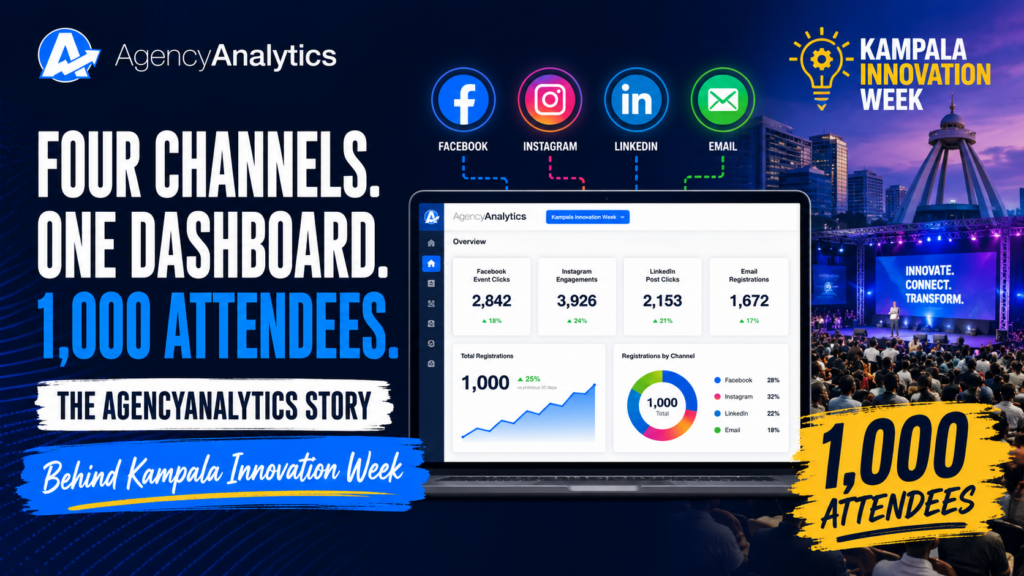
In 2020, I launched Kampala Innovation Week for Talent Africa Group — Uganda’s first hybrid event. The stack I used to run it was not simple: Facebook ads for awareness, MailChimp for email marketing, HubSpot for CRM and lead management, and Agency Analytics for reporting. That last tool was not an afterthought. It was the layer that tied everything together — the platform that took data from four different systems and turned it into a single, coherent picture of what was working, what wasn’t, and where the next dollar of investment should go. In a month, the event went from low registrations to over 1,000 participants. The Facebook ads drove awareness. MailChimp nurtured leads. HubSpot managed the pipeline. But AgencyAnalytics was what made the decision-making clear — showing in real time which channel was generating registrations, which email sequences were converting, and where the bottlenecks were. That experience — managing a high-pressure, multi-channel campaign with clear measurement infrastructure — is the foundation of how I approach reporting for every client engagement today. And what I have learned since is that the reporting tool is not just an administrative function. It is a direct driver of ROI and ROMI improvement. Here is why — and here is the evidence. The Reporting Problem That Is Costing Agencies and Consultants Their Clients Let us start with an uncomfortable truth. If you are still manually taking screenshots of Facebook Ads and pasting them into a slide deck, you are operating in 2018. In 2026, live data streams are the minimum standard. The manual reporting process that most agencies and consultants still use is not just inefficient. It is commercially dangerous. Every hour spent compiling data from six different platforms is an hour not spent optimising campaigns. Every report delivered five days after month-end is five days of delayed decision-making. And every client who has to wait for their consultant to “pull together the numbers” before making a budget decision is a client who is silently questioning the value of the engagement. According to the SoDA Report on agency efficiency, agencies with automated weekly or bi-weekly reporting dashboards retain clients 34% longer than those delivering monthly PDF reports manually. Client retention is a direct ROMI driver. If your current reporting process is contributing to client churn — and manual, delayed reporting does — then the investment in a professional reporting platform is not an overhead cost. It is a revenue protection investment. What AgencyAnalytics Actually Does AgencyAnalytics is not a general analytics tool. It is built specifically for agencies — pulling in data from over 80 marketing channels, including Google Ads, Facebook, SEO platforms, and email tools, and turning them into customisable, client-ready reports with white-labelled dashboards, scheduled reporting, and built-in ROI tracking. The platform makes it simple to manage dozens of clients from a single dashboard, with each client getting their own branded reporting portal. The white-label capabilities are comprehensive — you can customise everything from the dashboard interface to automated email reports with your agency’s branding. The integrations that matter most for the Growth Intelligence Stack used in every amdan.pro audit: AgencyAnalytics integrations include over 80 platforms, with Google Analytics 4, Gravity Forms, and HighLevel among the strongest. It eliminates manual updates, ensuring clients receive timely, data-driven reports without extra effort. The client portal gives clients access to real-time dashboards with instant access to their data anytime. When all of these data sources flow into a single dashboard — updated in real time, branded with your agency identity, accessible to clients 24/7 — the reporting function shifts from a backward-looking administrative task to a forward-looking strategic asset. How AgencyAnalytics Directly Improves ROI The connection between a reporting platform and improved ROI is not indirect. It operates through four specific mechanisms: 1. Faster Decision-Making Reduces Wasted Spend The most expensive period in any marketing campaign is the period between when something stops working and when you find out about it. A Facebook ad set whose cost per lead has doubled over 72 hours is burning budget. If you discover this on a weekly report review, you have lost three days of overspend. If your AgencyAnalytics dashboard is sending automated anomaly alerts — as it does with its AI summaries, anomaly detection, and metric alerts — you find out within hours and can pause or adjust before significant damage is done. For a client spending $600/month on ads, catching a 72-hour CPL spike within hours versus days can represent the difference between a wasted $60 and a wasted $200. At scale, this single function pays for the platform many times over. 2. Attribution Clarity Moves Budget to What Works The most common ROI problem in multi-channel marketing is not that the channels don’t work. It is that the business doesn’t know which channels are working — so it distributes budget based on assumption rather than evidence. A business running Google Search Ads, Facebook campaigns, and organic SEO simultaneously, with no unified reporting layer, cannot answer the question: “Where did this client come from?” They might attribute it to Facebook because the client mentioned seeing an ad — without knowing that the client had also visited the website three times from organic search before clicking the Facebook ad. AgencyAnalytics’ unified dashboard surfaces this multi-touch picture. By consolidating Google Analytics conversion data with Google Ads spend data and Facebook campaign performance, the platform allows genuine channel attribution — which channels are contributing leads, at what cost, and in what sequence. The ROMI improvement from this clarity is direct and measurable. Shifting 20% of budget from a channel with a $120 CPL to one with a $45 CPL, based on attribution data that was previously unavailable, produces a ROMI improvement that compounds every month the reallocation is maintained. 3. Client Transparency Reduces Churn — and Churn Is a ROMI Killer The most underestimated ROMI drain in service businesses is client churn. Acquiring a new client at a $350/hour consulting rate, with a 20% close rate from paid
The $14,400 Question Every Service Business Needs to Answer About Their Software Stack
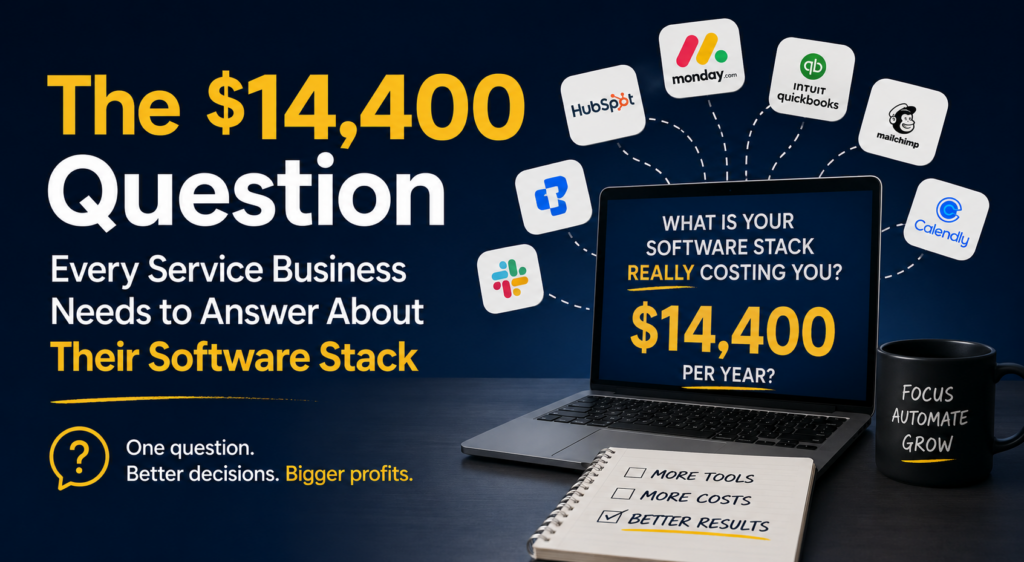
The Marketing Stack Audit: How to Calculate ROI & ROMI on Every Tool You Pay For .Most businesses have a software problem they don’t know they have. They are paying for 8, 10, sometimes 15 tools every month. Some of those tools are generating significant revenue. Some are sitting largely unused. Some are duplicating functions that another tool in the stack already covers. And almost none of the businesses paying for these tools have done the calculation that would tell them which category each tool falls into. The result: the average SaaS company uses 91+ tools in 2026, with at least 50% of SaaS licences underutilised or unused. Money that should be compounding into revenue is funding software subscriptions that are delivering no measurable return. This article is the framework for fixing that — specifically applied to the growth intelligence stack we use in every client audit: SEMrush, HubSpot, ClickFunnels, Leadpages, Apollo, Google Analytics, Google Tag Manager, Google Search Console, Hotjar, QuickBooks, and Kit (ConvertKit). Each tool has a job. Each tool has a cost. And each tool should be generating a return that justifies that cost — or it should be cut. The Two Metrics That Matter: ROI vs ROMI Before calculating anything, the definitions matter — because ROI and ROMI are measuring different things, and confusing them produces misleading conclusions. ROI (Return on Investment) measures the total return on any investment relative to its cost: ROI = (Revenue Generated − Total Investment) ÷ Total Investment × 100 If your total revenue is $200,000 and marketing spending is $50,000, then: $200,000 − $50,000 = $150,000 net profit. ROI = $150,000 ÷ $50,000 × 100 = 300%. For each dollar you spend on marketing, you earn $3 in profit. ROMI (Return on Marketing Investment) focuses specifically on marketing activities — isolating the return from marketing spend versus overall business investment: ROMI = (Revenue Attributable to Marketing − Marketing Investment) ÷ Marketing Investment × 100 ROMI focuses specifically on marketing activities and provides a more granular view of marketing effectiveness. If your company spent $50,000 on a campaign that generated $200,000 in revenue, ROMI = [($200,000 − $50,000) / $50,000] × 100% = 300%. For software stack analysis, you need both: The Full Software Cost Audit: What You Are Actually Spending Before calculating returns, you need an honest inventory of costs. Most businesses underestimate their software spend because they look at individual tools in isolation rather than the cumulative stack. Here is the Growth Intelligence Stack we use in client audits — with approximate monthly costs at standard tiers: Tool Function Est. Monthly Cost SEMrush SEO, keyword intelligence, competitive analysis $140–$500 HubSpot CRM, email marketing, sales pipeline $50–$800 ClickFunnels Funnel building, landing pages $97–$297 Leadpages Landing pages, lead capture $37–$99 Apollo Lead generation, prospecting, outreach $49–$99 Kit (ConvertKit) Email marketing, sequences, automation $29–$99 Hotjar Website heatmaps, session recordings $32–$80 Google Analytics Website traffic analysis Free Google Tag Manager Tag and tracking management Free Google Search Console Search performance monitoring Free QuickBooks Accounting, invoicing, financial tracking $30–$90 AWS / GoDaddy / Shopify / WordPress Hosting, e-commerce infrastructure $20–$300 Total (mid-tier estimate) ~$561–$2,463/mo At a mid-tier stack running $1,200/month, your software costs $14,400 per year before a single dollar of ad spend, freelancer cost, or your own time. That $14,400 is an investment. It needs to produce a return that justifies it — ideally a ROMI of at least 300%, which means $43,200+ in attributable revenue from that investment. The question every business should be asking: is it? How to Calculate ROI Per Tool The framework for calculating ROI on each tool in your stack has three steps: Step 1 — Assign Each Tool a Revenue Function Every tool in a growth stack should have a specific, measurable role in generating or protecting revenue. If you cannot articulate what revenue function a tool serves, that is a problem. SEMrush → Organic traffic growth → leads from organic search → revenue HubSpot → Lead capture, nurturing, CRM → conversion of leads to clients → revenue ClickFunnels/Leadpages → Paid traffic conversion → leads from paid ads → revenue Apollo → Outbound prospecting → booked calls → revenue Kit/ConvertKit → Email sequences → lead nurture → revenue Hotjar → Conversion rate optimisation → improved checkout/funnel performance → revenue QuickBooks → Financial management → invoicing accuracy, tax compliance → cost avoidance Google tools → Traffic measurement, search visibility → optimisation decisions → revenue Step 2 — Measure the Revenue Each Tool Contributes This requires attribution — connecting the revenue you generate to the tools that contributed to generating it. There are several approaches: multi-touch attribution assigns value to each marketing touchpoint in the customer journey. In practice, for most small and medium businesses, a simplified attribution model works: For SEMrush: Track organic traffic in Google Analytics. Calculate what percentage of your leads come from organic search. Apply that percentage to your revenue to get organic revenue. Compare to SEMrush’s monthly cost. For HubSpot: Track leads captured through HubSpot forms and sequences. Track which leads converted to paying clients. Calculate revenue from HubSpot-sourced clients. Compare to HubSpot’s monthly cost. For ClickFunnels/Leadpages: Track leads generated per landing page using UTM parameters and Google Analytics. Calculate conversion rate and revenue from those leads. Compare to platform cost. For Apollo: Track outbound sequences sent, replies received, calls booked, and clients closed. Calculate revenue from Apollo-sourced clients. Compare to Apollo’s monthly cost. For Kit/ConvertKit: Track email open rates, click rates, and — most importantly — revenue from email-triggered purchases or bookings. Compare to platform cost. For Hotjar: Calculate improvement in conversion rate since implementation. Apply conversion rate uplift to your traffic volume and average transaction value to estimate revenue impact. Compare to Hotjar’s monthly cost. Step 3 — Apply the ROI Formula Per Tool Tool ROI = (Revenue Attributed to Tool − Tool Monthly Cost) ÷ Tool Monthly Cost × 100 Example — SEMrush at $140/month: Example — Apollo at $49/month: These numbers illustrate why high-performing tools deserve more investment
Understanding Texas Business Landscape: Strategy Leadership and Execution

Texas Business Landscape: Digital Marketing & SEO Strategy | Amdan.pro amdan.pro Digital Marketing SEO Strategy Work With Me Market Intelligence Texas’ Business Landscape:What It Means for YourDigital Marketing & SEO Texas is America’s fastest-growing major economy — and most brands competing here are still running digital strategies built for slower, smaller markets. Here’s how to close that gap. By Amdan · Digital Strategy · amdan.pro Texas is no longer a regional market that national brands can afford to treat as an afterthought. With a GDP that would rank it among the world’s top ten economies, a population growing faster than any other major state, and a business environment actively pulling corporations, talent, and capital away from traditional coastal centers — Texas has become one of the highest-stakes digital marketing battlegrounds in the United States. And most brands competing here are running generic strategies that were never built for this market. The opportunity — and the risk — is significant. Companies that localize their digital marketing and SEO for the Texas market gain real competitive advantages in search visibility, audience relevance, and customer acquisition cost. Those that apply national playbooks to Texas audiences consistently leave organic growth on the table and overpay for paid traffic that converts poorly. $2.5T+ Texas GDP — one of the world’s largest economies 62K+ Net new residents per month — fastest-growing major state #1 U.S. state for corporate relocations — 7 consecutive years Why Texas Demands a Distinct Digital Strategy The foundational mistake brands make in Texas is assuming that national SEO and digital marketing strategies translate directly to a state this large, this diverse, and this fast-moving. Texas is not a single market — it is four distinct metropolitan ecosystems with different industry concentrations, different search behaviors, different competitive landscapes, and different audience profiles, all operating under a shared cultural context that has its own values, communication norms, and trust signals. “Winning in Texas digital marketing means understanding that Austin, Dallas, Houston, and San Antonio are not the same market with different weather. They are different competitive universes.” — Amdan, Digital Strategy Advisor The implication for SEO is direct and practical. A law firm, a B2B technology company, a healthcare provider, or an ecommerce brand competing in Texas needs a geo-targeted content architecture, locally-anchored keyword strategy, and audience understanding specific to each major Texas market — not a single statewide approach that is too broad to dominate anywhere. The Four Texas Digital Markets Austin Tech & Startup Audience High digital sophistication. Search behavior skews toward product comparisons, startup resources, and growth-stage B2B services. Content must be substantive — generic performs poorly here. Dallas–Fort Worth Enterprise & Corporate Audience Fortune 500 decision-makers, financial services, and enterprise technology buyers. High-value B2B search with long consideration cycles. Trust signals and thought leadership content are critical. Houston Industrial, Energy & International Energy sector, healthcare, and international trade audiences. Multilingual search behaviors matter here more than in any other Texas market. Industry-specific content depth wins. San Antonio Defense, Cyber & Value-Driven Defense, cybersecurity, and cost-conscious professional audiences. An underrated SEO opportunity — lower competition than Austin or DFW, with real purchase intent in specialized verticals. The Texas SEO Opportunity: What Most Brands Miss The rapid influx of corporations and talent into Texas has created a search demand surge that organic content strategies have not yet caught up to. New residents searching for services, businesses establishing Texas presences and researching local vendors, and a growing professional class looking for Texas-specific industry intelligence — all of this represents search demand that is, in many verticals, still underserved by quality content. This is a genuine first-mover advantage window for brands that build Texas-focused content strategies now. The window will not stay open indefinitely. As more national brands recognize the Texas opportunity and invest in localization, the cost of entry into high-value Texas search positions will rise. The brands that establish topical authority and local search dominance in 2024 and 2025 will be structurally advantaged against later entrants. Where the SEO Gaps Are Based on the Texas business landscape analysis, the highest-opportunity content and SEO gaps cluster around several themes that map directly to the state’s economic evolution. Relocation and establishment content — companies and individuals relocating to Texas generate enormous search volume around legal, financial, real estate, HR, and operational questions that are specific to Texas regulatory and business environments. This is evergreen demand that grows with the state’s population. Industry-specific Texas content — the energy transition, the Texas tech ecosystem, the Texas Medical Center’s life sciences community, and the defense sector all generate professional search demand for deeply specialized content. Most national publishers cannot serve this with the depth Texas professionals expect. Texas B2B vendor search — as corporations establish or expand Texas operations, procurement teams search for Texas-based or Texas-knowledgeable vendors across every professional services category. Ranking for Texas-specific B2B intent queries is often significantly easier than ranking for national equivalents, with comparable or superior commercial value. Digital Marketing Strategy for The Texas Market Beyond SEO, Texas’ cultural and competitive characteristics demand specific adjustments to paid search, content marketing, and social media strategies that national playbooks rarely account for. Paid Search: What Changes in Texas Texas’ metropolitan markets have meaningfully different CPCs, audience compositions, and competitive dynamics than national campaigns assume. DFW’s concentration of corporate headquarters creates B2B paid search environments where competitor spending is high and generic creative performs poorly. Austin’s tech-savvy audience has high ad literacy — vague value propositions get scrolled past. Houston’s diversity and internationalism means ad copy that works in DFW may underperform in Houston without localization. Texas Market Paid Search Characteristics SEO Priority Austin High CPC in tech/SaaS verticals; ad-literate audience; strong organic preference Thought leadership content Dallas–Fort Worth Competitive B2B landscape; long cycles; LinkedIn complements search Enterprise intent keywords Houston Energy & healthcare verticals dominate; multilingual opportunity Industry depth + local San Antonio Lower competition; defense/gov adjacent; value-driven messaging Niche authority content Content Strategy: Meeting the Texas Standard Texas business culture has a
What New York Businesses Are Missing About SEO in the Age of AI Search
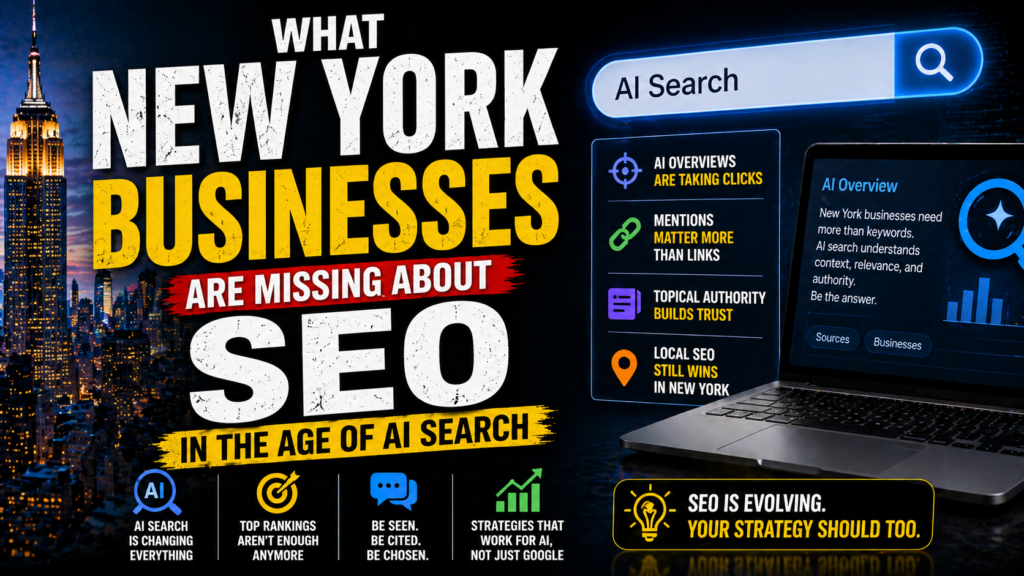
New York is one of the most competitive search markets in the world. Real estate. Finance. Legal. Healthcare. Hospitality. Professional services. Every major industry category in New York has dozens — sometimes hundreds — of businesses spending seriously on SEO, each trying to own the same commercial keywords. The competition for page-one organic positions in Manhattan alone would be considered fierce in most other markets globally. And in 2026, most of those businesses are competing for a prize that is quietly shrinking. The organic search result — the blue link that a New York law firm or real estate brokerage or financial advisory has spent years and tens of thousands of dollars trying to rank for — is being displaced. Not eliminated. Displaced. By AI Overviews that answer the query before the user ever sees a link. By featured snippets. By People Also Ask boxes. By Google’s increasingly aggressive insertion of its own content between the searcher and the result. The businesses that understand what is actually happening to New York’s search landscape in 2026 — and that have the data infrastructure to respond to it — are the ones that will hold their organic positions through this transition. The ones that don’t are watching their traffic decline without understanding why their rankings haven’t changed. This is the conversation that matters right now. And it is one I can have with data behind it — because for the past two years, I have held an agency partnership with SEMrush, one of the world’s leading online visibility management platforms, used by over 10 million marketers worldwide and trusted by 30% of Fortune 500 companies. What AI Search Is Actually Doing to New York’s Organic Traffic The number that every New York business owner and marketing director needs to understand first: nearly 60% of Google searches now end without a single click. The user searched. Google answered — via an AI Overview, a featured snippet, or a knowledge panel. No website was visited. No organic click was generated. A business that ranks number one for a high-value query in 2026 may be receiving a fraction of the traffic that position delivered in 2022. This is not a future risk. It is a current reality — and it is disproportionately affecting exactly the kind of informational and commercial queries that New York’s service businesses depend on for top-of-funnel organic acquisition. A Manhattan real estate firm that ranks first for “how much does it cost to buy an apartment in New York” is now likely watching Google answer that question directly in the AI Overview. A financial advisor who ranked for “best way to invest $100,000 in 2026” is watching Gemini synthesise an answer from multiple sources. A law firm that ranked for “employment lawyer New York” may find their result pushed below a local pack, an AI Overview, and three paid ads before the first organic click is available. Semrush launched Spotlight 2026, its flagship marketing conference in London on October 13, describing the event as designed to equip marketers with the strategies required to compete and win brand visibility in the AI search era — as the interconnections between SEO and AI Search become increasingly clear. The platform I have worked with for two years is now hosting conferences specifically about this transition. That is not a coincidence — it reflects where the entire SEO industry is moving. What a SEMrush Agency Partnership Actually Means Before explaining what New York businesses should do differently, it is worth being specific about what a SEMrush agency partnership provides — because it shapes how I approach every client engagement. SEMrush agency partners receive advanced training, priority support, co-marketing opportunities, and access to exclusive agency resources covering SEO, PPC campaign management, content marketing, competitive analysis, and online visibility. Every SEMrush Agency Partner is certified through SEMrush Academy and rated with an Agency Score — certifications that show clients the partner knows how to use SEMrush to help them get ahead. What this means in practice for clients: when I conduct a Growth Intelligence Audit, I am not working from general SEO principles or publicly available data. I am working from SEMrush’s proprietary data infrastructure — the largest keyword database in the industry, real-time ranking tracking, competitive gap analysis, backlink intelligence, and the platform’s new AI visibility monitoring that tracks how brands and their competitors appear in AI-generated search responses. SEMrush’s enterprise platform consolidates SEO, AI search, and site health in one place — leveraging first-class SEO and AI search data to help clients scale with proven, trusted infrastructure. Two years of working with this platform daily — running audits for clients across Gulf real estate, East African e-commerce, Ugandan event management, and international consulting businesses — has given me a depth of tool proficiency that directly translates into faster, more accurate diagnostic work for every client I engage. The data I pull for a New York business’s competitive analysis is the same data that 30% of Fortune 500 companies use to make their SEO decisions. That is not a marketing claim — it is the infrastructure reality of the platform. The 5 Things New York Businesses Are Getting Wrong in 2026 1. Optimising for Rankings Instead of Visibility The most common SEO mistake in New York’s competitive market in 2026 is treating keyword ranking position as the primary success metric. Ranking is a means to visibility. Visibility — being present wherever your buyers are forming intent, including in AI Overviews, featured snippets, Google’s AI Mode, and citation-based answers in ChatGPT and Perplexity — is the actual objective. A business that ranks number three for a valuable New York query but has zero AI visibility is more exposed than one that ranks number eight but appears consistently in AI-generated answers. The ranking tells you where you are in the traditional results. It tells you nothing about your presence in the surfaces that are increasingly capturing the first engagement with a searcher. SEMrush’s AI visibility tracking —
The Best Marketing Education I Ever Got Was Working for the US Navy — Not a University

I have never had a formal marketing degree. What I have had is something considerably harder to replicate — a front-row seat to how the world’s most disciplined, most strategically precise organisation on the planet thinks about leadership, decision-making, and the delivery of outcomes under pressure. In 2019, while working in Bahrain, I served as Executive Assistant to the Commander of the US Navy. The US Naval Support Activity Bahrain is the largest American military installation in the Middle East — a hub of strategic operations that coordinates across the Gulf, the Indian Ocean, and beyond. The Commander I worked under operated at a level of clarity, precision, and strategic intentionality that I had not encountered anywhere in the business world. And in the margins of that role — in the reading I was given, the conversations I had, and the framework I was asked to internalise — I received the best marketing education of my career. The book at the centre of it was not a marketing textbook in the conventional sense. It was Strategy from the Outside In: Profiting from Customer Value by George S. Day and Christine Moorman. Winner of the American Marketing Association Foundation’s Berry-AMA 2011 Book Prize for the best book in marketing — written by professors from The Wharton School and Duke University’s Fuqua School of Business. I had been running my web design, development, and hosting business since 2017. I had built websites, run Facebook ads, integrated payment systems, and generated leads for clients across Uganda and Bahrain. I thought I understood marketing. The book — and the mentorship that accompanied it — showed me how much I didn’t. The Problem With Inside-Out Thinking The central argument of Strategy from the Outside In is deceptively simple: most businesses approach strategy from the inside out — starting with what they have, what they can make, and what they want to sell — and then go looking for customers to buy it. These influential strategy ideas have lured many companies into a dangerous internal focus, viewing the world from the inside out. As a result, companies lose sight of the market, which leads to poor results over the long run. Inside-out thinking distracts companies from the core purpose of a business: to create and serve customers. This is the default mode of almost every small business and startup I have ever worked with. They build the product, then look for the market. They design the service, then look for the client. They set the price, then explain why it is justified. The Navy does not operate this way. The Commander I worked under was relentlessly external in his orientation. Every decision, every resource allocation, every communication was evaluated against a single standard: what does the operating environment actually require? Not what do we have. Not what do we prefer. What does the situation demand? That outside-in orientation — applied to a military command — is the same outside-in orientation that Day and Moorman argue produces superior business results. Start with the customer. Start with the market. Start with the external reality. Then build your strategy to meet it. What the Outside-In Framework Actually Means In Strategy from the Outside In, Day and Moorman explain that the key to lasting and highly profitable success is the ability to compete on and profit from customer value. Customer value is not customer satisfaction. It is not a good product. It is the specific combination of performance, price, and relationship that makes a customer choose you — repeatedly — over every alternative available to them. The outside-in framework asks four questions that most businesses never seriously answer: What do customers actually value — not what we think they value? Most businesses assume they know. The ones that have genuinely researched this, mapped it, and built their offer around the answer are the minority — and they consistently outperform the majority. Where are we delivering superior value — and where are we not? Not across the board. Specifically, by customer segment, by product or service line, by market. The honest answer to this question reveals where to invest and where to stop. What does the competitive landscape look like from the customer’s perspective? Not from ours. A competitor that feels insignificant from inside our organisation may be winning the comparison that matters most to the buyer. Outside-in thinking forces you to see the landscape through the eyes of the person making the purchase decision. Are we building capabilities that create future customer value — or just serving today’s demand? The businesses that endure are the ones that anticipate what customers will value next and build toward it ahead of the market. These are not abstract questions. They are the questions I now ask at the beginning of every client engagement — because they reveal the gap between where a business thinks it is positioned and where it actually is in the mind of its customers. What the Navy Taught Me That the Book Confirmed Working as Executive Assistant to the Commander was not a passive role. It required understanding the Commander’s priorities well enough to manage them — which meant understanding not just what he was doing, but why, and how each decision connected to the broader strategic objective. The discipline I observed was not military in the way most people imagine — rigid hierarchy, blind obedience, command and control. It was strategic in the deepest sense: clear objectives, honest assessment of current reality, disciplined allocation of resources toward the highest-leverage actions, and constant feedback loops that updated the strategy as the environment changed. That is precisely what Strategy from the Outside In describes as the outside-in operating system. Day and Moorman take you from theory to practice, with an emphasis on real world stories, practical models, and useable metrics so that you can profit from customer value — from the outside in. What the Navy added to the book’s framework was the lived experience of seeing it applied
From the Street to the Screen: How Kampala’s Vendor Eviction Could Accelerate Uganda’s E-Commerce Revolution

On the night of February 19, 2026, Kampala’s streets went quiet in a way they hadn’t in decades. Enforcement officers from the Kampala Capital City Authority — backed by police and military — dismantled thousands of wooden and metal stalls that had lined the Central Business District for years. The operation followed a two-week ultimatum from Kampala Minister Minsa Kabanda: vacate the streets or face arrest. The move was framed as part of a broader plan to decongest the central business district and formalise trade. What followed was chaos. Vendors accused authorities of failing to communicate a clear relocation plan. Ssemanda Brian, chairperson of the CBD vendors’ section, said traders had received no guidance from top city officials since the eviction. “Those are not our targeted customers. We serve travellers and people working around the city. Vendors in town operate differently from those in markets outside the city centre,” Ssemanda said. Within days, thousands of displaced traders were squeezed onto balconies, absorbed into overcrowded small shops, or simply sitting at home. Children pulled from school. Rent unpaid. No alternative income in sight. But inside this crisis — if Uganda’s policymakers, development organisations, and private sector actors are paying attention — is one of the clearest e-commerce development opportunities the country has seen. The Advice That Contained Everything — and Delivered Nothing Buried in the government’s communication around the eviction was a statement from KCCA’s head of public and corporate affairs that deserves more attention than it received. Daniel Muhumuza Nuweabine advised the displaced vendors to “embrace the free online business selling platforms to diversify their selling skills and market other than selling their products on the streets.” The advice is correct. The infrastructure to act on it — for a vendor operating on UGX 50,000 in daily capital with limited digital literacy, variable data access, and no experience in online commerce — does not yet exist at the scale required. This gap between the advice and the reality of implementation is exactly where Uganda’s e-commerce development story either advances or stalls. And it is where the most important work of 2026 needs to happen. Who These Vendors Actually Are — and What They Can Become Before mapping the e-commerce opportunity, the baseline matters. Field observation across Kampala’s urban corridors reveals that the majority of street vendors are time-constrained, capital-constrained, risk-averse actors optimising for immediate household survival. Their operational reality is defined by extremely low entry capital — often under UGX 50,000 — daily income cycles, and immediate consumption needs. This is not a description of people who cannot participate in e-commerce. It is a description of people who need a specific kind of on-ramp — one built around their actual constraints, not the assumptions of a middle-income digital entrepreneur. Consider what a typical Kampala street vendor already has: A product. They have been selling goods — fresh produce, household items, clothing, cooked food — with enough commercial instinct to survive in one of Africa’s most competitive informal trading environments. A customer relationship. Their business is built on repeat customers, price negotiation, and trust — the same dynamics that drive e-commerce conversion in peer-to-peer and social commerce models. Mobile money access. Uganda’s mobile money penetration means many vendors already transact digitally — receiving and sending payments via MTN Mobile Money or Airtel Money — without necessarily thinking of it as “digital commerce.” A WhatsApp account. The majority of urban Ugandan traders already use WhatsApp to communicate with suppliers and customers. WhatsApp Business is not a foreign concept — it is one configuration upgrade away from what they already do. The gap is not capability. It is infrastructure, training, and a structured transition pathway. And that pathway is what Uganda’s e-commerce ecosystem needs to build. The Three Layers of the E-Commerce Transition Moving Kampala’s displaced vendors into viable digital commerce is not a single intervention. It requires three layers working simultaneously. Layer 1 — Digital Literacy and Platform Access The first barrier is practical: many vendors do not know how to list a product on Jumia, create a Facebook Marketplace listing, set up a WhatsApp Business account with a product catalogue, or photograph goods in a way that converts online. These are learnable skills. They are not complex. But they require structured, accessible, and practically delivered training — not a government pamphlet and not a one-day workshop with no follow-up. The organisations best positioned to deliver this are the ones already working with Uganda’s SME community: the Federation of SMEs, PSFU, UNDP’s digital inclusion programmes, and private sector actors with commercial interest in growing the e-commerce market. Each new vendor who learns to sell online is a new node in the e-commerce ecosystem — generating demand for logistics, digital payments, platform services, and repeat transactions. Layer 2 — Platform and Marketplace Infrastructure The second barrier is structural: the platforms that exist for e-commerce in Uganda are not optimised for low-capital, high-frequency, small-unit vendors. Jumia Uganda is the closest thing to a mass-market e-commerce platform in the country, but its onboarding requirements, commission structure, and logistics model are built around product sellers with inventory — not street vendors selling fresh produce or cooked food in daily cycles. What Uganda’s e-commerce ecosystem needs — and what represents a significant commercial opportunity — is marketplace infrastructure specifically designed for the informal trader transitioning online. Think: a WhatsApp-native ordering system for neighbourhood food vendors. A Facebook Marketplace workflow optimised for low-data environments. A mobile-first storefront builder that requires no technical knowledge and integrates directly with mobile money. These are not hypothetical products. They are the logical next step in Uganda’s e-commerce development, and the vendors displaced by KCCA’s February 2026 operation represent the most immediate addressable market for them. Layer 3 — Logistics and Last-Mile Delivery The third barrier is operational: you can sell online, but you still need to deliver. Infrastructure limitations including poor road networks and slow last-mile delivery remain a persistent challenge, particularly for rural and peri-urban areas. In Kampala’s CBD, however,