
The Inseparable Trinity: SEO, GEO, and AEO Are Reshaping eCommerce
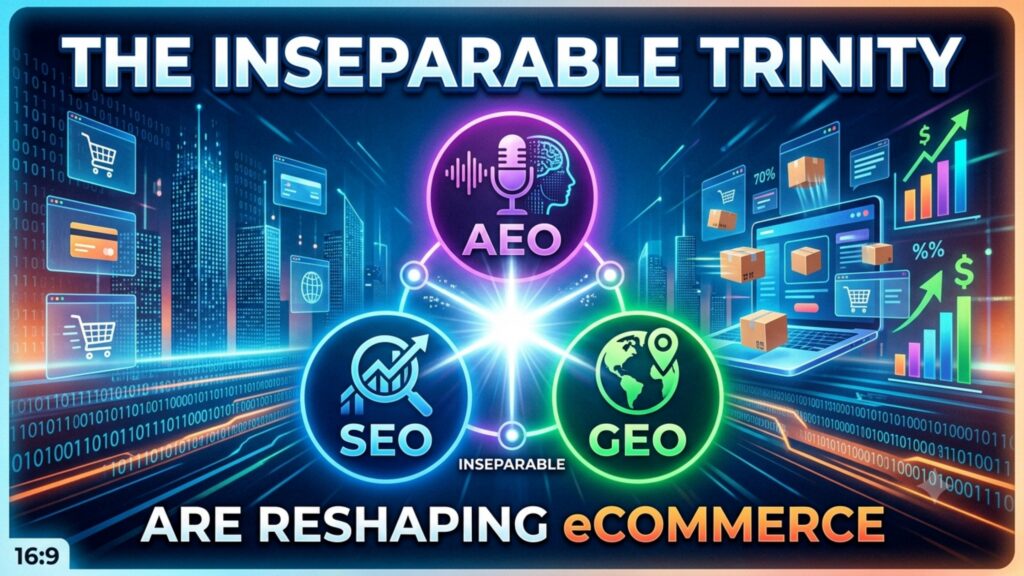
From our ongoing coverage of the startup ecosystem’s evolution — where we previously explored how AI-native tools, no-code infrastructure, and global remote hiring have redefined what it means to launch a company in this era — we now turn to the invisible architecture determining which startups get discovered and which disappear. The startup ecosystem is shifting beneath our feet. Five years ago, a founder could succeed with basic SEO optimization and a functional Shopify store. Today, that founder is competing against invisible forces — algorithms, AI systems, and generative search engines that decide who gets discovered and who doesn’t. This isn’t about ranking anymore. It’s about being cited. The Core Insight: How Startups Are Getting Left Behind When we think about eCommerce growth, most founders still operate within a framework built for 2018. They optimize for Google rankings, they run Facebook ads, and they wonder why their customer acquisition costs are climbing while their organic visibility flatlines. The problem isn’t their work — it’s their toolset. According to recent industry data, 58.5% of US Google searches now end without a single click to any external website. For startups in Africa, the Middle East, and the USA, this represents both a crisis and an opportunity. The crisis is obvious: your website alone is no longer enough. The opportunity is deeper — it means you can win by optimizing for where customers actually discover you. But here’s what most startup founders miss: the three search channels — traditional SEO, Generative Engine Optimization (GEO), and AI Engine Optimization (AEO) — are not separate strategies. They’re interconnected systems that require coordinated investment. This is a reality I have tracked closely through two years of SEMrush agency partnership work across Gulf real estate, East African e-commerce, and international consulting markets. The data infrastructure I use daily — the same platform trusted by 30% of Fortune 500 companies — confirms what the broader industry is now waking up to: the businesses compounding revenue in 2026 are not the ones with the highest traditional rankings. They are the ones with the most complete visibility across all three search layers. As I detailed in my analysis of what New York businesses are missing about SEO in the age of AI search, a business that ranks number one for a high-value query in 2026 may be receiving a fraction of the traffic that position delivered in 2022 — because AI Overviews, featured snippets, and People Also Ask boxes are absorbing the click. Understanding the Trinity: SEO, GEO, and AEO Traditional SEO: Still the Foundation, But Evolving Search Engine Optimization remains foundational, but the game has changed. AI Overviews now appear on approximately 48% of all tracked Google queries — up 58% year-over-year from 30% just a year ago. This matters for your eCommerce store because: The traffic drain is measurable and severe. When an AI Overview appears, organic click-through rates can fall by as much as 61% on desktop, with position #1 losing roughly 58% of its clicks. Even more alarming: only 17% of AI Overview citations now come from pages ranking in the organic top 10 — meaning citation presence is an entirely separate visibility layer from traditional ranking. For an eCommerce startup, this means: Content Optimization Tip: Use tools like SurferSEO to analyze what top-ranking content actually covers — not just keywords, but entities, topics, and semantic depth. Surfer’s Content Score system is trained on what drives visibility in both Google and AI search, helping you engineer content that algorithms and AI systems cite. The infrastructure reality: Technical performance is not abstract. In my guide to unlocking the power of eight tools that supercharge website performance, I break down how Cloudflare’s edge caching reduces Time to First Byte by 52% and improves Largest Contentful Paint by 33%. For eCommerce stores serving buyers across Africa and the Gulf from a single origin server, this geographic performance distribution is decisive — 73% of pages with good Core Web Vitals scores rank in the top 10 versus 53% of pages with poor scores. A site that loads in 4 seconds on mobile is penalised in traditional rankings, excluded from featured snippets, and unlikely to be cited by generative systems that prioritise fast, reliable sources. GEO (Generative Engine Optimization): The New Layer Generative Engine Optimization (GEO) is the strategy of getting your brand cited and recommended by generative AI systems like ChatGPT, Google Gemini, Perplexity, and others. This is where most startups are blind. The scale is staggering: ChatGPT now handles approximately 2.5 billion prompts per day and has grown to roughly 900 million weekly users. When a customer asks ChatGPT “What are the best sustainable African fashion brands?” your store only shows up if: The math is striking: AI referral traffic grew 527% year-over-year between early 2024 and 2025. Even more compelling: AI-referred visitors convert at 4.4x the rate of traditional organic visitors. If your eCommerce store isn’t optimized for GEO, you’re not just losing traffic — you’re losing your highest-intent potential customers before they even know you exist. For eCommerce founders, GEO optimization means: Getting Started with GEO: HubSpot’s Paid AEO Platform HubSpot’s paid AEO platform ($50/month standalone or $45/month annually) tracks how your brand appears in AI answers across ChatGPT, Perplexity, and Gemini, with integrated recommendations to close visibility gaps. For eCommerce founders, this tool is invaluable — it shows you exactly which products and brand mentions are earning citations in AI responses, and what content changes will move the needle. This aligns directly with what I monitor through SEMrush’s AI visibility tracking — available through the agency platform — which tracks not just where you rank, but whether your brand and content are being cited in AI-generated search responses. For businesses investing seriously in organic search, this metric is no longer optional. It is the leading indicator of where organic traffic is heading. AEO (AI Engine Optimization): Future-Proofing Your Store AI Engine Optimization (AEO) goes further — it’s about optimizing for how large language models understand,
Meet Fapulsester: The Startup Revolutionizing African and Middle Eastern Luxury Fashion

For three years I lived and worked in Bahrain. I sat in majlis rooms in Manama, attended corporate events at the Financial Harbour, walked through the malls of Adliya, and watched how people in this part of the world dressed — and how seriously they took it. Fashion in the GCC is not vanity. It is identity. It is family pride. It is how you show up for Eid, for a wedding, for a business meeting that matters. It is cultural language. And in those same three years, I kept meeting African professionals — Nigerians, Kenyans, Ugandans, Ghanaians — who were navigating the same city I was, but carrying an additional weight. They had two fashion worlds to dress for. Their GCC professional life demanded one wardrobe. Their community — the church on Friday, the Eid celebration with their Muslim colleagues, the wedding of a friend flying in from Lagos — demanded another. They wanted to wear their Ankara. Their Kente. Their Agbada. But there was nowhere to buy it that felt premium enough for who they had become. I grew up in Uganda. I understand what it means to carry your heritage into rooms that were not designed with you in mind. That tension — between two worlds, two aesthetics, two occasions — is exactly what Fapulseter was built to resolve. The Gap I Could Not Unsee I have spent over seven years working in SEO, paid media, and revenue growth. I have worked across e-commerce, real estate, healthcare, events, and corporate sectors in the Gulf and in Africa. I have helped businesses generate millions in revenue and reach millions of people. But when I looked at the global luxury fashion market — a $1.7 trillion industry — I kept seeing the same blind spot. Farfetch. Net-a-Porter. Mytheresa. These are extraordinary platforms. They have changed how luxury fashion is bought globally. But they were built for a specific consumer: broadly Western, broadly secular, broadly one-dimensional in their cultural needs. The GCC woman shopping for Ramadan was an afterthought. The African professional in Dubai looking for a bespoke Agbada for his brother’s wedding in Accra was invisible. Modanisa understood one part of this — the modest fashion market — and built a billion-dollar business on that insight alone. Afrikrea understood African designers needed a marketplace. But nobody had connected both worlds. Nobody had built for the woman in Riyadh who wants a luxury abaya for Eid and an Ankara kaftan for her Nigerian colleague’s baby naming ceremony. Nobody had built for the man in Bahrain who wants a tailored Emirati kandura and a hand-embroidered Agbada shipped from Lagos. That consumer exists. I know her. I know him. I have had dinner with them. So I built Fapulseter. What Fapulseter Actually Is Fapulseter is not an online store. I want to be precise about that, because the distinction matters. We are building the digital infrastructure that powers African and Middle Eastern luxury fashion globally. The platform today combines intelligent fashion discovery, an AI styling concierge, voice shopping, image-based product search, designer onboarding, and custom luxury order management — all inside a single premium shopping experience. At the heart of it is Layla — our AI stylist. Layla is not a chatbot. She is not a recommendation algorithm dressed up in conversational language. Layla understands your occasion. She knows the difference between dressing for a Saudi wedding and dressing for a Kuwaiti ghabga. She understands what full modest coverage means in Qatar versus what it means in Bahrain. She knows that if you are attending a Yoruba naming ceremony in Dubai, you may need complementary aso-ebi accessories, not just a dress. She speaks the cultural language of our customers. And when what you need does not exist in our catalogue, Layla connects you directly to an artisan who will make it for you. That is bespoke commissioning built into the discovery journey. No major luxury platform offers this. Farfetch cannot. Net-a-Porter cannot. It would require them to rebuild their entire operating model. We designed for it from day one. Why Bahrain. Why Now. People ask me why I chose Bahrain as our headquarters. The answer is both strategic and personal. Strategically, Bahrain sits at the centre of the GCC’s $300 billion luxury market. It is one of the most progressive business environments in the Gulf — progressive legislation, zero personal income tax, free trade agreements, and an increasingly international professional class that is exactly the consumer Fapulseter serves. The Bahrain Economic Development Board has been explicit about its ambition to attract digital and creative economy businesses. We intend to be part of that story. We are establishing a physical headquarters in Manama — a minimal but intentional retail presence. Not a warehouse. Not a pop-up. A curated space where clients can experience Fapulseter in person, where designers can meet customers, and where bespoke commissions can be managed locally with speed and care. Local fulfilment for GCC customers. That matters in a market where trust is built through proximity. Personally, Bahrain is where I built my professional credibility. My client relationships in the Gulf — in real estate, corporate services, motor industry — taught me how this market thinks, what it trusts, and what it demands from a premium brand. You cannot learn that from a market report. I lived it. And from Bahrain, we scale through ambassadors — not branches. Nigeria. Kenya. The UAE. The United Kingdom’s African diaspora. Each market has community leaders, influencers, and cultural connectors who understand their fashion ecosystem better than any central office ever could. We bring them into the Fapulseter family and give them the infrastructure. They bring the trust. The Technology Is the Differentiator I come from a background in web intelligence. I have built SEO and paid media systems for businesses across Gulf markets and African businesses. I understand how platforms are found, how they convert, and how they retain. Fapulseter is built on that understanding from the ground up. Our platform uses
From a Family Electronics Business to Digital Strategy: My View of Africa’s Tech Evolution

For more than two decades, our family business has operated within one of the most important economic shifts in African history: the rise of affordable mobile technology powered largely by Chinese manufacturing. Long before “digital transformation” became a global policy phrase, Chinese electronics brands were already transforming everyday African life from the ground up. In Uganda and across Africa, brands like Tecno, Itel, Infinix, and Redmi did something many Western companies failed to understand at the time: they built for the realities of the African consumer. They developed devices with: This was not simply about selling phones. It was the beginning of Africa’s modern digital infrastructure. China’s Role in Africa’s Digital Transformation The impact of China on Africa’s digital economy goes far beyond manufacturing. Chinese technology ecosystems accelerated: For millions of Africans, the first internet experience did not happen on a desktop computer. It happened on a Chinese-made smartphone. That single shift changed consumer behavior, communication patterns, business models, and even political discourse across the continent. Today, Africa’s digital economy is one of the fastest-growing in the world because mobile technology became accessible to ordinary people — not just elites. Watching Consumer Behavior Changed My Perspective Growing up around the electronics business exposed me to something deeper than retail. I became fascinated not only by the devices people bought, but by what happened after they turned them on. I started observing: That curiosity pushed me beyond phone sales. I wanted to understand the systems behind digital growth. I wanted to understand: That journey led me into web development, SEO, digital marketing, sales funnels, and startup advisory. Building Digital Infrastructure Beyond Hardware Over the years, I transitioned from simply participating in Africa’s electronics economy to helping businesses build their digital presence and growth infrastructure. Today, my work spans multiple areas of digital transformation. Website Development and Digital Presence I have spent years building and managing websites for businesses across different sectors, helping organizations move from offline visibility into fully functional digital ecosystems. This includes: I learned early that in Africa’s mobile-first economy, websites are no longer optional. They are commercial infrastructure. SEO and Search Visibility As smartphone usage increased, search behavior became one of the most powerful economic drivers in Africa. I specialized in SEO to help businesses: My work in SEO expanded into: This became especially important as African businesses increasingly sought visibility beyond local markets. Paid Media and Digital Advertising With over five years of experience in paid media and more than $12,000 spent in advertising campaigns, I have worked extensively with: This work helped businesses understand not only how to get traffic — but how to convert attention into revenue. Supporting African Entrepreneurship and Startups My involvement in digital transformation also expanded into startup ecosystems across Africa and the Middle East. Through engagements connected to organizations such as Doola based in USA and Flat6Labs, Startup Uganda, and International Trade Centre, I gained exposure to how emerging markets are building innovation ecosystems. This experience reinforced something important: Africa’s future will not only be shaped by technology consumers. It will be shaped by African builders. The Next Phase of Africa’s Digital Economy The next decade of African digital transformation will likely move beyond smartphone access into: China will continue to play a major role in this transformation through: But Africa itself is also evolving from being only a consumer market into a producer of digital innovation. Why This Matters Personally For me, this journey started in a phone business. But the phones became a gateway into understanding how technology reshapes human behavior, commerce, and opportunity. Watching customers move from: gave me a front-row seat to Africa’s digital evolution. That evolution inspired me to build skills and businesses that contribute directly to digital transformation rather than remaining only in retail distribution. Today, whether through SEO, web infrastructure, startup advisory, digital advertising, e-commerce systems, or content strategy, my work is centered around one idea: Helping African businesses and entrepreneurs compete effectively in a global digital economy. And in many ways, that journey began with a simple observation inside a family electronics business: Technology does not only change devices. It changes behavior, markets, industries, and the future of entire continents.
Your Startup Doesn’t Have Borders. Your Advisor Shouldn’t Either

Most startup advisors work in one market. They understand Silicon Valley or they understand Lagos or they understand the Gulf. They have one network, one mental model of how startups get built and funded, and one set of assumptions about what founders need to succeed. I have spent the last several years building something different — not by design at first, but by the accumulation of real relationships, real presence, and real work across three of the world’s most consequential emerging startup ecosystems: Africa, the Middle East, and America. This is the story of how that happened — and why the three-market startup advisory practice I am building from Austin, Texas is the model that the next generation of global founders actually needs. The Three Markets — And Why Each One Matters 🌍 Africa — The Demographic Engine Africa has 1.4 billion people. By 2050 it will have 2.5 billion — the youngest, fastest-growing population on the planet. Its digital economy is accelerating at 17% annually. Its mobile money infrastructure has leapfrogged banking systems that took Western markets a century to build. Its startup ecosystem has produced unicorns in fintech, logistics, healthcare, and agriculture across Nigeria, Kenya, South Africa, and Egypt. But Africa’s startup ecosystem has a persistent structural problem: most of its most promising founders cannot access the capital, the market validation, or the global distribution networks that would allow their businesses to scale beyond their home markets. My entry into Africa’s startup ecosystem came through direct, operational involvement — not observation from the outside. During Kampala Innovation Week — Uganda’s first hybrid event, which I was consulted to launch for Talent Africa Group — I encountered and engaged with three of the continent’s most significant startup infrastructure organisations: the International Trade Center, Startup Uganda, and Startup Africa. The International Trade Center connects African SMEs and startups to global trade networks. Startup Uganda is the national backbone for Uganda’s entrepreneurship ecosystem. Startup Africa, convened during Kampala Innovation Week, brings together founders, investors, and ecosystem builders from across the continent. Being physically present at this convergence — not as an observer but as the person who built the digital campaign that put 1,000+ people in the room — gave me a specific kind of access to Africa’s startup community that most international advisors do not have. I understand what Ugandan and East African founders are building, what they need, and what the gap is between where they are and where they want to go. 🏙️ Middle East — The Capital Gateway The Gulf is one of the world’s most underappreciated startup ecosystems — not because the ecosystem is weak, but because Western media has been slow to recognise what has been built. Flat6Labs is the leading entrepreneurship platform in emerging markets, empowering entrepreneurs to build, launch, and grow transformative ideas through acceleration programs, ecosystem development, and tailored innovation services. Flat6Labs Bahrain is a seed program supported by Tamkeen that accelerates and launches both local and international startups in the Kingdom of Bahrain — each cycle selecting 8–10 promising teams to receive cash funding, strategic mentorship, office space, and a multitude of partner perks and services. Flat6Labs Bahrain was created in partnership with Tamkeen — the Labour Fund — with the aim of fostering a dynamic and sustainable entrepreneurship environment, supporting job creation, and helping position Bahrain as an innovation leader in the Arabian Gulf region and MENA at large. My relationship with the Gulf’s startup ecosystem was built during the years I spent working in Bahrain — attending Flat6Labs events, engaging with Startup Bahrain, and operating inside the Tamkeen-backed entrepreneurship infrastructure that the Bahraini government has deliberately constructed to attract and develop founders from across the region and beyond. Flat6Labs invests $30,000 to $250,000 in startups and has helped hundreds of companies scale, with cohorts that are highly competitive but provide unmatched investor network and mentorship access. The Gulf’s startup ecosystem has three things that Africa’s ecosystem frequently lacks: sovereign wealth fund capital, regulatory clarity for fintech and digital businesses, and proximity to the global financial infrastructure that allows startups to scale internationally. Gulf-backed startups can access Saudi Arabia’s Vision 2030 investment, the UAE’s global connectivity, and Bahrain’s fintech regulatory sandbox — infrastructure that most African startups have to route through European or American intermediaries to access. 🇺🇸 America — The Scale Infrastructure The American market is not where most startups begin. It is where the ones that want to scale globally need to arrive. Doola is a YCombinator-backed (YC S20) “Business-in-a-Box” platform that empowers global founders by helping them set up a US business without handling complex paperwork — today, people on every continent have launched companies with doola. Doola has launched its Business-in-a-Box for E-Commerce — the first solution that brings the entire back-end of e-commerce into one place: LLC formation, compliance, multi-state tax rules, bookkeeping, financials, and business analytics across Shopify, Amazon, and beyond. It has already helped 10,000+ entrepreneurs from 175+ countries scale to seven figures. My engagement with Doola is not simply about having registered amdan.pro LLC in Austin, Texas. It is a strategic partnership built around a shared understanding of what globally-minded founders — particularly those from Africa and the Gulf — need when they decide to build for the American market. Doola’s AI Co-Founder is built for global e-commerce entrepreneurs and automates tasks that usually drain founders’ time — banking and payments, compliance and filings, bookkeeping, and US tax guidance — with no US Social Security Number required, fluent in 175+ countries’ unique challenges. For an African or Gulf founder who wants to launch a Shopify store, an Amazon FBA business, or a US-registered SaaS company, Doola removes the back-office complexity that would otherwise require a US-based lawyer, accountant, and compliance specialist. For my startup advisory practice, the Doola partnership means I can walk a Ugandan e-commerce founder or a Bahraini SaaS company directly into the American market without the infrastructure friction that has historically been a barrier. Why Three Markets Is
The $14,400 Question Every Service Business Needs to Answer About Their Software Stack
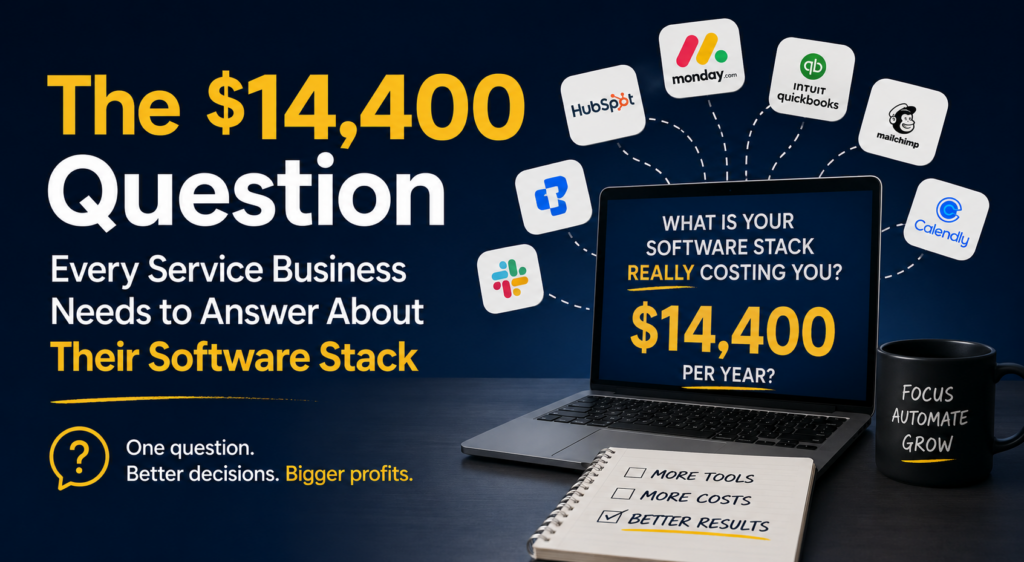
The Marketing Stack Audit: How to Calculate ROI & ROMI on Every Tool You Pay For .Most businesses have a software problem they don’t know they have. They are paying for 8, 10, sometimes 15 tools every month. Some of those tools are generating significant revenue. Some are sitting largely unused. Some are duplicating functions that another tool in the stack already covers. And almost none of the businesses paying for these tools have done the calculation that would tell them which category each tool falls into. The result: the average SaaS company uses 91+ tools in 2026, with at least 50% of SaaS licences underutilised or unused. Money that should be compounding into revenue is funding software subscriptions that are delivering no measurable return. This article is the framework for fixing that — specifically applied to the growth intelligence stack we use in every client audit: SEMrush, HubSpot, ClickFunnels, Leadpages, Apollo, Google Analytics, Google Tag Manager, Google Search Console, Hotjar, QuickBooks, and Kit (ConvertKit). Each tool has a job. Each tool has a cost. And each tool should be generating a return that justifies that cost — or it should be cut. The Two Metrics That Matter: ROI vs ROMI Before calculating anything, the definitions matter — because ROI and ROMI are measuring different things, and confusing them produces misleading conclusions. ROI (Return on Investment) measures the total return on any investment relative to its cost: ROI = (Revenue Generated − Total Investment) ÷ Total Investment × 100 If your total revenue is $200,000 and marketing spending is $50,000, then: $200,000 − $50,000 = $150,000 net profit. ROI = $150,000 ÷ $50,000 × 100 = 300%. For each dollar you spend on marketing, you earn $3 in profit. ROMI (Return on Marketing Investment) focuses specifically on marketing activities — isolating the return from marketing spend versus overall business investment: ROMI = (Revenue Attributable to Marketing − Marketing Investment) ÷ Marketing Investment × 100 ROMI focuses specifically on marketing activities and provides a more granular view of marketing effectiveness. If your company spent $50,000 on a campaign that generated $200,000 in revenue, ROMI = [($200,000 − $50,000) / $50,000] × 100% = 300%. For software stack analysis, you need both: The Full Software Cost Audit: What You Are Actually Spending Before calculating returns, you need an honest inventory of costs. Most businesses underestimate their software spend because they look at individual tools in isolation rather than the cumulative stack. Here is the Growth Intelligence Stack we use in client audits — with approximate monthly costs at standard tiers: Tool Function Est. Monthly Cost SEMrush SEO, keyword intelligence, competitive analysis $140–$500 HubSpot CRM, email marketing, sales pipeline $50–$800 ClickFunnels Funnel building, landing pages $97–$297 Leadpages Landing pages, lead capture $37–$99 Apollo Lead generation, prospecting, outreach $49–$99 Kit (ConvertKit) Email marketing, sequences, automation $29–$99 Hotjar Website heatmaps, session recordings $32–$80 Google Analytics Website traffic analysis Free Google Tag Manager Tag and tracking management Free Google Search Console Search performance monitoring Free QuickBooks Accounting, invoicing, financial tracking $30–$90 AWS / GoDaddy / Shopify / WordPress Hosting, e-commerce infrastructure $20–$300 Total (mid-tier estimate) ~$561–$2,463/mo At a mid-tier stack running $1,200/month, your software costs $14,400 per year before a single dollar of ad spend, freelancer cost, or your own time. That $14,400 is an investment. It needs to produce a return that justifies it — ideally a ROMI of at least 300%, which means $43,200+ in attributable revenue from that investment. The question every business should be asking: is it? How to Calculate ROI Per Tool The framework for calculating ROI on each tool in your stack has three steps: Step 1 — Assign Each Tool a Revenue Function Every tool in a growth stack should have a specific, measurable role in generating or protecting revenue. If you cannot articulate what revenue function a tool serves, that is a problem. SEMrush → Organic traffic growth → leads from organic search → revenue HubSpot → Lead capture, nurturing, CRM → conversion of leads to clients → revenue ClickFunnels/Leadpages → Paid traffic conversion → leads from paid ads → revenue Apollo → Outbound prospecting → booked calls → revenue Kit/ConvertKit → Email sequences → lead nurture → revenue Hotjar → Conversion rate optimisation → improved checkout/funnel performance → revenue QuickBooks → Financial management → invoicing accuracy, tax compliance → cost avoidance Google tools → Traffic measurement, search visibility → optimisation decisions → revenue Step 2 — Measure the Revenue Each Tool Contributes This requires attribution — connecting the revenue you generate to the tools that contributed to generating it. There are several approaches: multi-touch attribution assigns value to each marketing touchpoint in the customer journey. In practice, for most small and medium businesses, a simplified attribution model works: For SEMrush: Track organic traffic in Google Analytics. Calculate what percentage of your leads come from organic search. Apply that percentage to your revenue to get organic revenue. Compare to SEMrush’s monthly cost. For HubSpot: Track leads captured through HubSpot forms and sequences. Track which leads converted to paying clients. Calculate revenue from HubSpot-sourced clients. Compare to HubSpot’s monthly cost. For ClickFunnels/Leadpages: Track leads generated per landing page using UTM parameters and Google Analytics. Calculate conversion rate and revenue from those leads. Compare to platform cost. For Apollo: Track outbound sequences sent, replies received, calls booked, and clients closed. Calculate revenue from Apollo-sourced clients. Compare to Apollo’s monthly cost. For Kit/ConvertKit: Track email open rates, click rates, and — most importantly — revenue from email-triggered purchases or bookings. Compare to platform cost. For Hotjar: Calculate improvement in conversion rate since implementation. Apply conversion rate uplift to your traffic volume and average transaction value to estimate revenue impact. Compare to Hotjar’s monthly cost. Step 3 — Apply the ROI Formula Per Tool Tool ROI = (Revenue Attributed to Tool − Tool Monthly Cost) ÷ Tool Monthly Cost × 100 Example — SEMrush at $140/month: Example — Apollo at $49/month: These numbers illustrate why high-performing tools deserve more investment
The African Investor’s Guide to Bitcoin: Complete allocation calculator and market cycle tactics included

African investors face unique challenges: volatile local currencies, high inflation, expensive cross-border transfers, and limited access to stable global assets. Bitcoin and complementary tools like stablecoins offer powerful solutions for hedging risks, facilitating payments, and building long-term wealth. This guide provides a practical Bitcoin Strategy Framework tailored for African investors, with a USD-focused approach. It leverages platforms like Noones for P2P trading and access to local payment methods across Africa, alongside Blockchain.com‘s robust wallet, exchange, and investment tools. 1. Understanding Currency Risk in Africa — Why Bitcoin Matters Now Many African currencies have faced significant devaluation and high inflation. Nigeria’s naira, for example, has lost substantial value in recent years, while other nations grapple with similar pressures. Holding savings solely in local fiat exposes investors to erosion of purchasing power. Bitcoin as a hedge: Often called “digital gold,” Bitcoin has a fixed supply of 21 million coins, making it resistant to the inflationary printing common in fiat systems. It has historically performed well as a store of value during periods of currency instability. Stablecoins for stability: USD-pegged assets like USDT and USDC act as a bridge. They offer dollar-like stability while enabling fast on-chain transfers. In Africa, stablecoins now dominate many P2P trades, serving as a practical USD proxy. Actionable tip: Diversify holdings — e.g., 40-60% in Bitcoin for growth potential, 30-50% in stablecoins for stability, and the rest in local assets or cash for liquidity. 2. Cross-Border Payments: From Expensive and Slow to Instant and Affordable Traditional remittances and business payments in Africa often incur 6-10%+ fees, take days to settle, and involve multiple intermediaries. Crypto changes this. How Bitcoin and stablecoins help: Noones advantage: Peer-to-peer marketplace with escrow protection, direct fiat-to-crypto ramps using popular African payment options, and strong support for stablecoins. Ideal for remittances, trade invoices, or diaspora payments. Open Noones account here ……… Blockchain.com tools: Secure wallets for holding and sending BTC or stablecoins, with easy tracking and institutional-grade features. Framework step: Use stablecoins for day-to-day cross-border needs and Bitcoin for larger, longer-term transfers or savings. 3. Long-Term Wealth Building: A USD-Denominated Bitcoin Strategy Treat Bitcoin as a core portfolio asset rather than pure speculation. Core Bitcoin Strategy Framework (USD Edition): Integration with Noones × Blockchain.com: Buy/ trade P2P on Noones with local currency, transfer to Blockchain.com for secure storage, advanced charting, or institutional services. This creates a seamless on-ramp, custody, and strategy engine. 4. Practical Steps to Get Started as an African Investor // Bitcoin Strategy Framework — USD Edition Noones × Blockchain.comInvestment Engine Buy on P2P → Store safely → Earn passively. Don’t trust either platform with everything. NOONES — ENTRY/EXIT BLOCKCHAIN.COM — HOLD/EARN // 01 — Platform Roles Noones Access Gateway Peer-to-peer marketplace for buying BTC with cash or bank transfer. Your fiat ↔ crypto bridge. Buy BTC with USD via P2P Fiat ↔ crypto conversion Only escrow-enabled traders Move funds immediately after purchase Entry Only Blockchain.com Storage + Yield Tool Wallet, optional exchange, and earn feature. Use for holding and generating passive income. Hold BTC long-term Earn ~8% APY on a portion Not a full custodial trust platform Keep earn % low — platform risk is real Hold + Earn // 02 — Three-Step Flow 1 NOONES Buy BTC via P2P Use Noones to purchase Bitcoin with USD. Trade ONLY with high-rated vendors, escrow always ON. Never leave funds sitting on the P2P platform — withdraw immediately after every trade. 2 BLOCKCHAIN Split & Secure Your Stack Transfer your BTC to Blockchain.com wallet (or ideally a private wallet). Separate your “wealth core” from your yield portion. This separation is the foundation of the entire strategy. 3 BOTH Allocate: Hold vs. Earn 70–80% stays in cold/warm storage for long-term appreciation. 20–30% goes into Blockchain.com Earn at your chosen APY. This creates monthly income without gambling your wealth core on platform risk. // 03 — USD Investment Calculator Monthly Investment Planner Enter your monthly USD amount, adjust the hold/earn split and yield rate to see projected returns. Monthly investment $ USD / month Earn APY rate 5% 8% 10% 12% Hold allocation 75% HOLD / 25% EARN HOLD — 75% EARN — 25% HOLD EARN Hold Amount $3,750 USD / month→ BTC long-term storage Earn Amount $1,250 USD / month→ Blockchain.com Earn Monthly Yield $8.33 USD passive income→ from earn portion Annual Yield $100 USD / year→ from earn portion 12-Month Hold Stack $45,000 USD in BTC→ pre-growth value Bull Case (2× BTC) $90,000 USD at 2× BTC growth→ cycle dependent ★ Hold stack over 12 months: $45,000 in BTC. At 2× BTC growth = $90,000+. Yield adds $100/yr passive income on top. // 04 — Market Cycle Strategy 🐻 Bear Market Accumulation Mode → Buy heavily via Noones (prices cheap) → Keep yield earn active for income → Stack aggressively into hold wallet → Yield supplements lost upside 🐂 Bull Market Growth Mode → Move OUT of earn, keep BTC liquid → Price growth far exceeds any APY → Watch for exit signals at cycle peaks → Use Noones to convert BTC → USD if needed // 05 — Risk Flags ⚠ Critical Mistakes to Avoid ✕Leaving BTC on Noones after a trade — P2P platforms are not wallets ✕Putting 100% of BTC into yield — platform risk is real, Blockchain.com has had issues ✕Trading with low-rated vendors or skipping escrow on P2P — scams are common ✕Staying in yield during a bull run — you’ll underperform vs simply holding BTC // 06 — The One-Line Strategy // Final Truth Buy cheap on Noones →Store safely on Blockchain wallet →Use small % for yield to earn monthly income Noones = Access (buy/sell) Blockchain.com = Tool (hold/earn) Bitcoin = Wealth Engine Risks and Responsible Investing Bitcoin is volatile. Regulatory changes, security threats, and market cycles exist. Always DYOR (Do Your Own Research), diversify, and consider professional advice. Start small and scale responsibly. Conclusion: Bitcoin as Financial Sovereignty for African Investors For African investors, Bitcoin isn’t just
He Protected America for 28 years,ran for Congress Texas and taught me how to win in Business

Commander Furman retired after 28 years of military service — a career that took him across the Gulf, the Pacific, and the strategic command centres where America’s most consequential operational decisions are made. He attended Texas A&M University and the Naval Postgraduate School, and he carried the discipline of both institutions into every briefing, every decision, and every conversation I was fortunate enough to be part of. Today, Commander Furman is running for Congress in Texas’ redrawn 35th Congressional District — South Texas, San Antonio, a region he calls home and a community he has committed to representing with the same clarity of purpose he brought to 28 years of military service. I mention this not for political reasons. Commander Furman’s campaign is his own — and Texas voters will make their own judgement. I mention it because the mentorship he gave me in Bahrain in 2019 is directly connected to how I approach every client engagement I run today — and because the strategic lessons I learned from a man shaped by Texas, the US Navy, and decades of high-stakes operational decision-making are exactly the lessons that Texas businesses need to hear about digital growth in 2026. What a Navy Commander Taught Me About Business Strategy Commander Furman’s approach to decision-making was shaped by a principle that military leadership calls situational awareness — a clear, honest, continuously updated picture of the operating environment that precedes every decision. In Bahrain, I watched him apply this with a discipline I had never encountered in a business context. Before any resource was allocated, before any action was taken, before any communication was issued — the question was always the same: what does the environment actually require? Not what do we prefer. Not what do we have. What does the situation demand? I was running my own web design, development, and hosting business at the time — already two years into building client campaigns, running Facebook ads, and integrating digital systems for businesses across Uganda and the Gulf. The Commander’s framework did not replace what I knew. It restructured how I applied it. The outside-in discipline — starting with the market, the customer, and the competitive environment before deciding what to do — became the foundation of every audit, every strategy, and every recommendation I have made since. It is also, I have come to believe, the discipline that most Texas businesses are missing in their digital marketing in 2026. The Texas Digital Landscape in 2026 Texas is not a single market. It is five or six markets operating simultaneously — each with distinct demographics, competitive dynamics, and digital behaviour patterns. The Houston energy corridor behaves differently from Austin’s tech corridor. San Antonio’s military-adjacent economy — shaped by Fort Sam Houston, Lackland Air Force Base, Randolph AFB, and the naval presence that Commander Furman served — has different buyer psychology than Dallas-Fort Worth’s financial and corporate services concentration. South Texas’ border economy, which sits at the heart of Commander Furman’s congressional district, operates with different infrastructure constraints and different digital adoption curves than the Texas Triangle’s major metropolitan centres. What they share is this: every one of these markets is being transformed by the same forces reshaping digital visibility across the US — AI search, shifting consumer behaviour, and the declining reliability of tactics that worked three years ago. The 4 Things Texas Businesses Are Getting Wrong Online 1. Treating SEO as a One-Time Project The most common digital marketing mistake I encounter in Texas businesses — particularly in San Antonio, Houston, and the South Texas corridor — is treating SEO as a project with a beginning and an end. A website is built. An agency is hired for a three-month SEO engagement. Rankings improve. The engagement ends. Twelve months later, the rankings have slipped, the agency is gone, and the business owner is trying to understand what happened. SEO in 2026 is not a project. It is an ongoing operational function — like accounting or customer service. The businesses that hold their organic positions through Google’s algorithm updates, through the AI search transition, and through competitive market shifts are the ones with continuous, disciplined attention to their digital presence — not the ones who treated it as a one-time fix. Commander Furman’s military background included continuous intelligence updates and strategy adjustments. The operating environment changed. The plan adapted. Texas businesses need to approach their digital presence the same way. 2. Running Ads Without Understanding the Customer’s Journey Texas has some of the most sophisticated advertising markets in the United States. Houston’s energy sector, Dallas’s financial services, Austin’s tech ecosystem, and San Antonio’s defence and healthcare industries all attract serious ad spend — and serious competition. The businesses losing money in these markets are almost universally making the same mistake: running ads without mapping the customer’s journey from first awareness to final decision. A San Antonio defence contractor running Google Ads to a homepage. A Houston energy services company running Facebook ads to a contact form with no prior relationship established. An Austin SaaS company spending $10,000 per month on paid search and sending traffic to a product page that converts at 0.8%. The ad is not the problem. The journey is. As I learned from Commander Furman — and from two years of working daily with SEMrush’s competitive intelligence data — the strategy must account for the full operating environment, not just the moment of engagement. 3. Ignoring the AI Search Transition Texas businesses in professional services — legal, financial, healthcare, real estate — are facing the same AI search disruption that is affecting every major US market, but with a specific Texas dimension. The queries that Texas buyers use to find professional service providers — “real estate attorney San Antonio,” “financial advisor Houston,” “SEO consultant Austin,” “digital marketing agency Dallas” — are precisely the kinds of commercial queries where Google’s AI Overviews are most aggressively inserting synthesised answers before the first organic result. A law firm that has spent three
Understanding Texas Business Landscape: Strategy Leadership and Execution

Texas Business Landscape: Digital Marketing & SEO Strategy | Amdan.pro amdan.pro Digital Marketing SEO Strategy Work With Me Market Intelligence Texas’ Business Landscape:What It Means for YourDigital Marketing & SEO Texas is America’s fastest-growing major economy — and most brands competing here are still running digital strategies built for slower, smaller markets. Here’s how to close that gap. By Amdan · Digital Strategy · amdan.pro Texas is no longer a regional market that national brands can afford to treat as an afterthought. With a GDP that would rank it among the world’s top ten economies, a population growing faster than any other major state, and a business environment actively pulling corporations, talent, and capital away from traditional coastal centers — Texas has become one of the highest-stakes digital marketing battlegrounds in the United States. And most brands competing here are running generic strategies that were never built for this market. The opportunity — and the risk — is significant. Companies that localize their digital marketing and SEO for the Texas market gain real competitive advantages in search visibility, audience relevance, and customer acquisition cost. Those that apply national playbooks to Texas audiences consistently leave organic growth on the table and overpay for paid traffic that converts poorly. $2.5T+ Texas GDP — one of the world’s largest economies 62K+ Net new residents per month — fastest-growing major state #1 U.S. state for corporate relocations — 7 consecutive years Why Texas Demands a Distinct Digital Strategy The foundational mistake brands make in Texas is assuming that national SEO and digital marketing strategies translate directly to a state this large, this diverse, and this fast-moving. Texas is not a single market — it is four distinct metropolitan ecosystems with different industry concentrations, different search behaviors, different competitive landscapes, and different audience profiles, all operating under a shared cultural context that has its own values, communication norms, and trust signals. “Winning in Texas digital marketing means understanding that Austin, Dallas, Houston, and San Antonio are not the same market with different weather. They are different competitive universes.” — Amdan, Digital Strategy Advisor The implication for SEO is direct and practical. A law firm, a B2B technology company, a healthcare provider, or an ecommerce brand competing in Texas needs a geo-targeted content architecture, locally-anchored keyword strategy, and audience understanding specific to each major Texas market — not a single statewide approach that is too broad to dominate anywhere. The Four Texas Digital Markets Austin Tech & Startup Audience High digital sophistication. Search behavior skews toward product comparisons, startup resources, and growth-stage B2B services. Content must be substantive — generic performs poorly here. Dallas–Fort Worth Enterprise & Corporate Audience Fortune 500 decision-makers, financial services, and enterprise technology buyers. High-value B2B search with long consideration cycles. Trust signals and thought leadership content are critical. Houston Industrial, Energy & International Energy sector, healthcare, and international trade audiences. Multilingual search behaviors matter here more than in any other Texas market. Industry-specific content depth wins. San Antonio Defense, Cyber & Value-Driven Defense, cybersecurity, and cost-conscious professional audiences. An underrated SEO opportunity — lower competition than Austin or DFW, with real purchase intent in specialized verticals. The Texas SEO Opportunity: What Most Brands Miss The rapid influx of corporations and talent into Texas has created a search demand surge that organic content strategies have not yet caught up to. New residents searching for services, businesses establishing Texas presences and researching local vendors, and a growing professional class looking for Texas-specific industry intelligence — all of this represents search demand that is, in many verticals, still underserved by quality content. This is a genuine first-mover advantage window for brands that build Texas-focused content strategies now. The window will not stay open indefinitely. As more national brands recognize the Texas opportunity and invest in localization, the cost of entry into high-value Texas search positions will rise. The brands that establish topical authority and local search dominance in 2024 and 2025 will be structurally advantaged against later entrants. Where the SEO Gaps Are Based on the Texas business landscape analysis, the highest-opportunity content and SEO gaps cluster around several themes that map directly to the state’s economic evolution. Relocation and establishment content — companies and individuals relocating to Texas generate enormous search volume around legal, financial, real estate, HR, and operational questions that are specific to Texas regulatory and business environments. This is evergreen demand that grows with the state’s population. Industry-specific Texas content — the energy transition, the Texas tech ecosystem, the Texas Medical Center’s life sciences community, and the defense sector all generate professional search demand for deeply specialized content. Most national publishers cannot serve this with the depth Texas professionals expect. Texas B2B vendor search — as corporations establish or expand Texas operations, procurement teams search for Texas-based or Texas-knowledgeable vendors across every professional services category. Ranking for Texas-specific B2B intent queries is often significantly easier than ranking for national equivalents, with comparable or superior commercial value. Digital Marketing Strategy for The Texas Market Beyond SEO, Texas’ cultural and competitive characteristics demand specific adjustments to paid search, content marketing, and social media strategies that national playbooks rarely account for. Paid Search: What Changes in Texas Texas’ metropolitan markets have meaningfully different CPCs, audience compositions, and competitive dynamics than national campaigns assume. DFW’s concentration of corporate headquarters creates B2B paid search environments where competitor spending is high and generic creative performs poorly. Austin’s tech-savvy audience has high ad literacy — vague value propositions get scrolled past. Houston’s diversity and internationalism means ad copy that works in DFW may underperform in Houston without localization. Texas Market Paid Search Characteristics SEO Priority Austin High CPC in tech/SaaS verticals; ad-literate audience; strong organic preference Thought leadership content Dallas–Fort Worth Competitive B2B landscape; long cycles; LinkedIn complements search Enterprise intent keywords Houston Energy & healthcare verticals dominate; multilingual opportunity Industry depth + local San Antonio Lower competition; defense/gov adjacent; value-driven messaging Niche authority content Content Strategy: Meeting the Texas Standard Texas business culture has a
What New York Businesses Are Missing About SEO in the Age of AI Search
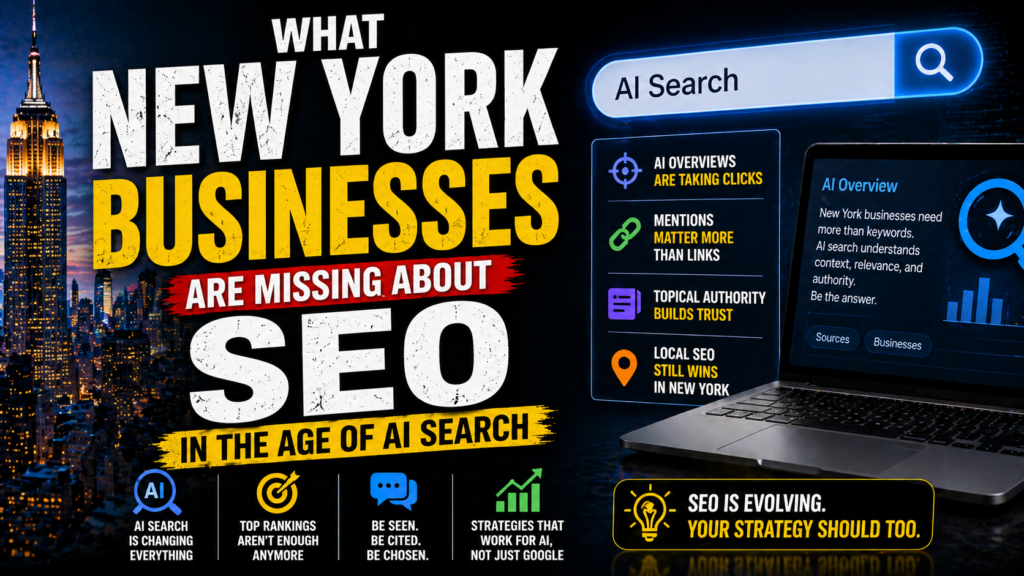
New York is one of the most competitive search markets in the world. Real estate. Finance. Legal. Healthcare. Hospitality. Professional services. Every major industry category in New York has dozens — sometimes hundreds — of businesses spending seriously on SEO, each trying to own the same commercial keywords. The competition for page-one organic positions in Manhattan alone would be considered fierce in most other markets globally. And in 2026, most of those businesses are competing for a prize that is quietly shrinking. The organic search result — the blue link that a New York law firm or real estate brokerage or financial advisory has spent years and tens of thousands of dollars trying to rank for — is being displaced. Not eliminated. Displaced. By AI Overviews that answer the query before the user ever sees a link. By featured snippets. By People Also Ask boxes. By Google’s increasingly aggressive insertion of its own content between the searcher and the result. The businesses that understand what is actually happening to New York’s search landscape in 2026 — and that have the data infrastructure to respond to it — are the ones that will hold their organic positions through this transition. The ones that don’t are watching their traffic decline without understanding why their rankings haven’t changed. This is the conversation that matters right now. And it is one I can have with data behind it — because for the past two years, I have held an agency partnership with SEMrush, one of the world’s leading online visibility management platforms, used by over 10 million marketers worldwide and trusted by 30% of Fortune 500 companies. What AI Search Is Actually Doing to New York’s Organic Traffic The number that every New York business owner and marketing director needs to understand first: nearly 60% of Google searches now end without a single click. The user searched. Google answered — via an AI Overview, a featured snippet, or a knowledge panel. No website was visited. No organic click was generated. A business that ranks number one for a high-value query in 2026 may be receiving a fraction of the traffic that position delivered in 2022. This is not a future risk. It is a current reality — and it is disproportionately affecting exactly the kind of informational and commercial queries that New York’s service businesses depend on for top-of-funnel organic acquisition. A Manhattan real estate firm that ranks first for “how much does it cost to buy an apartment in New York” is now likely watching Google answer that question directly in the AI Overview. A financial advisor who ranked for “best way to invest $100,000 in 2026” is watching Gemini synthesise an answer from multiple sources. A law firm that ranked for “employment lawyer New York” may find their result pushed below a local pack, an AI Overview, and three paid ads before the first organic click is available. Semrush launched Spotlight 2026, its flagship marketing conference in London on October 13, describing the event as designed to equip marketers with the strategies required to compete and win brand visibility in the AI search era — as the interconnections between SEO and AI Search become increasingly clear. The platform I have worked with for two years is now hosting conferences specifically about this transition. That is not a coincidence — it reflects where the entire SEO industry is moving. What a SEMrush Agency Partnership Actually Means Before explaining what New York businesses should do differently, it is worth being specific about what a SEMrush agency partnership provides — because it shapes how I approach every client engagement. SEMrush agency partners receive advanced training, priority support, co-marketing opportunities, and access to exclusive agency resources covering SEO, PPC campaign management, content marketing, competitive analysis, and online visibility. Every SEMrush Agency Partner is certified through SEMrush Academy and rated with an Agency Score — certifications that show clients the partner knows how to use SEMrush to help them get ahead. What this means in practice for clients: when I conduct a Growth Intelligence Audit, I am not working from general SEO principles or publicly available data. I am working from SEMrush’s proprietary data infrastructure — the largest keyword database in the industry, real-time ranking tracking, competitive gap analysis, backlink intelligence, and the platform’s new AI visibility monitoring that tracks how brands and their competitors appear in AI-generated search responses. SEMrush’s enterprise platform consolidates SEO, AI search, and site health in one place — leveraging first-class SEO and AI search data to help clients scale with proven, trusted infrastructure. Two years of working with this platform daily — running audits for clients across Gulf real estate, East African e-commerce, Ugandan event management, and international consulting businesses — has given me a depth of tool proficiency that directly translates into faster, more accurate diagnostic work for every client I engage. The data I pull for a New York business’s competitive analysis is the same data that 30% of Fortune 500 companies use to make their SEO decisions. That is not a marketing claim — it is the infrastructure reality of the platform. The 5 Things New York Businesses Are Getting Wrong in 2026 1. Optimising for Rankings Instead of Visibility The most common SEO mistake in New York’s competitive market in 2026 is treating keyword ranking position as the primary success metric. Ranking is a means to visibility. Visibility — being present wherever your buyers are forming intent, including in AI Overviews, featured snippets, Google’s AI Mode, and citation-based answers in ChatGPT and Perplexity — is the actual objective. A business that ranks number three for a valuable New York query but has zero AI visibility is more exposed than one that ranks number eight but appears consistently in AI-generated answers. The ranking tells you where you are in the traditional results. It tells you nothing about your presence in the surfaces that are increasingly capturing the first engagement with a searcher. SEMrush’s AI visibility tracking —
Dubai vs Bahrain: Where Should You Buy Property in 2026 — And Which Gets You a Golden Visa?

Two properties. Two Gulf markets. Two completely different investment outcomes. The first is a furnished 1-bedroom apartment in Hamza Tower, Dubai Sports City — 873 square feet, already tenanted, listed at AED 820,000 ($223,000). The second is a 1-bedroom apartment in Al Juffair, Bahrain’s Capital Governorate — 657 square feet, listed by ERA Real Estate at 41,000 BHD ($108,730). Both are in freehold zones. Both are in USD-pegged currency markets. Both are in established residential areas with consistent expat demand. But when you run the full comparison — purchase price, rental yield, net return, Golden Visa eligibility, and 10-year investor outcome — the picture is considerably more nuanced than the headline numbers suggest. This is the comparison every East African, South Asian, and emerging market investor looking at Gulf real estate needs to read before committing capital in 2026. The Properties: What You Are Actually Buying Property A — Hamza Tower, Dubai Sports City, UAE Hamza Tower is a completed 16-storey residential building in Dubai Sports City, DubaiLand. The specific unit — an upgraded, furnished 1-bedroom on a mid-floor — is listed at AED 820,000 ($223,000) and is already rented, meaning day-one rental income for the buyer. Hamza Tower carries an 8.9% rental yield according to Property Finder data, one of the stronger yield profiles in Dubai Sports City. Real estate in Dubai Sports City has a return on investment rate of 8.4%, which is competitive compared to premium Dubai locations like Downtown or Palm Jumeirah that offer 4–6% but stronger capital appreciation. Average rental value of Hamza Tower apartments is AED 72,124 per annum, translating to approximately AED 6,010 ($1,635) per month — with new rentals averaging AED 55,108/year and renewed rentals averaging AED 43,881/year. Property B — Al Juffair, Capital Governorate, Bahrain The Bahrain property is a 1-bedroom apartment of 657 square feet in Al Juffair — Manama’s most consistently performing residential district — listed by ERA Real Estate at 41,000 BHD ($108,730) at a price per square foot of 62 BHD. Al Juffair’s structural advantage is well-documented: it sits adjacent to the US Naval Support Activity Bahrain — the largest American military installation in the Middle East — creating permanent, structural demand from military personnel, contractors, and the expat professional community. Demand in this district replenishes regardless of broader economic cycles. Estimated monthly rent for a standard long-term tenancy: 300 BHD ($795). Annual income: 3,600 BHD ($9,540). Gross yield: 8.78%. The ROI Comparison: Running the Real Numbers Purchase Price The most important number in any yield comparison is the denominator — what you paid. Dubai Hamza Tower Bahrain Al Juffair Purchase price AED 820,000 ($223,000) 41,000 BHD ($108,730) Price gap Dubai costs $114,270 more The Dubai property costs more than twice what the Bahrain property costs. Every yield percentage is calculated against that base — which means the absolute capital at risk is fundamentally different. Rental Income Metric Dubai Bahrain Monthly rent ~AED 6,010 ($1,635) 300 BHD ($795) Annual rent ~$19,620 $9,540 Already tenanted ✅ Yes ❌ No Dubai generates more absolute rental income — approximately double Bahrain’s monthly figure. This is the Dubai property’s primary advantage. If your objective is maximum rental income from a single asset, Dubai delivers more cash. Yield Analysis Metric Dubai Bahrain Gross yield 8.7% (DLD-registered data) 8.78% DLD transfer fee 4% ($8,920) ~1.7% ($1,848) Agency commission ~2% ($4,460) ~2% ($2,175) Annual service charge AED 10–50/sqft/year Lower Net yield (after costs) ~5.5–6.5% ~7–8% Currency peg ✅ AED/USD ✅ BHD/USD Both currencies are USD-pegged — zero currency conversion risk for dollar-benchmarked investors. On gross yield, the properties are virtually identical at approximately 8.7–8.78%. On net yield, Bahrain pulls ahead because its transaction costs are significantly lower — Dubai’s 4% DLD transfer fee alone costs $8,920 on this property, versus approximately $1,848 in Bahrain’s equivalent fees. 10-Year Projection Dubai Bahrain Capital invested $223,000 $108,730 Annual net rental income ~$13,000 ~$8,200 10-year rental total ~$130,000 ~$82,000 Capital saved vs Dubai — +$114,270 Total 10-year position $130,000 income $82,000 income + $114,270 saved Net advantage — +$66,270 ahead The capital efficiency calculation flips the comparison entirely. The $114,270 you don’t spend buying Bahrain instead of Dubai — invested conservatively at 6% annually — compounds to approximately $204,000 over 10 years. The rental income gap ($130,000 vs $82,000) is $48,000 in Dubai’s favour. But the capital efficiency advantage of $114,270 more than compensates — leaving the Bahrain investor materially ahead over a 10-year horizon. The Golden Visa: Where the Real Difference Is This is where the comparison fundamentally changes — and where every investor needs to pay close attention to what has changed in 2026. Dubai Golden Visa — What This Property Actually Qualifies For Dubai has reset criteria for its two-year property-linked residency visa, removing the minimum property value requirement for sole owners. This means the AED 820,000 Hamza Tower apartment qualifies for a 2-year investor visa — renewable, but requiring reapplication every two years. The 10-year Golden Visa requires a minimum AED 2 million investment — approximately $545,000. At AED 820,000, this property falls significantly short. To qualify for Dubai’s 10-year Golden Visa through property, you would need to purchase approximately 2.4 additional properties of this value — a combined investment of approximately $535,000. Dubai Golden Visa summary for this property: Bahrain Golden Residency — What This Property Qualifies For Bahrain reduced its minimum real estate investment for the Golden Residency visa to BHD 130,000 ($345,000), down from BHD 200,000. The programme, launched in 2022, offers a 10-year renewable residence permit with work rights and family reunification. The Al Juffair apartment at 41,000 BHD ($108,730) does not on its own meet the BHD 130,000 threshold. However — and this is the critical investment insight — purchasing three apartments of this type (3 × 41,000 BHD = 123,000 BHD) comes within reach of the threshold, and combining with any additional qualifying property crosses it. Alternatively, the BHD 130,000 threshold can be met through a single higher-value property or a portfolio of properties whose combined value