
Bahrain vs Kampala: Where Should East Africans Invest in Property in 2026?
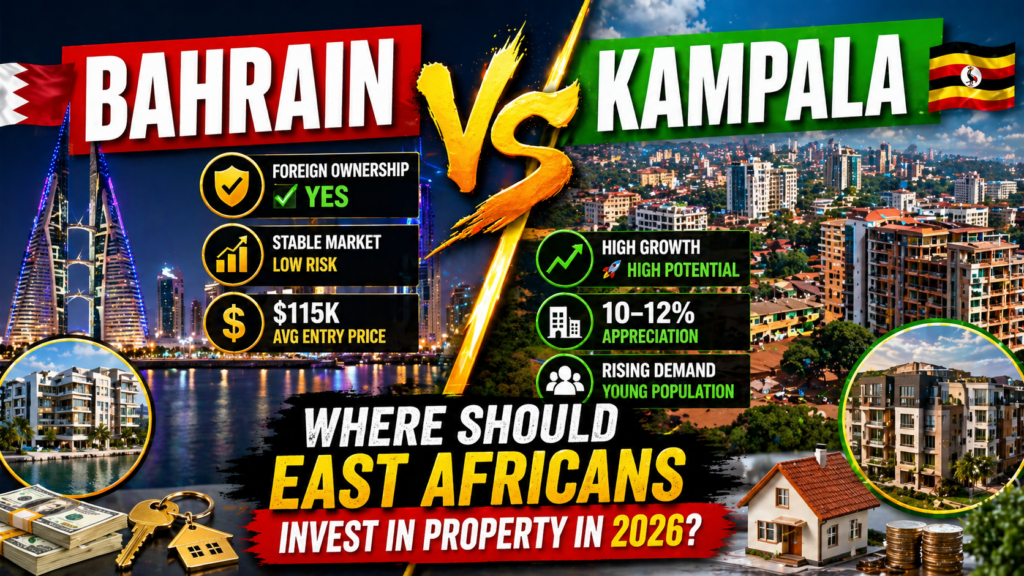
A growing number of East African investors are asking the same question in 2026: should I buy property at home or in the Gulf? It is a legitimate question. Kampala’s luxury residential market is attracting serious international developers. VAAL Real Estate — a Turkish-Egyptian firm with projects in Kenya, Ghana, the UK, and the Middle East — has committed $30 million to Cadenza Residence, a 24-storey tower in Nakasero that will be one of the tallest buildings in Uganda when it completes in July 2027. At the same time, Bahrain’s Al Juffair district is offering 1-bedroom apartments at 41,000 BHD — approximately $108,730 — in a market with proven yields, dollar-pegged currency, and one of the most liquid residential markets in the Gulf. Both look compelling on paper. The numbers, however, tell a more specific story. This is an honest, data-driven comparison of two real properties currently available to investors — not a promotional piece for either market. The Properties Property A — Bahrain, Al Juffair Property B — Uganda, VAAL Cadenza Residence The first and most significant data point: Uganda costs $35,270 more for a comparable 1-bedroom unit — before a single month of rent is collected. The Rental Income Reality Bahrain — Al Juffair Al Juffair is one of Bahrain’s most consistently performing rental districts. It sits adjacent to the US Naval Support Activity base — the largest US military installation in the Middle East — which creates permanent, high-quality tenant demand from military personnel, contractors, and the expat professional community that clusters around it. The rental market here is not speculative. It is structural. Demand replenishes itself regardless of broader economic cycles because the base and Bahrain’s financial sector create a continuous inflow of tenants. For the 41,000 BHD 1-bedroom apartment: monthly rent of 300 BHD ($795) is the market-rate figure for this property type and location — conservative relative to what fully furnished units achieve, but realistic for a standard long-term tenancy. Annual rental income: 3,600 BHD ($9,540)Gross yield on purchase price: 8.78%Net yield after costs and 10% municipal tax: ~7–8% Uganda — VAAL Cadenza Nakasero is Kampala’s most prestigious address. Neighbouring several embassies, the Parliament, State House, and the United Nations offices, it commands the highest rents in the city for luxury residential stock. The market data for prime Kampala 1-bedrooms in early 2026 shows a realistic range of 2,500,000 to 4,500,000 UGX per month ($685–$1,245) for fully serviced furnished units targeting expats and diplomats. For a luxury new-build like Cadenza — with amenities including a heated swimming pool, gym, business centre, and full generator backup — the upper end of this range is achievable in the right conditions. However, two market realities temper this optimism: First, prime Kampala has a vacancy rate of 15–22% in the luxury segment. Tenants in Nakasero and Kololo have strong negotiating power because supply has outpaced demand in recent years. A unit that achieves 4,500,000 UGX when occupied may sit empty for two to three months per year. Second, Cadenza does not complete until July 2027. An investor purchasing today earns zero rental income for at least 14 months — while the Bahrain apartment generates returns from day one. Using a realistic furnished rate of 3,500,000 UGX ($960/month) with an 18% vacancy adjustment: Effective monthly income: ~$787Annual rental income: ~$9,444Gross yield on $144,000: ~6.6%Net yield after vacancy, tax (12% on gross above threshold), and costs: ~4–5% The 10-Year Numbers Conservative Projection Metric Bahrain 41K BHD VAAL Cadenza Uganda Purchase price $108,730 $144,000 Monthly rent $795 $960 (optimistic) Vacancy adjustment 0% (structural demand) 18% (market rate) Effective monthly income $795 $787 Annual income $9,540 $9,444 10-year gross rent $95,400 $94,440 Capital saved vs Uganda +$35,270 — 10-year total advantage +$36,230 ahead — The result is striking: even taking Uganda’s best-case furnished rent — higher than Bahrain’s monthly figure — Bahrain still produces a superior 10-year outcome because the $35,270 price difference never closes. That $35,270 invested separately at a conservative 6% annual return compounds to approximately $63,000 over 10 years. The capital efficiency gap between these two investments is not marginal. The Risk Factors Nobody Puts in the Brochure Currency Risk Bahrain’s dinar is pegged to the US dollar at a fixed rate of 0.376 BHD to $1 — a peg that has held since 1987 and is backed by Gulf Cooperation Council reserves. An East African investor buying in Bahrain has zero currency conversion risk on their dollar-denominated returns. Uganda’s shilling has depreciated against the dollar consistently over the past decade. A rental income of 3,500,000 UGX that translates to $960 today may translate to $880 in three years and $800 in five if historical depreciation trends continue. The investment thesis that looks compelling in UGX terms erodes in USD terms over time — which matters enormously for any investor benchmarking returns in dollars. Vacancy Risk Juffair’s vacancy rate for 1-bedroom apartments is structurally low. The combination of US Navy presence, corporate expat demand from Bahrain’s financial sector, and proximity to Manama’s central business district creates consistent occupancy. Units in well-maintained buildings here lease within days, not months. Prime Kampala luxury stock, by contrast, has vacancy rates of 15–22%. This is not a temporary market condition — it reflects the fundamental affordability constraint of the Ugandan market. The pool of tenants who can afford $900–$1,200 per month in Kampala is small and highly competitive to access. Cadenza will compete with every other premium development in Nakasero for a limited number of qualifying tenants. Completion Risk VAAL Cadenza is scheduled to complete in July 2027. Construction timelines in emerging markets carry inherent risk. A delay of six to twelve months — not uncommon in large-scale residential developments — extends the period of zero rental income and increases carrying costs for investors who have borrowed to finance the purchase. Bahrain carries no completion risk. The property is built, titled, and available to lease immediately. Resale Liquidity Bahrain’s property market is one of the most liquid in the Gulf for foreign
Why Gulf Real Estate Companies Are Losing Leads Online in 2026(And How to Fix It)

Gulf real estate businesses spend more on digital marketing per lead than almost any other sector in the region. They run Google Ads. They post on Instagram. They sponsor influencers. They list on every property portal. Some of them have marketing budgets that would be considered generous by international standards. And yet — most of them are converting a fraction of the leads they should be generating. This is not a spend problem. It is a system problem. And it repeats across the GCC with enough consistency that the leaks are identifiable, predictable, and fixable. Why Gulf Real Estate Is Different Before diagnosing the leaks, it is worth understanding why real estate in the Gulf creates a uniquely complex digital marketing challenge. The buyer journey is long. A client buying a property in Bahrain, Dubai, or Riyadh may research for weeks or months before making first contact. They visit multiple platforms, compare multiple developments, engage with multiple agents — and then go quiet. Re-engaging them requires a system. Most agencies don’t have one. The transaction value is high. A single closed deal in Gulf real estate can be worth tens or hundreds of thousands of dollars. This means the economics of lead generation are entirely different from a business selling a $50 product. A $200 cost per lead that produces one $200,000 sale is exceptional ROI. Most real estate marketing teams are not thinking about it this way — they are focused on volume rather than quality. Trust is the primary conversion driver. Gulf buyers — particularly for high-value residential and commercial property — do not make decisions based on an ad alone. They make decisions based on a combination of brand trust, agent credibility, local market knowledge, and peer validation. Digital marketing that doesn’t build trust — that focuses only on driving enquiries — produces low-quality leads that rarely convert. The 5 Biggest Revenue Leaks in Gulf Real Estate Marketing Leak 1: Ads Driving Traffic to Generic Portals Instead of Owned Landing Pages Many Gulf real estate agencies run Google Ads or social media campaigns that direct traffic to property portals — Bayut, Property Finder, or similar — rather than to their own website or landing pages. This is an expensive mistake. When you pay for a click that lands on a portal, you are paying to drive traffic to a platform that also shows your competitors’ listings. The buyer may submit an enquiry — but it goes to multiple agents simultaneously. Your paid traffic is subsidising your competition. Owned landing pages — specifically designed for the property or development being advertised, with a single clear call to action — consistently outperform portal referrals for quality of lead. The buyer who submits their details on your landing page is contacting you. Not three other agents. Leak 2: No Conversion Tracking on Ad Spend This is the most expensive and most common leak. Gulf real estate businesses spending $5,000–$20,000/month on Google Ads frequently have no reliable conversion tracking in place. Without conversion tracking, you do not know which campaigns, which keywords, and which ad creatives are generating actual leads versus just clicks. You are making budget decisions based on assumptions — and those assumptions are almost always wrong. The fix requires Google Tag Manager, properly configured conversion events, and integration with your CRM. Once you can see which keyword or ad produced each lead, optimisation becomes straightforward. Without it, you are optimising blind. This is covered in full as part of a proper digital marketing diagnostic. Leak 3: Leads Falling Into a CRM Black Hole A lead that is not followed up within 30 minutes in Gulf real estate is significantly less likely to convert. Buyers who enquire — particularly on a property portal or via a paid ad — are often simultaneously submitting enquiries to multiple agents. The first credible, professional response has a disproportionate conversion advantage. Most Gulf real estate agencies do not have an automated lead follow-up sequence. A lead comes in by email or WhatsApp, gets manually forwarded to an agent, and the response time depends entirely on whether that agent is available and diligent. A properly configured CRM — with automated WhatsApp or email responses sent within minutes of lead submission, followed by a structured nurturing sequence — can recover a significant percentage of leads that currently go cold. The revenue sitting in unconfigured CRM systems in Gulf real estate agencies is substantial. For a broader look at what a revenue leak is and how to find yours, the principles apply directly here. Leak 4: Instagram and Facebook Ads Targeting the Wrong Audience Social media advertising for Gulf real estate is often targeted too broadly or with the wrong creative-to-audience match. A common mistake: running the same luxury property ad creative to a broad UAE or Bahrain audience regardless of income signal, purchase intent, or nationality. Gulf real estate buyers are highly segmented. An off-plan investment buyer has entirely different motivations and triggers than an expatriate family searching for a rental. A GCC national buying a primary residence behaves differently from a foreign investor seeking yield. Segmented campaigns — with creatives, messaging, and calls to action tailored to each audience type — consistently outperform broad targeting approaches. This requires more upfront creative work but delivers materially better CPLs and conversion rates. Leak 5: SEO Completely Neglected in Favour of Paid Channels Paid ads produce immediate visibility. This makes them psychologically satisfying and easy to justify in a budget conversation. But they stop working the moment the budget stops. Gulf real estate agencies that invest exclusively in paid channels and neglect organic search are building on rented land. A competitor who invests consistently in SEO — building topical authority around property types, locations, and buyer questions — will accumulate a compounding visibility advantage that cannot be easily replicated or outspent. In most Gulf property categories, organic search competition is still low enough that a 12–18 month SEO investment can establish a position that generates leads
How East African Businesses Can Compete Online Using SEO and Paid Ads
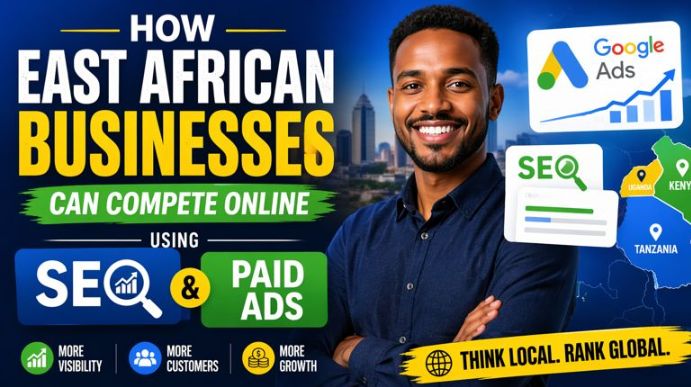
East Africa’s digital economy is not emerging. It has emerged. Nigeria, Kenya, Uganda, Tanzania, and Rwanda have collectively produced some of the fastest-growing internet user bases on the planet. Mobile money transformed financial access. Affordable smartphones brought hundreds of millions of new users online. And yet — the vast majority of established businesses in these markets are still treating digital marketing as a secondary channel, a nice-to-have that sits beneath traditional media and word-of-mouth referrals. That gap is a competitive opportunity. The businesses that understand how to build genuine online visibility in East Africa in 2026 — not just a Facebook page that gets occasional boosted posts — are outcompeting larger, better-funded rivals for the same customers. This guide is about how to build that advantage. The East African Digital Landscape in 2026 Understanding the landscape before building a strategy is not optional. East Africa is not a monolithic market, and the channels, behaviours, and competitive dynamics vary significantly across countries. Mobile-first, always. The majority of internet access in East Africa is through smartphones, not desktops. If your website is not optimised for mobile — fast-loading, clean navigation, thumb-friendly forms — you are losing the majority of your potential traffic before a single word is read. Facebook and WhatsApp dominate social. Unlike the Gulf where Instagram and Snapchat command significant attention, Facebook remains the primary social platform across much of East Africa — particularly for businesses reaching broader consumer audiences. WhatsApp functions as both a communication tool and a sales channel, often the final step before a purchase decision. Google search is growing fast. Search behaviour is maturing across the region. More consumers and B2B buyers are using Google to research products, services, and providers before making contact. Businesses with strong local SEO foundations are capturing this intent. Those without it are invisible to buyers who have already decided they want what you offer. Competition in search is still low. This is the most important strategic fact about East African digital markets in 2026. For most industries and most keywords in Nairobi, Kampala, Dar es Salaam, or Kigali, the organic search results are poorly optimised. Landing on page one for competitive commercial keywords — a multi-year investment in Western markets — can often be achieved in months in East Africa with a disciplined SEO approach. SEO in East Africa: The Opportunity Nobody Is Talking About In Nairobi, search for “corporate event management company Kenya” or “real estate agent Kampala” or “private school admissions Uganda.” Look at the results. Most page-one results are either directories, poorly formatted single-page websites, or businesses whose last blog post was published in 2021. This is not an exception. It is the norm across most commercial categories in East Africa. What this means for your business: the barrier to organic visibility is dramatically lower here than in comparable Western markets. A consistent content and SEO strategy — properly structured, targeting the right keywords, built on a technically sound website — can produce first-page rankings within three to six months in most categories. The foundation of East African SEO: Your website must be technically clean — fast page speed (critical on mobile), proper heading structure, meta titles and descriptions on every page, and a sitemap submitted to Google Search Console. These basics are missing from the majority of East African business websites, which means simply having them gives you a structural advantage. Content depth matters. Publishing three blog posts and expecting to rank is not a strategy. Topical authority — owning a subject area with comprehensive, specific, well-structured content — is how Google’s algorithm identifies which sites deserve to rank. A business that publishes 20 useful, well-written articles about property investment in Nairobi will outrank a competitor who has one generic homepage paragraph about the same topic. Local signals are powerful. Google My Business profiles, local citations, reviews, and location-specific landing pages all contribute to local search visibility. Most East African businesses have unclaimed or poorly optimised Google Business profiles — a five-minute fix that has a measurable impact on local search rankings. For a comprehensive look at how local SEO works in 2026 and how small businesses consistently outrank larger brands, that guide covers the principles that apply directly to East African markets. Google Ads in East Africa: High Intent, Low Cost The other side of the digital visibility equation is paid search. Google Ads in East Africa offers something increasingly rare in global markets: genuinely low cost per click for commercial intent keywords. CPCs for business services, education, real estate, and healthcare keywords in Nairobi, Kampala, or Dar es Salaam are a fraction of what the same intent costs in London or Dubai. A business with a $300/month Google Ads budget in East Africa — the kind of budget that barely registers in a Western market — can generate meaningful lead volume when the campaign is properly structured. The critical requirement is conversion tracking. Without knowing which keywords, which ads, and which landing pages are generating actual leads — not just clicks — you cannot optimise. And without optimisation, even low-cost traffic becomes expensive relative to what it produces. The Growth Intelligence Audit includes a full paid media review that covers conversion tracking setup, campaign structure, and CPA benchmarking — the foundation any East African business needs before scaling ad spend. What performs well in East Africa on Google Ads: High-intent, specific search terms. “Private primary school fees Nairobi 2026” outperforms “school Kenya” because the searcher is at a decision point. The more specific the keyword, the higher the intent, and the lower the wasted spend. Landing pages in the local language of the buyer. An ad that sends a Kenyan buyer to a generic English homepage converts significantly worse than one that sends them to a page written specifically for their context — their city, their concern, their decision. WhatsApp as the conversion action. As with Gulf markets, WhatsApp integration in East African campaigns consistently outperforms email forms as a conversion mechanism. Buyers
Digital Marketing in Bahrain: What Works and What Doesn’t in 2026
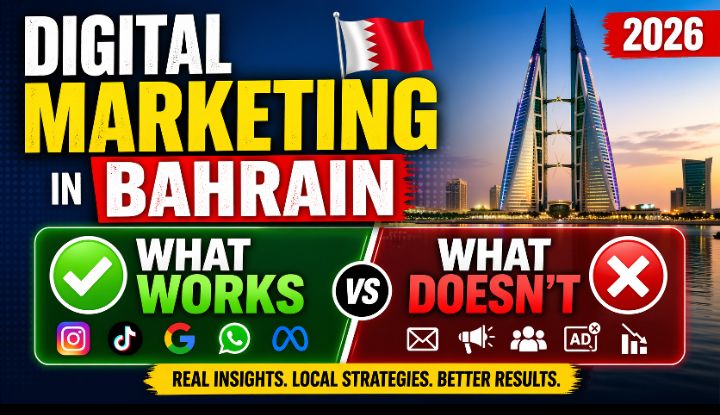
Most digital marketing guides are written for London, New York, or Sydney. They assume broad broadband penetration, mature e-commerce behaviour, high ad platform competition, and audiences who are accustomed to clicking on organic search results. They assume your competitors are already running sophisticated funnels and that your audience has been retargeted a hundred times before. Bahrain is different. The Gulf is different. And the businesses that copy the Western playbook without adapting it to this market consistently underperform — not because digital marketing doesn’t work here, but because they’re running the wrong version of it. This is the guide that should exist for Bahrain and the broader GCC. What works, what doesn’t, and what the data actually shows about digital behaviour in this market. The Bahrain Digital Landscape in 2026 Bahrain has one of the highest internet penetration rates in the Arab world — consistently above 98%. Smartphone usage is near-universal. Social media adoption is among the highest globally, with platforms like Instagram, Snapchat, and YouTube commanding significant daily attention. What this means: your audience is online. The question is not whether digital marketing works in Bahrain — it does. The question is which channels, which formats, and which messages actually move this specific audience. Key characteristics of the Bahrain digital market: Search behaviour leans heavily toward Arabic and bilingual queries. A business running only English keyword campaigns is invisible to a significant portion of the market. WhatsApp is not just a messaging app — it is a business communication channel. Buyers in Bahrain research online but frequently convert through WhatsApp. A marketing strategy that doesn’t account for this conversion path is leaking leads. Trust signals matter more here than in many Western markets. Personal referrals, visible client logos, and demonstrable local presence carry significant weight. A website without Arabic content, local case studies, or regional credentials loses deals to competitors who have these signals — regardless of ad spend. What Works in Bahrain Google Search Ads — High Intent, Lower Competition Than You Think Search intent in Bahrain is strong, and competition for many commercial keywords remains significantly lower than in comparable Western markets — meaning your cost per click is often lower and your quality score can be built faster. The key is keyword strategy. Generic English terms like “marketing agency” face moderate competition. But specific, intent-rich phrases — particularly those mixing English and Arabic service terms — are frequently underpriced and under-targeted. For service businesses, real estate, healthcare, and education, Google Search Ads at even modest budgets of $300–$600/month can generate qualified leads at a cost per acquisition that produces strong ROMI when the account is properly structured. The critical mistake most businesses make: running Google Ads without conversion tracking. Without knowing which keywords are generating actual leads — not just clicks — you are optimising blind. A proper analytics and Search Console setup is non-negotiable before spending a single dollar. Instagram and Snapchat — Not Optional for B2C Instagram and Snapchat are not secondary platforms in Bahrain. They are primary discovery channels — particularly for consumer brands, real estate, hospitality, and lifestyle services. Instagram’s visual format performs well for property showcases, product launches, and brand storytelling. Snapchat, which maintains unusually high penetration in the Gulf compared to most global markets, is effective for reaching younger audiences and driving awareness at low CPMs. The businesses winning on these platforms are not running generic ad creatives. They are producing content that reflects Gulf aesthetics, speaks to local aspirations, and uses Arabic alongside English — not as an afterthought but as the primary voice. WhatsApp Business Integration Any lead generation campaign in Bahrain that doesn’t connect to WhatsApp is leaving conversions on the table. The typical customer journey looks like this: a prospect sees your Instagram ad or Google result, visits your website, and then — rather than filling in a contact form — searches for your WhatsApp number. If they can’t find it within seconds, they leave. Embedding WhatsApp click-to-chat links in your ads, landing pages, and website is not a nice-to-have in this market. It is a fundamental conversion path. Arabic SEO — The Underutilised Advantage The vast majority of businesses in Bahrain with an English-only web presence are surrendering organic visibility to the portion of the market that searches in Arabic or bilingual terms. Arabic SEO requires more than running your English content through a translation tool. It requires understanding how Gulf Arabic speakers phrase search queries, which terms are used versus which are technically correct but never searched, and how to structure content for bilingual audiences. Businesses that invest in genuine Arabic SEO content — not machine-translated pages — consistently outrank larger competitors for high-value local queries. This is one of the clearest competitive advantages available in this market and one of the most underused. For a deeper look at local SEO principles that apply across the region, this guide to local SEO in 2026 is worth reading. What Doesn’t Work in Bahrain Copying Western Ad Creatives Directly Ad creative that performs in the US or UK frequently underperforms in the Gulf — not because the quality is poor, but because the cultural references, imagery, and tone don’t resonate. Stock photography featuring Western faces and settings in a Bahrain-targeted campaign signals inauthenticity to a local audience that is highly attuned to whether a brand understands their context. Gulf audiences respond to local imagery, regional case studies, and messaging that acknowledges their specific circumstances. Lead Forms Without WhatsApp Follow-Up Generating form fills and then following up only by email is a leak that costs most Bahrain businesses a significant proportion of their leads. Email open rates in the Gulf are lower than in Western markets. WhatsApp messages, by contrast, have near-universal open rates. If your CRM follow-up sequence relies on email only, you are losing leads to competitors who respond on WhatsApp within minutes. A well-configured HubSpot CRM with WhatsApp integration closes this gap. High-Budget Campaigns Without a Diagnostic Foundation The most expensive mistake in
What Does a Growth Intelligence Audit Actually Include?
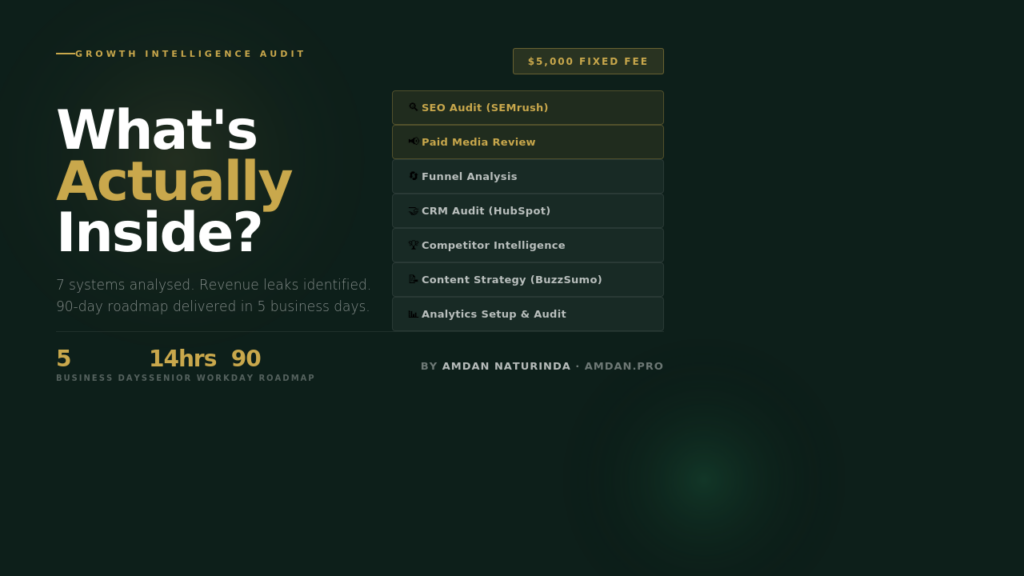
Most business owners who contact me have already tried something. They ran Google Ads that burned through budget with no leads. They hired an SEO agency that delivered a traffic report but no revenue. They built a website that looked good and converted nobody. The problem is almost never a lack of marketing activity. It is a lack of diagnostic clarity. Nobody sat down and mapped the actual system — where leads come from, where they drop off, what the data says versus what the team believes. That is exactly what the Growth Intelligence Audit is designed to fix. What the Growth Intelligence Audit Is Not Before explaining what is included, it is worth being clear about what this is not. It is not a generic SEO report generated by a tool and repackaged as strategy. It is not a surface-level website review. It is not a list of recommendations without data to support them. It is a multi-system diagnostic — covering SEO, paid media, funnels, CRM, and content — conducted by a senior consultant who has worked across Gulf, African, and international markets, using professional-grade tools and over seven years of pattern recognition. The output is a Revenue Leak Report and a 90-Day Growth Roadmap. Not a slide deck full of observations — a prioritised action plan tied to measurable revenue outcomes. What the Audit Covers 1. SEO Performance Analysis (via SEMrush) We begin with a full crawl of your website and a keyword position audit using SEMrush. This covers your current organic visibility — which keywords you rank for, which you should rank for but don’t, where your competitors are outranking you, and what technical issues are suppressing your performance. In 2026, SEO analysis also includes AI visibility — whether your content is being cited in Google AI Overviews, ChatGPT, and Perplexity. Ranking on page one is no longer sufficient if 60% of searches end without a click. We assess your AI citation presence and identify the gaps. Deliverable: Keyword gap report, technical SEO issue list, AI visibility assessment. 2. Paid Media Audit (Google Ads & Facebook/Instagram) If you are running paid ads, we audit the full account structure — campaign architecture, targeting, ad copy, landing page alignment, conversion tracking, and cost per acquisition. The most common finding: ad spend is generating clicks but the conversion tracking is broken or missing entirely, so the business has no reliable data on which campaigns are actually producing leads. We fix this before recommending any budget changes. If you are not yet running paid ads, we assess the opportunity — what a $300–$600/month Google Search and Facebook campaign could realistically return in your market, based on current CPA benchmarks and ROMI modelling. Deliverable: Ad account audit report, conversion tracking assessment, channel recommendation. 3. Funnel & Landing Page Review We map your full customer journey — from first touchpoint to closed deal — and identify where prospects are dropping off. This includes a review of your key landing pages, lead capture forms, follow-up sequences, and the alignment between your ad messaging and your on-page offer. Misalignment between what an ad promises and what a landing page delivers is one of the most common and costly revenue leaks we find. We also assess your offer clarity. Can a prospect who lands on your page immediately understand what you do, who it is for, and what to do next? If the answer requires more than five seconds, revenue is leaking. Deliverable: Funnel map, drop-off identification, landing page recommendations. 4. CRM & Lead Nurturing Audit (via HubSpot) If you use a CRM — particularly HubSpot — we audit how leads are being captured, segmented, and followed up. The most expensive revenue leak in most businesses is not at the top of the funnel. It is in the middle: leads that expressed interest, were never properly followed up, and went cold or chose a competitor. A well-configured CRM and nurturing sequence can recover a significant percentage of these leads at zero additional ad spend. If you are not using a CRM, we assess whether HubSpot or an alternative is appropriate for your volume and team structure, and what a basic implementation would look like. Deliverable: CRM audit, nurturing sequence review, lead recovery recommendations. 5. Competitor Intelligence Analysis We analyse your top three to five competitors — their keyword strategies, ad activity, content approach, and estimated traffic — to identify where they are winning and where the gaps are. This is not about copying competitors. It is about understanding the competitive landscape so your strategy is built with full visibility of the terrain. Markets where competitors have weak content or thin SEO coverage are opportunities. Markets where competitors have invested heavily in specific channels are signals to differentiate. Deliverable: Competitor matrix, opportunity identification. 6. Content Strategy Assessment (via BuzzSumo) We review your existing content — blog posts, social media, lead magnets — against what is actually performing in your category using BuzzSumo data. This identifies which topics your audience engages with, which content formats drive shares and backlinks, and whether your current content is aligned with the search intent of your target clients. Deliverable: Content gap analysis, topic opportunity list. 7. Google Analytics & Search Console Setup and Audit We verify that your measurement infrastructure is correctly configured — that Google Analytics and Search Console are tracking the right events, that conversion goals are set up, and that the data you are making decisions from is actually accurate. Businesses that have been running for years often discover during this audit that key pages were excluded from tracking, that form submissions were not counted as conversions, or that referral traffic was being misattributed. You cannot improve what you cannot measure accurately. Deliverable: Analytics audit report, configuration fixes if required. What You Walk Away With After five business days, you receive two documents: Revenue Leak Report — a prioritised list of where your business is losing revenue across every system we audited, with the data that supports each