
The Farm Has Always Been the Business. We Are Just Giving It the Software to Prove It.

Africa employs 60% of its working population in agriculture. It holds 60% of the world’s uncultivated arable land. Its farming sector feeds over a billion people — and yet, by almost every productivity metric, it operates far below its potential. The reasons are well-documented: limited access to finance, absence of reliable market linkages, low technology adoption, and — perhaps most consequentially — the near-total absence of documented farm performance data that would allow banks to confidently lend to farmers and farmers to confidently borrow. A farmer in Uganda with five acres of maize, fifteen goats, and ten years of farming experience has an asset. What they almost universally lack is the documented evidence of that asset’s performance — the records of yield per season, cost per unit of production, revenue per harvest, and livestock health trajectory that would allow a bank to assess creditworthiness with confidence rather than guesswork. This is the gap that Soillx is being built to close. What Soillx Is Soillx is a startup being developed at the intersection of agricultural technology, financial inclusion, and market access — built on a partnership with Farmbrite, one of the world’s most comprehensive farm management software platforms, and designed specifically for farmers across Africa and Asia. The model is not complicated. But its simplicity is deceptive, because each component solves a problem that has historically required a different organisation, a different platform, and a different conversation. Soillx brings all four into one system: Farm Management Software — Farmbrite’s platform, adapted and supported for African and Asian farming contexts, giving farmers the tools to record, track, and analyse every aspect of their operation. Bank Financing — partnerships with African and Asian banks that use Soillx’s platform data as the evidence base for agricultural loan decisions, connecting capable farmers to the capital they need to improve productivity. Market Access — a Shopify-backed e-commerce platform and app that allows farmers to sell their produce directly to buyers, removing the intermediary margin that currently captures value from both ends of the agricultural supply chain. Equipment Supply — sourcing from China through established supply relationships to deliver the farming equipment that productivity improvements require, at accessible prices. All four components are connected through the Farmbrite platform — which means the data generated by farm management flows directly into the financial reporting that banks use for loan decisions, and the revenue data from market sales flows back into the farm’s financial records, creating a complete, auditable picture of farm performance. Why Farmbrite Is the Right Foundation Farmbrite is an all-in-one farm management software for modern farmers and ranchers — designed to help farmers know more, grow more, and sell more, all from one easy-to-use place. It covers livestock management, crop planning, task management, financial tracking, equipment records, and customer management — all accessible through a cloud-based platform with native mobile apps for iOS and Android. Farmbrite provides tools for managing farm operations, planning and optimising production, scheduling tasks and activities, tracking finances, managing customers, and more — with native mobile apps that facilitate on-the-go data access and input. The financial tracking capability is particularly significant for the Soillx model. Users consistently highlight the ease of keeping track of accounting including uploading pictures of each receipt — and the all-inclusive nature of livestock information including pedigree, breeding, and medical records. Farmbrite works for global customers from all around the world, offering localised currency, measurement, and language support directly within the platform — currently supporting farmers from over 100 countries. For a startup being built to serve farmers in Uganda, Kenya, Tanzania, Rwanda, and across Asia, this global localisation capability is not a feature — it is a prerequisite. A farm management platform that cannot handle Ugandan shillings, Kenyan acres, or the specific livestock categories relevant to East African animal husbandry is not useful to the farmers Soillx is being built to serve. Farmbrite’s pricing starts at $35/month for the Grower plan, which includes 25 users, unlimited acreage, unlimited plantings and varieties, crop record keeping, and advanced crop planning. For small and medium farming operations across Africa, this price point — particularly with Soillx’s membership subscription model subsidising or bundling the software cost — makes enterprise-grade farm management accessible at a fraction of what comparable Western agtech platforms charge. The Bank Financing Model: Solving Agriculture’s Oldest Problem Many smallholder farmers lack the collateral to access traditional bank loans — one of the most critical constraints on farm productivity and food security across Africa. The conventional bank loan assessment model requires documented evidence of income, assets, and repayment capacity. Most African smallholder farmers cannot provide this documentation — not because the evidence does not exist, but because it has never been captured in a format that a bank can assess. A farmer who has been growing maize for fifteen years has fifteen years of production history. They know which seasons were good and which were poor. They know their input costs, their yields, and their revenue. But none of it is documented in a way that a credit officer can evaluate. Farmbrite’s farm management software changes this. A farmer who uses Soillx’s platform for one growing season generates a complete, time-stamped, auditable record of their farm’s performance — planting dates, input applications, yield measurements, livestock health events, equipment maintenance, revenue from sales, and expense records. This data, flowing into Farmbrite’s integrated accounting system, becomes the credit evidence that banks have historically lacked. A bank partner working with Soillx does not need to assess a farmer’s creditworthiness through the traditional collateral model. They can assess it through the platform data — which tells them, with precision, what the farm produces, what it costs to produce it, and what the revenue trajectory looks like. The loan proceeds flow back into the farm — into improved seed, into equipment, into expanded livestock — and the platform continues to track the productivity impact of that investment. The bank can monitor, in real time, whether the loan is being used as intended and
From a Family Electronics Business to Digital Strategy: My View of Africa’s Tech Evolution

For more than two decades, our family business has operated within one of the most important economic shifts in African history: the rise of affordable mobile technology powered largely by Chinese manufacturing. Long before “digital transformation” became a global policy phrase, Chinese electronics brands were already transforming everyday African life from the ground up. In Uganda and across Africa, brands like Tecno, Itel, Infinix, and Redmi did something many Western companies failed to understand at the time: they built for the realities of the African consumer. They developed devices with: This was not simply about selling phones. It was the beginning of Africa’s modern digital infrastructure. China’s Role in Africa’s Digital Transformation The impact of China on Africa’s digital economy goes far beyond manufacturing. Chinese technology ecosystems accelerated: For millions of Africans, the first internet experience did not happen on a desktop computer. It happened on a Chinese-made smartphone. That single shift changed consumer behavior, communication patterns, business models, and even political discourse across the continent. Today, Africa’s digital economy is one of the fastest-growing in the world because mobile technology became accessible to ordinary people — not just elites. Watching Consumer Behavior Changed My Perspective Growing up around the electronics business exposed me to something deeper than retail. I became fascinated not only by the devices people bought, but by what happened after they turned them on. I started observing: That curiosity pushed me beyond phone sales. I wanted to understand the systems behind digital growth. I wanted to understand: That journey led me into web development, SEO, digital marketing, sales funnels, and startup advisory. Building Digital Infrastructure Beyond Hardware Over the years, I transitioned from simply participating in Africa’s electronics economy to helping businesses build their digital presence and growth infrastructure. Today, my work spans multiple areas of digital transformation. Website Development and Digital Presence I have spent years building and managing websites for businesses across different sectors, helping organizations move from offline visibility into fully functional digital ecosystems. This includes: I learned early that in Africa’s mobile-first economy, websites are no longer optional. They are commercial infrastructure. SEO and Search Visibility As smartphone usage increased, search behavior became one of the most powerful economic drivers in Africa. I specialized in SEO to help businesses: My work in SEO expanded into: This became especially important as African businesses increasingly sought visibility beyond local markets. Paid Media and Digital Advertising With over five years of experience in paid media and more than $12,000 spent in advertising campaigns, I have worked extensively with: This work helped businesses understand not only how to get traffic — but how to convert attention into revenue. Supporting African Entrepreneurship and Startups My involvement in digital transformation also expanded into startup ecosystems across Africa and the Middle East. Through engagements connected to organizations such as Doola based in USA and Flat6Labs, Startup Uganda, and International Trade Centre, I gained exposure to how emerging markets are building innovation ecosystems. This experience reinforced something important: Africa’s future will not only be shaped by technology consumers. It will be shaped by African builders. The Next Phase of Africa’s Digital Economy The next decade of African digital transformation will likely move beyond smartphone access into: China will continue to play a major role in this transformation through: But Africa itself is also evolving from being only a consumer market into a producer of digital innovation. Why This Matters Personally For me, this journey started in a phone business. But the phones became a gateway into understanding how technology reshapes human behavior, commerce, and opportunity. Watching customers move from: gave me a front-row seat to Africa’s digital evolution. That evolution inspired me to build skills and businesses that contribute directly to digital transformation rather than remaining only in retail distribution. Today, whether through SEO, web infrastructure, startup advisory, digital advertising, e-commerce systems, or content strategy, my work is centered around one idea: Helping African businesses and entrepreneurs compete effectively in a global digital economy. And in many ways, that journey began with a simple observation inside a family electronics business: Technology does not only change devices. It changes behavior, markets, industries, and the future of entire continents.
Why Public Speaking Is Not a Soft Skill in Africa. It Is the Most Commercially Valuable One You Can Build

In 2020, I began working with Associate Professor Denis Bwesigye — founder of Public Speaking and Leadership Solutions Uganda — a public health professional who had studied at Zenspeak School in Manhattan, New York, receiving coaching from a world-renowned communications coach — on something that was not, on the surface, a digital marketing project. It was a skills development programme. The mission: build the public speaking, leadership communication, and professional presence capabilities of Ugandan professionals — through one-on-one coaching sessions, group workshops, and the kind of structured, evidence-based skills training that most African professional development programmes do not provide. My role was to build the growth infrastructure that would allow the programme to reach the people who needed it: Facebook ads campaigns for lead generation, landing page development and optimisation for registration conversion, and the digital systems that turned awareness into enrolment. We are now developing an e-learning platform that will extend this work beyond the limits of in-person delivery — allowing professionals across Uganda and beyond to access structured public speaking and leadership coaching regardless of geography, schedule, or proximity to a training centre. That work — a public health academic trained at a Manhattan communications school, a digital marketing consultant with roots in Bahrain and Austin, and an e-learning platform being built for African professionals — is, in microcosm, the story of what Africa’s skills development moment actually looks like in 2026. And it is the work being built, right now, through Public Speaking and Leadership Solutions Uganda. The Macro Reality: Africa Is at an Inflection Point The numbers behind Africa’s current moment are not the cautious projections of optimistic development reports. They are measurements of transformation already underway. After a challenging venture winter in 2024, Africa’s startup ecosystem witnessed a robust change — startups across the continent secured approximately $3.1 billion in capital throughout 2025, a significant jump from the $2.2 billion recorded the previous year. Mobile technologies are paving the way for greater digitalisation across the continent, contributing nearly 8% of Africa’s GDP in 2024. Digital transformation could contribute nearly 20% to South Africa’s GDP by 2028 alone, creating 300,000 jobs and expanding access to essential services to millions. Kenya’s digital innovation ecosystem — from mobile money to platform-based logistics and e-commerce — is creating new occupations in fintech, digital marketing, data services and platform management that barely existed a decade ago. Rwanda has positioned itself as an African testbed for emerging technologies, investing heavily in broadband, digital public services and coding academies to build a workforce ready for data-driven and AI-enabled jobs. Frontier technologies — from artificial intelligence and advanced data analytics to the Internet of Things, robotics and clean energy solutions — are already reshaping value chains in agriculture, manufacturing, services and public administration. The question for African policymakers and industry leaders is not whether these technologies will transform the labour market, but whether the continent will shape that transformation, or simply adjust to it on other people’s terms. That last sentence is the most important one. Africa is at a fork in the road — not between growth and stagnation, but between agency and dependency. Between building the skills infrastructure that allows Africans to lead the continent’s technological transformation, and importing that capability from outside at the cost of ownership, margin, and self-determination. The Skills Gap: The Constraint That Compounds Everything Else Every investment, every infrastructure project, every technology deployment in Africa faces the same upstream constraint: the availability of skilled people to build, operate, adapt, and scale it. African SMEs that build capability stacks around cloud ERP, embedded AI, secure platforms and digital skills will be able to compete with far larger organisations in 2026. Those that delay risk being locked out of supply chains, talent pools and digital markets. The skills gap in Africa is not primarily a gap in access to education. Enrolment rates have improved significantly across most of sub-Saharan Africa over the past two decades. The gap is between the education that is being delivered and the skills that the emerging digital economy actually requires. Most African university curricula were designed for an economy that is already changing faster than the syllabi can be updated. A computer science graduate who studied on a curriculum written in 2018 is entering a job market where AI-assisted development, cloud architecture, and digital marketing analytics are the baseline requirements — not the advanced skills. In 2026, the intersection of Education, Health, and Entrepreneurship is where we see the most innovation. EdTech has moved beyond simple video lessons to personalised, AI-driven learning platforms that address the skills gap. The EdTech sector is a vital component of Africa’s entrepreneurship story because it provides the human capital required for all other industries. A continent that solves its skills gap — that connects its young population with the specific, applied, market-relevant capabilities that the digital economy rewards — unlocks a compounding advantage that no other intervention can replicate. This is the problem that the work with Associate Prof Denis Bwesigye is addressing. Not at continental scale. At the scale of one programme, one cohort, one professional at a time — and with an e-learning platform that is designed to remove the geographic and logistical constraints that have historically limited who can access this kind of development. Why Public Speaking Is a Strategic Skill — Not a Soft One The public speaking and leadership communication programme I have been supporting since 2020 addresses something that most African professional development programmes treat as peripheral: the ability to communicate with authority, clarity, and presence in professional contexts. This is not a peripheral skill. In 2026, it is one of the most commercially consequential capabilities a professional or entrepreneur can develop. Consider what professional communication determines in practice: Pitching for investment. Every African startup founder who has ever stood in front of an investor panel — whether at Flat6Labs in Bahrain, Startup Uganda’s pitch events, or a Doola-backed YCombinator preparation session in Austin — has experienced the moment when
Your Startup Doesn’t Have Borders. Your Advisor Shouldn’t Either
Most startup advisors work in one market. They understand Silicon Valley or they understand Lagos or they understand the Gulf. They have one network, one mental model of how startups get built and funded, and one set of assumptions about what founders need to succeed. I have spent the last several years building something different — not by design at first, but by the accumulation of real relationships, real presence, and real work across three of the world’s most consequential emerging startup ecosystems: Africa, the Middle East, and America. This is the story of how that happened — and why the three-market startup advisory practice I am building from Austin, Texas is the model that the next generation of global founders actually needs. The Three Markets — And Why Each One Matters 🌍 Africa — The Demographic Engine Africa has 1.4 billion people. By 2050 it will have 2.5 billion — the youngest, fastest-growing population on the planet. Its digital economy is accelerating at 17% annually. Its mobile money infrastructure has leapfrogged banking systems that took Western markets a century to build. Its startup ecosystem has produced unicorns in fintech, logistics, healthcare, and agriculture across Nigeria, Kenya, South Africa, and Egypt. But Africa’s startup ecosystem has a persistent structural problem: most of its most promising founders cannot access the capital, the market validation, or the global distribution networks that would allow their businesses to scale beyond their home markets. My entry into Africa’s startup ecosystem came through direct, operational involvement — not observation from the outside. During Kampala Innovation Week — Uganda’s first hybrid event, which I was consulted to launch for Talent Africa Group — I encountered and engaged with three of the continent’s most significant startup infrastructure organisations: the International Trade Center, Startup Uganda, and Startup Africa. The International Trade Center connects African SMEs and startups to global trade networks. Startup Uganda is the national backbone for Uganda’s entrepreneurship ecosystem. Startup Africa, convened during Kampala Innovation Week, brings together founders, investors, and ecosystem builders from across the continent. Being physically present at this convergence — not as an observer but as the person who built the digital campaign that put 1,000+ people in the room — gave me a specific kind of access to Africa’s startup community that most international advisors do not have. I understand what Ugandan and East African founders are building, what they need, and what the gap is between where they are and where they want to go. 🏙️ Middle East — The Capital Gateway The Gulf is one of the world’s most underappreciated startup ecosystems — not because the ecosystem is weak, but because Western media has been slow to recognise what has been built. Flat6Labs is the leading entrepreneurship platform in emerging markets, empowering entrepreneurs to build, launch, and grow transformative ideas through acceleration programs, ecosystem development, and tailored innovation services. Flat6Labs Bahrain is a seed program supported by Tamkeen that accelerates and launches both local and international startups in the Kingdom of Bahrain — each cycle selecting 8–10 promising teams to receive cash funding, strategic mentorship, office space, and a multitude of partner perks and services. Flat6Labs Bahrain was created in partnership with Tamkeen — the Labour Fund — with the aim of fostering a dynamic and sustainable entrepreneurship environment, supporting job creation, and helping position Bahrain as an innovation leader in the Arabian Gulf region and MENA at large. My relationship with the Gulf’s startup ecosystem was built during the years I spent working in Bahrain — attending Flat6Labs events, engaging with Startup Bahrain, and operating inside the Tamkeen-backed entrepreneurship infrastructure that the Bahraini government has deliberately constructed to attract and develop founders from across the region and beyond. Flat6Labs invests $30,000 to $250,000 in startups and has helped hundreds of companies scale, with cohorts that are highly competitive but provide unmatched investor network and mentorship access. The Gulf’s startup ecosystem has three things that Africa’s ecosystem frequently lacks: sovereign wealth fund capital, regulatory clarity for fintech and digital businesses, and proximity to the global financial infrastructure that allows startups to scale internationally. Gulf-backed startups can access Saudi Arabia’s Vision 2030 investment, the UAE’s global connectivity, and Bahrain’s fintech regulatory sandbox — infrastructure that most African startups have to route through European or American intermediaries to access. 🇺🇸 America — The Scale Infrastructure The American market is not where most startups begin. It is where the ones that want to scale globally need to arrive. Doola is a YCombinator-backed (YC S20) “Business-in-a-Box” platform that empowers global founders by helping them set up a US business without handling complex paperwork — today, people on every continent have launched companies with doola. Doola has launched its Business-in-a-Box for E-Commerce — the first solution that brings the entire back-end of e-commerce into one place: LLC formation, compliance, multi-state tax rules, bookkeeping, financials, and business analytics across Shopify, Amazon, and beyond. It has already helped 10,000+ entrepreneurs from 175+ countries scale to seven figures. My engagement with Doola is not simply about having registered amdan.pro LLC in Austin, Texas. It is a strategic partnership built around a shared understanding of what globally-minded founders — particularly those from Africa and the Gulf — need when they decide to build for the American market. Doola’s AI Co-Founder is built for global e-commerce entrepreneurs and automates tasks that usually drain founders’ time — banking and payments, compliance and filings, bookkeeping, and US tax guidance — with no US Social Security Number required, fluent in 175+ countries’ unique challenges. For an African or Gulf founder who wants to launch a Shopify store, an Amazon FBA business, or a US-registered SaaS company, Doola removes the back-office complexity that would otherwise require a US-based lawyer, accountant, and compliance specialist. For my startup advisory practice, the Doola partnership means I can walk a Ugandan e-commerce founder or a Bahraini SaaS company directly into the American market without the infrastructure friction that has historically been a barrier. Why Three Markets Is
Beyond Al Jazeera’s Lens: The Palestinian Professionals Who Built Careers, Closed Deals

I want to write something that Al Jazeera doesn’t show you. Not because Al Jazeera is wrong — the journalists they have lost covering Gaza were doing work of immense courage and moral importance, and their sacrifice deserves recognition, not dismissal. But because a single story, told repeatedly and exclusively, can make an entire people invisible in their full humanity. And the Palestinians I knew in Bahrain — the ones I worked beside, learned from, shared meals with, and built professional relationships with — deserve to be seen in their fullness. I grew up alongside Palestinians during my years in Bahrain. Not in a refugee camp. Not in a war zone. In offices, classrooms, cars, and courtrooms. In the daily, unremarkable, deeply human texture of working life in one of the Gulf’s most cosmopolitan cities. Let me tell you about the people I knew. The Driver Who Was Also a Diplomat During my time in Bahrain, I had a Palestinian driver who was far more than a driver. He was a navigator — not just of Bahrain’s roads, but of its social landscape. He knew which neighbourhoods were safe for which conversations. He knew the informal codes of the Gulf business world — when to speak, when to stay silent, when a handshake meant more than a contract. He was multilingual in the way that Palestinian diaspora professionals often are: Arabic in several registers, English for business, enough Urdu to communicate with South Asian colleagues, enough conversational Bahraini dialect to be genuinely trusted by locals. He assisted me in closing deals. Not because he was instructed to — because he understood the relational architecture of Gulf commerce instinctively. He made introductions. He provided context. He told me, quietly and without fuss, when a meeting was going wrong and why. He was, in the full professional sense, an indispensable partner in work that I would have done less well without him. He was also, when the subject arose, deeply thoughtful about Palestine — not angry, not despairing, but strategic. He was thinking about where his children would go to university. He was thinking about which skills would be valuable in twenty years. He was, in every practical sense, building a life of purpose and forward motion despite carrying the weight of a people’s dispossession. The Lawyer Who Shaped My Understanding of Due Diligence I also worked with a Palestinian lawyer in Bahrain — a man of extraordinary precision and professional discipline. In the Gulf’s business environment, where deals move fast and documentation is complex, legal counsel is not optional. And the Palestinian legal professionals I encountered were not merely competent. They were rigorous in a way that came, I think, from understanding at a bone-deep level that documentation and legal standing are not bureaucratic formalities — they are survival tools. A people who have spent generations navigating stateless existence, contested borders, and the absence of institutional protection understand the power of a correctly drafted contract in a way that those with permanent citizenship often do not. The lawyer who assisted me brought that understanding to every engagement. He was precise about language. He was meticulous about precedent. He was also, like the driver, multilingual and culturally fluent in ways that made him genuinely effective in a multinational business environment. These are not characteristics that emerge from war. They are characteristics that emerge from education, from professional discipline, and from the particular kind of resilience that the Palestinian diaspora has demonstrated across every country it has inhabited. The Translator Who Made Connection Possible The third Palestinian professional who shaped my Bahrain years was a translator and cultural interpreter — someone whose value in a multilingual, multicultural business environment cannot be overstated. Translation, in the Gulf, is rarely just about language. It is about register — knowing that the same sentence means something different in a formal business context versus an informal social one. It is about cultural subtext — understanding what is being communicated through silence, through indirection, through the particular formality of a Gulf business introduction. It is about trust — being the person in the room who both parties believe is representing them accurately and faithfully. The Palestinian translator who assisted me was all of these things. He was also, outside working hours, a reader — someone who engaged seriously with ideas, who had opinions about the world, and who was building, quietly and with great determination, a professional and intellectual life that he could be proud of. What I Taught — and What I Learned At the Future Institute in Bahrain, I had the privilege of teaching digital skills to Palestinian youth — web hosting, web design and development, and social media management. I want to be honest about what that experience revealed. The students I taught were not passive recipients of training. They were hungry — in the specific, directed way of young people who understand that a skill is a form of freedom. They understood, in a way that perhaps more comfortable young people do not, that a skill cannot be taken from you. A home can be taken. A passport can be complicated. A livelihood can be disrupted. But the ability to build a website, manage a digital presence, or grow a brand online — that capability goes with you wherever you go. Palestinian freelancers are increasingly entering saturated markets like general web development, where competition is fierce and income remains modest. In contrast, high-demand and high-income digital fields such as digital marketing, AI and machine learning, UI/UX design, and data analysis remain significantly underrepresented — with 85% of global employers seeking digital marketing skills, but only 8% of Palestinian freelancers currently offering them. This is the gap I was trying, in my small way, to address. Not the conflict. Not the politics. The skills gap — the specific, actionable, commercially meaningful gap between what the global digital economy needs and what Palestinian youth were being trained to offer. Teaching web hosting and social media
The Powerful Truth About Marketing ROI: What You Measure Matters More Than What You Spend
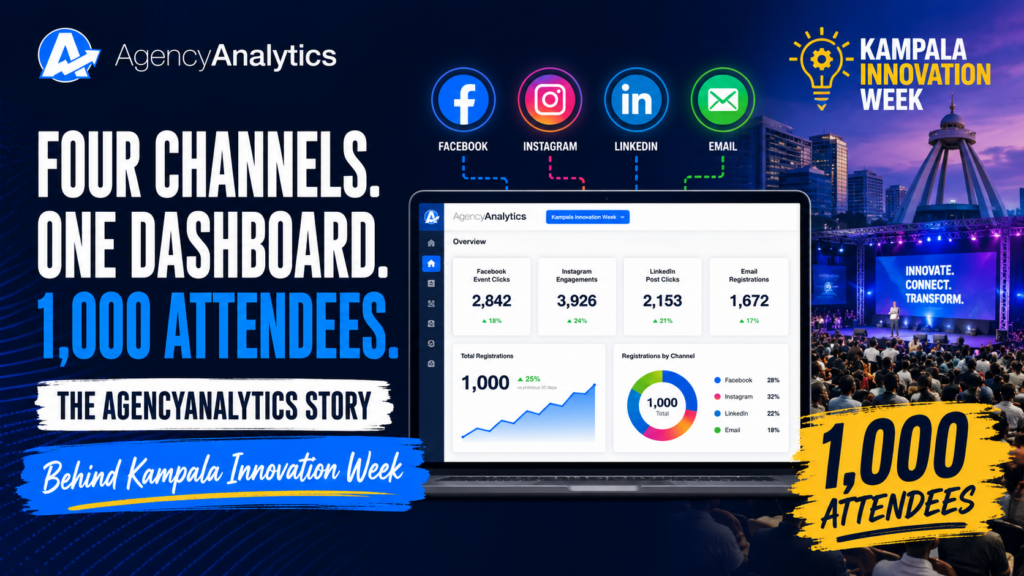
In 2020, I launched Kampala Innovation Week for Talent Africa Group — Uganda’s first hybrid event. The stack I used to run it was not simple: Facebook ads for awareness, MailChimp for email marketing, HubSpot for CRM and lead management, and Agency Analytics for reporting. That last tool was not an afterthought. It was the layer that tied everything together — the platform that took data from four different systems and turned it into a single, coherent picture of what was working, what wasn’t, and where the next dollar of investment should go. In a month, the event went from low registrations to over 1,000 participants. The Facebook ads drove awareness. MailChimp nurtured leads. HubSpot managed the pipeline. But AgencyAnalytics was what made the decision-making clear — showing in real time which channel was generating registrations, which email sequences were converting, and where the bottlenecks were. That experience — managing a high-pressure, multi-channel campaign with clear measurement infrastructure — is the foundation of how I approach reporting for every client engagement today. And what I have learned since is that the reporting tool is not just an administrative function. It is a direct driver of ROI and ROMI improvement. Here is why — and here is the evidence. The Reporting Problem That Is Costing Agencies and Consultants Their Clients Let us start with an uncomfortable truth. If you are still manually taking screenshots of Facebook Ads and pasting them into a slide deck, you are operating in 2018. In 2026, live data streams are the minimum standard. The manual reporting process that most agencies and consultants still use is not just inefficient. It is commercially dangerous. Every hour spent compiling data from six different platforms is an hour not spent optimising campaigns. Every report delivered five days after month-end is five days of delayed decision-making. And every client who has to wait for their consultant to “pull together the numbers” before making a budget decision is a client who is silently questioning the value of the engagement. According to the SoDA Report on agency efficiency, agencies with automated weekly or bi-weekly reporting dashboards retain clients 34% longer than those delivering monthly PDF reports manually. Client retention is a direct ROMI driver. If your current reporting process is contributing to client churn — and manual, delayed reporting does — then the investment in a professional reporting platform is not an overhead cost. It is a revenue protection investment. What AgencyAnalytics Actually Does AgencyAnalytics is not a general analytics tool. It is built specifically for agencies — pulling in data from over 80 marketing channels, including Google Ads, Facebook, SEO platforms, and email tools, and turning them into customisable, client-ready reports with white-labelled dashboards, scheduled reporting, and built-in ROI tracking. The platform makes it simple to manage dozens of clients from a single dashboard, with each client getting their own branded reporting portal. The white-label capabilities are comprehensive — you can customise everything from the dashboard interface to automated email reports with your agency’s branding. The integrations that matter most for the Growth Intelligence Stack used in every amdan.pro audit: AgencyAnalytics integrations include over 80 platforms, with Google Analytics 4, Gravity Forms, and HighLevel among the strongest. It eliminates manual updates, ensuring clients receive timely, data-driven reports without extra effort. The client portal gives clients access to real-time dashboards with instant access to their data anytime. When all of these data sources flow into a single dashboard — updated in real time, branded with your agency identity, accessible to clients 24/7 — the reporting function shifts from a backward-looking administrative task to a forward-looking strategic asset. How AgencyAnalytics Directly Improves ROI The connection between a reporting platform and improved ROI is not indirect. It operates through four specific mechanisms: 1. Faster Decision-Making Reduces Wasted Spend The most expensive period in any marketing campaign is the period between when something stops working and when you find out about it. A Facebook ad set whose cost per lead has doubled over 72 hours is burning budget. If you discover this on a weekly report review, you have lost three days of overspend. If your AgencyAnalytics dashboard is sending automated anomaly alerts — as it does with its AI summaries, anomaly detection, and metric alerts — you find out within hours and can pause or adjust before significant damage is done. For a client spending $600/month on ads, catching a 72-hour CPL spike within hours versus days can represent the difference between a wasted $60 and a wasted $200. At scale, this single function pays for the platform many times over. 2. Attribution Clarity Moves Budget to What Works The most common ROI problem in multi-channel marketing is not that the channels don’t work. It is that the business doesn’t know which channels are working — so it distributes budget based on assumption rather than evidence. A business running Google Search Ads, Facebook campaigns, and organic SEO simultaneously, with no unified reporting layer, cannot answer the question: “Where did this client come from?” They might attribute it to Facebook because the client mentioned seeing an ad — without knowing that the client had also visited the website three times from organic search before clicking the Facebook ad. AgencyAnalytics’ unified dashboard surfaces this multi-touch picture. By consolidating Google Analytics conversion data with Google Ads spend data and Facebook campaign performance, the platform allows genuine channel attribution — which channels are contributing leads, at what cost, and in what sequence. The ROMI improvement from this clarity is direct and measurable. Shifting 20% of budget from a channel with a $120 CPL to one with a $45 CPL, based on attribution data that was previously unavailable, produces a ROMI improvement that compounds every month the reallocation is maintained. 3. Client Transparency Reduces Churn — and Churn Is a ROMI Killer The most underestimated ROMI drain in service businesses is client churn. Acquiring a new client at a $350/hour consulting rate, with a 20% close rate from paid
The $14,400 Question Every Service Business Needs to Answer About Their Software Stack
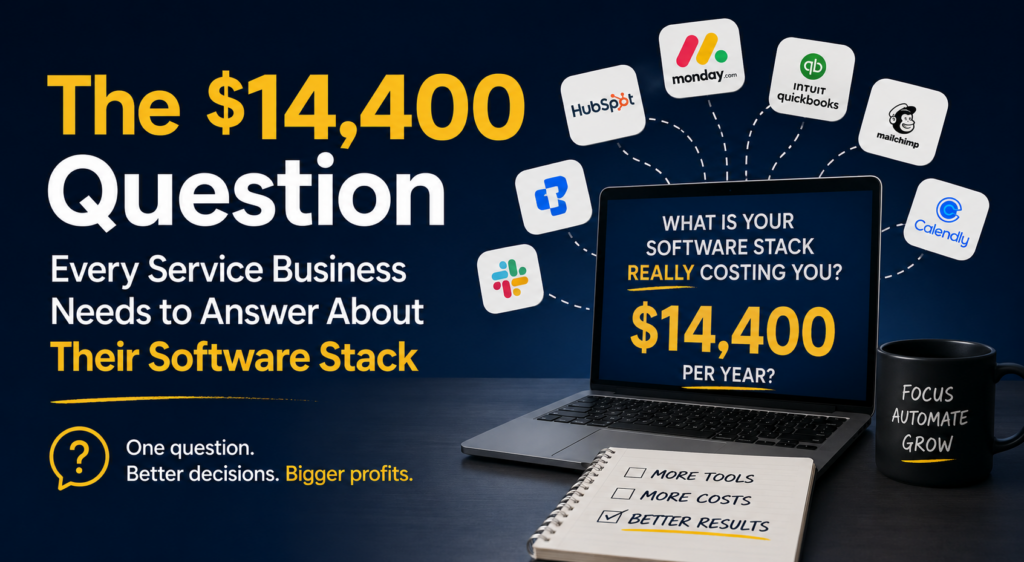
The Marketing Stack Audit: How to Calculate ROI & ROMI on Every Tool You Pay For .Most businesses have a software problem they don’t know they have. They are paying for 8, 10, sometimes 15 tools every month. Some of those tools are generating significant revenue. Some are sitting largely unused. Some are duplicating functions that another tool in the stack already covers. And almost none of the businesses paying for these tools have done the calculation that would tell them which category each tool falls into. The result: the average SaaS company uses 91+ tools in 2026, with at least 50% of SaaS licences underutilised or unused. Money that should be compounding into revenue is funding software subscriptions that are delivering no measurable return. This article is the framework for fixing that — specifically applied to the growth intelligence stack we use in every client audit: SEMrush, HubSpot, ClickFunnels, Leadpages, Apollo, Google Analytics, Google Tag Manager, Google Search Console, Hotjar, QuickBooks, and Kit (ConvertKit). Each tool has a job. Each tool has a cost. And each tool should be generating a return that justifies that cost — or it should be cut. The Two Metrics That Matter: ROI vs ROMI Before calculating anything, the definitions matter — because ROI and ROMI are measuring different things, and confusing them produces misleading conclusions. ROI (Return on Investment) measures the total return on any investment relative to its cost: ROI = (Revenue Generated − Total Investment) ÷ Total Investment × 100 If your total revenue is $200,000 and marketing spending is $50,000, then: $200,000 − $50,000 = $150,000 net profit. ROI = $150,000 ÷ $50,000 × 100 = 300%. For each dollar you spend on marketing, you earn $3 in profit. ROMI (Return on Marketing Investment) focuses specifically on marketing activities — isolating the return from marketing spend versus overall business investment: ROMI = (Revenue Attributable to Marketing − Marketing Investment) ÷ Marketing Investment × 100 ROMI focuses specifically on marketing activities and provides a more granular view of marketing effectiveness. If your company spent $50,000 on a campaign that generated $200,000 in revenue, ROMI = [($200,000 − $50,000) / $50,000] × 100% = 300%. For software stack analysis, you need both: The Full Software Cost Audit: What You Are Actually Spending Before calculating returns, you need an honest inventory of costs. Most businesses underestimate their software spend because they look at individual tools in isolation rather than the cumulative stack. Here is the Growth Intelligence Stack we use in client audits — with approximate monthly costs at standard tiers: Tool Function Est. Monthly Cost SEMrush SEO, keyword intelligence, competitive analysis $140–$500 HubSpot CRM, email marketing, sales pipeline $50–$800 ClickFunnels Funnel building, landing pages $97–$297 Leadpages Landing pages, lead capture $37–$99 Apollo Lead generation, prospecting, outreach $49–$99 Kit (ConvertKit) Email marketing, sequences, automation $29–$99 Hotjar Website heatmaps, session recordings $32–$80 Google Analytics Website traffic analysis Free Google Tag Manager Tag and tracking management Free Google Search Console Search performance monitoring Free QuickBooks Accounting, invoicing, financial tracking $30–$90 AWS / GoDaddy / Shopify / WordPress Hosting, e-commerce infrastructure $20–$300 Total (mid-tier estimate) ~$561–$2,463/mo At a mid-tier stack running $1,200/month, your software costs $14,400 per year before a single dollar of ad spend, freelancer cost, or your own time. That $14,400 is an investment. It needs to produce a return that justifies it — ideally a ROMI of at least 300%, which means $43,200+ in attributable revenue from that investment. The question every business should be asking: is it? How to Calculate ROI Per Tool The framework for calculating ROI on each tool in your stack has three steps: Step 1 — Assign Each Tool a Revenue Function Every tool in a growth stack should have a specific, measurable role in generating or protecting revenue. If you cannot articulate what revenue function a tool serves, that is a problem. SEMrush → Organic traffic growth → leads from organic search → revenue HubSpot → Lead capture, nurturing, CRM → conversion of leads to clients → revenue ClickFunnels/Leadpages → Paid traffic conversion → leads from paid ads → revenue Apollo → Outbound prospecting → booked calls → revenue Kit/ConvertKit → Email sequences → lead nurture → revenue Hotjar → Conversion rate optimisation → improved checkout/funnel performance → revenue QuickBooks → Financial management → invoicing accuracy, tax compliance → cost avoidance Google tools → Traffic measurement, search visibility → optimisation decisions → revenue Step 2 — Measure the Revenue Each Tool Contributes This requires attribution — connecting the revenue you generate to the tools that contributed to generating it. There are several approaches: multi-touch attribution assigns value to each marketing touchpoint in the customer journey. In practice, for most small and medium businesses, a simplified attribution model works: For SEMrush: Track organic traffic in Google Analytics. Calculate what percentage of your leads come from organic search. Apply that percentage to your revenue to get organic revenue. Compare to SEMrush’s monthly cost. For HubSpot: Track leads captured through HubSpot forms and sequences. Track which leads converted to paying clients. Calculate revenue from HubSpot-sourced clients. Compare to HubSpot’s monthly cost. For ClickFunnels/Leadpages: Track leads generated per landing page using UTM parameters and Google Analytics. Calculate conversion rate and revenue from those leads. Compare to platform cost. For Apollo: Track outbound sequences sent, replies received, calls booked, and clients closed. Calculate revenue from Apollo-sourced clients. Compare to Apollo’s monthly cost. For Kit/ConvertKit: Track email open rates, click rates, and — most importantly — revenue from email-triggered purchases or bookings. Compare to platform cost. For Hotjar: Calculate improvement in conversion rate since implementation. Apply conversion rate uplift to your traffic volume and average transaction value to estimate revenue impact. Compare to Hotjar’s monthly cost. Step 3 — Apply the ROI Formula Per Tool Tool ROI = (Revenue Attributed to Tool − Tool Monthly Cost) ÷ Tool Monthly Cost × 100 Example — SEMrush at $140/month: Example — Apollo at $49/month: These numbers illustrate why high-performing tools deserve more investment
I used Bitcoin for 5 Years: Why Digital Payments and Blockchain Are Africa’s Most Underestimated Financial Revolution

In 2019, I attended the PayTabs event at Unbound Bahrain — the anchor event of StartUp Bahrain week, celebrating the Kingdom’s commitment to fuelling a digital future for the MENA region. PayTabs demonstrated its online, mobile, social, and next-generation payment processing capabilities across MENA to a room of founders, investors, merchants, and financial technology operators. The energy was specific: this was not a theoretical conversation about the future of money. It was a practical one about the infrastructure being built right now to power digital commerce across one of the world’s fastest-growing economic regions. That same year, I was listed as an investor at the World Blockchain Roadshow Middle East — organised by the International Decentralized Association on Cryptocurrency and Blockchain (IDACB), covering five Arabian countries: Abu Dhabi, Dubai, Muscat, Manama, and Kuwait City, connecting more than 90 verified blockchain investors with perspective startups. And for the past five years, I have transacted in Bitcoin — not as a speculative bet on a chart, but as a genuine financial instrument: a store of value, a cross-border payment mechanism, and a hedge against the currency volatility that every African entrepreneur operating across multiple markets understands intimately. This article is the synthesis of those three threads — payment gateways, blockchain investment, and five years of Bitcoin experience — applied to the specific realities of Africa and the Middle East in 2026. What the PayTabs Event Revealed About Payment Infrastructure PayTabs was founded in 2014 by Saudi entrepreneur Abdulaziz Al Jouf with a vision to help merchants across the MENA region access a secure way to get paid online — and by 2019, it had become one of the region’s most consequential fintech companies. PayTabs became a founding partner of Bahrain Fintech Bay — the largest dedicated fintech hub in the Middle East and Africa. Speaking at the event, PayTabs Chief Digital Officer Philippe Berard said: “Bahrain’s central location in the Middle East makes it a critical online payments hub. Internet penetration in the kingdom is over 90% — one of the highest in the world — and it is only natural that e-commerce thrives against this backdrop.” What I observed at that event was not just a payment company demonstrating its product. It was an ecosystem in action — regulators, merchants, banks, and payment infrastructure providers working inside a framework that Bahrain had deliberately constructed to accelerate fintech adoption. The contrast with Africa’s payment landscape could not have been starker. While Bahrain was building a regulated, interoperable, multi-currency digital payment ecosystem in 2019 — with PayTabs enabling 130+ alternative payments to help merchants reach their online business’ full global potential — most African businesses were still collecting cash, processing payments through disconnected mobile money systems that couldn’t talk to each other, or navigating the complexity of cross-border transactions that took days and cost significant margin. Seven years later, the gap has narrowed — but it has not closed. Payment Gateways: Where Africa Stands in 2026 Africa’s payment gateway landscape in 2026 is more developed than it was in 2019, but it remains fragmented, expensive, and inaccessible for many of the businesses that need it most. The Major Players — Africa Flutterwave — Nigeria-founded, now pan-African and global. Processes payments across 34+ African countries, supports 30+ currencies, and provides APIs for e-commerce, marketplace, and subscription billing. The closest Africa has to a PayTabs equivalent in terms of breadth of service. Paystack — Acquired by Stripe in 2020 for $200 million. Operates primarily in Nigeria, Ghana, Kenya, and South Africa. Known for developer-friendly integration and clean checkout experience. Strong for SMEs and SaaS businesses. Chipper Cash — Cross-border mobile money transfer across Africa. Operates in Uganda, Kenya, Ghana, Tanzania, Rwanda, and beyond. Strong for peer-to-peer and business-to-business transfers at lower cost than traditional remittance. MTN Mobile Money / Airtel Money — The dominant payment infrastructure across East and West Africa at the consumer level. Ubiquitous for local transactions but limited for international payments, e-commerce integration, and subscription billing. DPO Group (now Network International) — One of the most established payment processors in sub-Saharan Africa, with operations in Uganda, Kenya, Tanzania, Rwanda, and beyond. Strong for hospitality, tourism, and enterprise merchants. The Major Players — Middle East PayTabs — An award-winning payment infrastructure company powering the future of fintech, with an AI-powered payment orchestration platform that empowers banks, fintech players, enterprises, and government institutions. Now operating across MENA with white-label capabilities for banks and governments. Telr — UAE-based payment gateway serving the Gulf, with strong Shopify and WooCommerce integration. HyperPay — Saudi Arabia-headquartered, operating across the Arab world. Strong for Arabic-language checkout experiences and local payment method support. Noon Payments — Backed by Noon.com, growing rapidly across the UAE and Saudi Arabia. The Comparison: What African Businesses Are Missing Feature Middle East (PayTabs/HyperPay) Africa (Flutterwave/Paystack) Multi-currency ✅ 168+ currencies ✅ 30+ currencies Arabic/local language checkout ✅ Native ⚠️ Limited Regulatory clarity ✅ CBB, UAE Central Bank ⚠️ Varies by country Cross-border B2B payments ✅ Strong ⚠️ Improving Subscription/recurring billing ✅ Full ✅ Growing White-label for banks ✅ Available ⚠️ Limited Government integration ✅ Active ⚠️ Emerging Settlement speed 1–2 days 2–5 days The gap is narrowing. But the Middle East’s payment infrastructure — built on clearer regulation, deeper banking integration, and a higher-value merchant base — remains more mature and more capable for businesses operating at scale. The Blockchain Layer: What I Witnessed at the World Blockchain Roadshow The World Blockchain Roadshow Middle East by IDACB was the first of its kind — connecting prominent blockchain investors and top ICO projects across five Arabian countries, with the aim of establishing links between crypto entrepreneurs worldwide. Being listed as an investor at that event in 2019 gave me a specific vantage point. I was not in the room as a spectator. I was in the room as someone with a stake in how blockchain technology would develop — and specifically, how it would interact with the payment and financial infrastructure of the markets I operated
He Protected America for 28 years,ran for Congress Texas and taught me how to win in Business

Commander Furman retired after 28 years of military service — a career that took him across the Gulf, the Pacific, and the strategic command centres where America’s most consequential operational decisions are made. He attended Texas A&M University and the Naval Postgraduate School, and he carried the discipline of both institutions into every briefing, every decision, and every conversation I was fortunate enough to be part of. Today, Commander Furman is running for Congress in Texas’ redrawn 35th Congressional District — South Texas, San Antonio, a region he calls home and a community he has committed to representing with the same clarity of purpose he brought to 28 years of military service. I mention this not for political reasons. Commander Furman’s campaign is his own — and Texas voters will make their own judgement. I mention it because the mentorship he gave me in Bahrain in 2019 is directly connected to how I approach every client engagement I run today — and because the strategic lessons I learned from a man shaped by Texas, the US Navy, and decades of high-stakes operational decision-making are exactly the lessons that Texas businesses need to hear about digital growth in 2026. What a Navy Commander Taught Me About Business Strategy Commander Furman’s approach to decision-making was shaped by a principle that military leadership calls situational awareness — a clear, honest, continuously updated picture of the operating environment that precedes every decision. In Bahrain, I watched him apply this with a discipline I had never encountered in a business context. Before any resource was allocated, before any action was taken, before any communication was issued — the question was always the same: what does the environment actually require? Not what do we prefer. Not what do we have. What does the situation demand? I was running my own web design, development, and hosting business at the time — already two years into building client campaigns, running Facebook ads, and integrating digital systems for businesses across Uganda and the Gulf. The Commander’s framework did not replace what I knew. It restructured how I applied it. The outside-in discipline — starting with the market, the customer, and the competitive environment before deciding what to do — became the foundation of every audit, every strategy, and every recommendation I have made since. It is also, I have come to believe, the discipline that most Texas businesses are missing in their digital marketing in 2026. The Texas Digital Landscape in 2026 Texas is not a single market. It is five or six markets operating simultaneously — each with distinct demographics, competitive dynamics, and digital behaviour patterns. The Houston energy corridor behaves differently from Austin’s tech corridor. San Antonio’s military-adjacent economy — shaped by Fort Sam Houston, Lackland Air Force Base, Randolph AFB, and the naval presence that Commander Furman served — has different buyer psychology than Dallas-Fort Worth’s financial and corporate services concentration. South Texas’ border economy, which sits at the heart of Commander Furman’s congressional district, operates with different infrastructure constraints and different digital adoption curves than the Texas Triangle’s major metropolitan centres. What they share is this: every one of these markets is being transformed by the same forces reshaping digital visibility across the US — AI search, shifting consumer behaviour, and the declining reliability of tactics that worked three years ago. The 4 Things Texas Businesses Are Getting Wrong Online 1. Treating SEO as a One-Time Project The most common digital marketing mistake I encounter in Texas businesses — particularly in San Antonio, Houston, and the South Texas corridor — is treating SEO as a project with a beginning and an end. A website is built. An agency is hired for a three-month SEO engagement. Rankings improve. The engagement ends. Twelve months later, the rankings have slipped, the agency is gone, and the business owner is trying to understand what happened. SEO in 2026 is not a project. It is an ongoing operational function — like accounting or customer service. The businesses that hold their organic positions through Google’s algorithm updates, through the AI search transition, and through competitive market shifts are the ones with continuous, disciplined attention to their digital presence — not the ones who treated it as a one-time fix. Commander Furman’s military background included continuous intelligence updates and strategy adjustments. The operating environment changed. The plan adapted. Texas businesses need to approach their digital presence the same way. 2. Running Ads Without Understanding the Customer’s Journey Texas has some of the most sophisticated advertising markets in the United States. Houston’s energy sector, Dallas’s financial services, Austin’s tech ecosystem, and San Antonio’s defence and healthcare industries all attract serious ad spend — and serious competition. The businesses losing money in these markets are almost universally making the same mistake: running ads without mapping the customer’s journey from first awareness to final decision. A San Antonio defence contractor running Google Ads to a homepage. A Houston energy services company running Facebook ads to a contact form with no prior relationship established. An Austin SaaS company spending $10,000 per month on paid search and sending traffic to a product page that converts at 0.8%. The ad is not the problem. The journey is. As I learned from Commander Furman — and from two years of working daily with SEMrush’s competitive intelligence data — the strategy must account for the full operating environment, not just the moment of engagement. 3. Ignoring the AI Search Transition Texas businesses in professional services — legal, financial, healthcare, real estate — are facing the same AI search disruption that is affecting every major US market, but with a specific Texas dimension. The queries that Texas buyers use to find professional service providers — “real estate attorney San Antonio,” “financial advisor Houston,” “SEO consultant Austin,” “digital marketing agency Dallas” — are precisely the kinds of commercial queries where Google’s AI Overviews are most aggressively inserting synthesised answers before the first organic result. A law firm that has spent three
Understanding Texas Business Landscape: Strategy Leadership and Execution
Texas Business Landscape: Digital Marketing & SEO Strategy | Amdan.pro amdan.pro Digital Marketing SEO Strategy Work With Me Market Intelligence Texas’ Business Landscape:What It Means for YourDigital Marketing & SEO Texas is America’s fastest-growing major economy — and most brands competing here are still running digital strategies built for slower, smaller markets. Here’s how to close that gap. By Amdan · Digital Strategy · amdan.pro Texas is no longer a regional market that national brands can afford to treat as an afterthought. With a GDP that would rank it among the world’s top ten economies, a population growing faster than any other major state, and a business environment actively pulling corporations, talent, and capital away from traditional coastal centers — Texas has become one of the highest-stakes digital marketing battlegrounds in the United States. And most brands competing here are running generic strategies that were never built for this market. The opportunity — and the risk — is significant. Companies that localize their digital marketing and SEO for the Texas market gain real competitive advantages in search visibility, audience relevance, and customer acquisition cost. Those that apply national playbooks to Texas audiences consistently leave organic growth on the table and overpay for paid traffic that converts poorly. $2.5T+ Texas GDP — one of the world’s largest economies 62K+ Net new residents per month — fastest-growing major state #1 U.S. state for corporate relocations — 7 consecutive years Why Texas Demands a Distinct Digital Strategy The foundational mistake brands make in Texas is assuming that national SEO and digital marketing strategies translate directly to a state this large, this diverse, and this fast-moving. Texas is not a single market — it is four distinct metropolitan ecosystems with different industry concentrations, different search behaviors, different competitive landscapes, and different audience profiles, all operating under a shared cultural context that has its own values, communication norms, and trust signals. “Winning in Texas digital marketing means understanding that Austin, Dallas, Houston, and San Antonio are not the same market with different weather. They are different competitive universes.” — Amdan, Digital Strategy Advisor The implication for SEO is direct and practical. A law firm, a B2B technology company, a healthcare provider, or an ecommerce brand competing in Texas needs a geo-targeted content architecture, locally-anchored keyword strategy, and audience understanding specific to each major Texas market — not a single statewide approach that is too broad to dominate anywhere. The Four Texas Digital Markets Austin Tech & Startup Audience High digital sophistication. Search behavior skews toward product comparisons, startup resources, and growth-stage B2B services. Content must be substantive — generic performs poorly here. Dallas–Fort Worth Enterprise & Corporate Audience Fortune 500 decision-makers, financial services, and enterprise technology buyers. High-value B2B search with long consideration cycles. Trust signals and thought leadership content are critical. Houston Industrial, Energy & International Energy sector, healthcare, and international trade audiences. Multilingual search behaviors matter here more than in any other Texas market. Industry-specific content depth wins. San Antonio Defense, Cyber & Value-Driven Defense, cybersecurity, and cost-conscious professional audiences. An underrated SEO opportunity — lower competition than Austin or DFW, with real purchase intent in specialized verticals. The Texas SEO Opportunity: What Most Brands Miss The rapid influx of corporations and talent into Texas has created a search demand surge that organic content strategies have not yet caught up to. New residents searching for services, businesses establishing Texas presences and researching local vendors, and a growing professional class looking for Texas-specific industry intelligence — all of this represents search demand that is, in many verticals, still underserved by quality content. This is a genuine first-mover advantage window for brands that build Texas-focused content strategies now. The window will not stay open indefinitely. As more national brands recognize the Texas opportunity and invest in localization, the cost of entry into high-value Texas search positions will rise. The brands that establish topical authority and local search dominance in 2024 and 2025 will be structurally advantaged against later entrants. Where the SEO Gaps Are Based on the Texas business landscape analysis, the highest-opportunity content and SEO gaps cluster around several themes that map directly to the state’s economic evolution. Relocation and establishment content — companies and individuals relocating to Texas generate enormous search volume around legal, financial, real estate, HR, and operational questions that are specific to Texas regulatory and business environments. This is evergreen demand that grows with the state’s population. Industry-specific Texas content — the energy transition, the Texas tech ecosystem, the Texas Medical Center’s life sciences community, and the defense sector all generate professional search demand for deeply specialized content. Most national publishers cannot serve this with the depth Texas professionals expect. Texas B2B vendor search — as corporations establish or expand Texas operations, procurement teams search for Texas-based or Texas-knowledgeable vendors across every professional services category. Ranking for Texas-specific B2B intent queries is often significantly easier than ranking for national equivalents, with comparable or superior commercial value. Digital Marketing Strategy for The Texas Market Beyond SEO, Texas’ cultural and competitive characteristics demand specific adjustments to paid search, content marketing, and social media strategies that national playbooks rarely account for. Paid Search: What Changes in Texas Texas’ metropolitan markets have meaningfully different CPCs, audience compositions, and competitive dynamics than national campaigns assume. DFW’s concentration of corporate headquarters creates B2B paid search environments where competitor spending is high and generic creative performs poorly. Austin’s tech-savvy audience has high ad literacy — vague value propositions get scrolled past. Houston’s diversity and internationalism means ad copy that works in DFW may underperform in Houston without localization. Texas Market Paid Search Characteristics SEO Priority Austin High CPC in tech/SaaS verticals; ad-literate audience; strong organic preference Thought leadership content Dallas–Fort Worth Competitive B2B landscape; long cycles; LinkedIn complements search Enterprise intent keywords Houston Energy & healthcare verticals dominate; multilingual opportunity Industry depth + local San Antonio Lower competition; defense/gov adjacent; value-driven messaging Niche authority content Content Strategy: Meeting the Texas Standard Texas business culture has a