
What New York Businesses Are Missing About SEO in the Age of AI Search
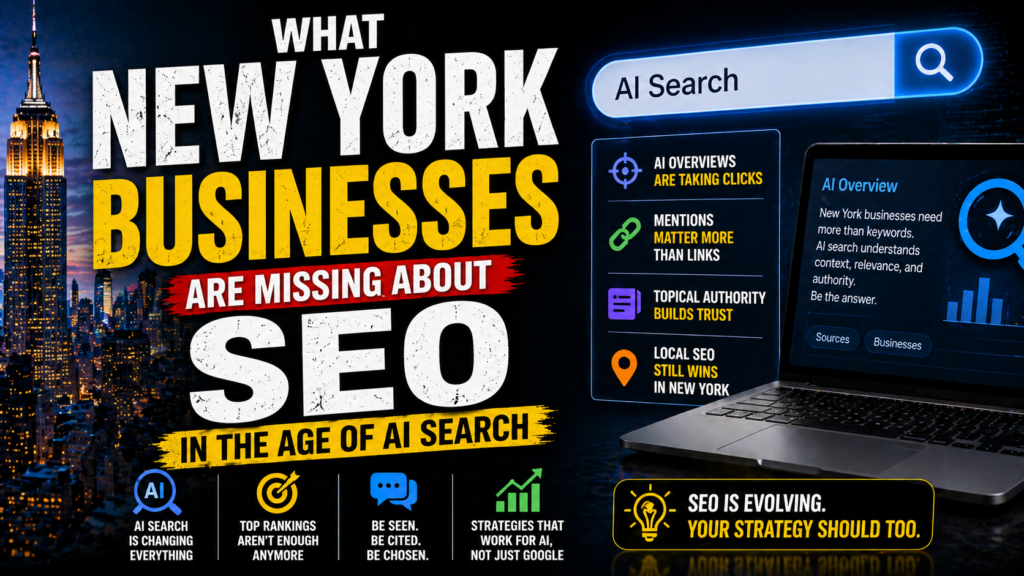
New York is one of the most competitive search markets in the world. Real estate. Finance. Legal. Healthcare. Hospitality. Professional services. Every major industry category in New York has dozens — sometimes hundreds — of businesses spending seriously on SEO, each trying to own the same commercial keywords. The competition for page-one organic positions in Manhattan alone would be considered fierce in most other markets globally. And in 2026, most of those businesses are competing for a prize that is quietly shrinking. The organic search result — the blue link that a New York law firm or real estate brokerage or financial advisory has spent years and tens of thousands of dollars trying to rank for — is being displaced. Not eliminated. Displaced. By AI Overviews that answer the query before the user ever sees a link. By featured snippets. By People Also Ask boxes. By Google’s increasingly aggressive insertion of its own content between the searcher and the result. The businesses that understand what is actually happening to New York’s search landscape in 2026 — and that have the data infrastructure to respond to it — are the ones that will hold their organic positions through this transition. The ones that don’t are watching their traffic decline without understanding why their rankings haven’t changed. This is the conversation that matters right now. And it is one I can have with data behind it — because for the past two years, I have held an agency partnership with SEMrush, one of the world’s leading online visibility management platforms, used by over 10 million marketers worldwide and trusted by 30% of Fortune 500 companies. What AI Search Is Actually Doing to New York’s Organic Traffic The number that every New York business owner and marketing director needs to understand first: nearly 60% of Google searches now end without a single click. The user searched. Google answered — via an AI Overview, a featured snippet, or a knowledge panel. No website was visited. No organic click was generated. A business that ranks number one for a high-value query in 2026 may be receiving a fraction of the traffic that position delivered in 2022. This is not a future risk. It is a current reality — and it is disproportionately affecting exactly the kind of informational and commercial queries that New York’s service businesses depend on for top-of-funnel organic acquisition. A Manhattan real estate firm that ranks first for “how much does it cost to buy an apartment in New York” is now likely watching Google answer that question directly in the AI Overview. A financial advisor who ranked for “best way to invest $100,000 in 2026” is watching Gemini synthesise an answer from multiple sources. A law firm that ranked for “employment lawyer New York” may find their result pushed below a local pack, an AI Overview, and three paid ads before the first organic click is available. Semrush launched Spotlight 2026, its flagship marketing conference in London on October 13, describing the event as designed to equip marketers with the strategies required to compete and win brand visibility in the AI search era — as the interconnections between SEO and AI Search become increasingly clear. The platform I have worked with for two years is now hosting conferences specifically about this transition. That is not a coincidence — it reflects where the entire SEO industry is moving. What a SEMrush Agency Partnership Actually Means Before explaining what New York businesses should do differently, it is worth being specific about what a SEMrush agency partnership provides — because it shapes how I approach every client engagement. SEMrush agency partners receive advanced training, priority support, co-marketing opportunities, and access to exclusive agency resources covering SEO, PPC campaign management, content marketing, competitive analysis, and online visibility. Every SEMrush Agency Partner is certified through SEMrush Academy and rated with an Agency Score — certifications that show clients the partner knows how to use SEMrush to help them get ahead. What this means in practice for clients: when I conduct a Growth Intelligence Audit, I am not working from general SEO principles or publicly available data. I am working from SEMrush’s proprietary data infrastructure — the largest keyword database in the industry, real-time ranking tracking, competitive gap analysis, backlink intelligence, and the platform’s new AI visibility monitoring that tracks how brands and their competitors appear in AI-generated search responses. SEMrush’s enterprise platform consolidates SEO, AI search, and site health in one place — leveraging first-class SEO and AI search data to help clients scale with proven, trusted infrastructure. Two years of working with this platform daily — running audits for clients across Gulf real estate, East African e-commerce, Ugandan event management, and international consulting businesses — has given me a depth of tool proficiency that directly translates into faster, more accurate diagnostic work for every client I engage. The data I pull for a New York business’s competitive analysis is the same data that 30% of Fortune 500 companies use to make their SEO decisions. That is not a marketing claim — it is the infrastructure reality of the platform. The 5 Things New York Businesses Are Getting Wrong in 2026 1. Optimising for Rankings Instead of Visibility The most common SEO mistake in New York’s competitive market in 2026 is treating keyword ranking position as the primary success metric. Ranking is a means to visibility. Visibility — being present wherever your buyers are forming intent, including in AI Overviews, featured snippets, Google’s AI Mode, and citation-based answers in ChatGPT and Perplexity — is the actual objective. A business that ranks number three for a valuable New York query but has zero AI visibility is more exposed than one that ranks number eight but appears consistently in AI-generated answers. The ranking tells you where you are in the traditional results. It tells you nothing about your presence in the surfaces that are increasingly capturing the first engagement with a searcher. SEMrush’s AI visibility tracking —