
What New York Businesses Are Missing About SEO in the Age of AI Search
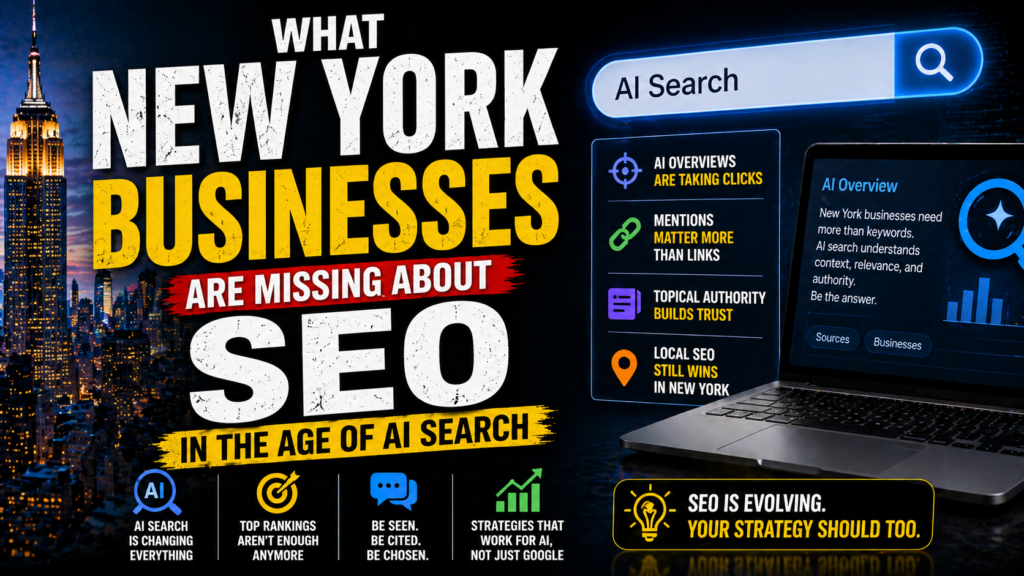
New York is one of the most competitive search markets in the world. Real estate. Finance. Legal. Healthcare. Hospitality. Professional services. Every major industry category in New York has dozens — sometimes hundreds — of businesses spending seriously on SEO, each trying to own the same commercial keywords. The competition for page-one organic positions in Manhattan alone would be considered fierce in most other markets globally. And in 2026, most of those businesses are competing for a prize that is quietly shrinking. The organic search result — the blue link that a New York law firm or real estate brokerage or financial advisory has spent years and tens of thousands of dollars trying to rank for — is being displaced. Not eliminated. Displaced. By AI Overviews that answer the query before the user ever sees a link. By featured snippets. By People Also Ask boxes. By Google’s increasingly aggressive insertion of its own content between the searcher and the result. The businesses that understand what is actually happening to New York’s search landscape in 2026 — and that have the data infrastructure to respond to it — are the ones that will hold their organic positions through this transition. The ones that don’t are watching their traffic decline without understanding why their rankings haven’t changed. This is the conversation that matters right now. And it is one I can have with data behind it — because for the past two years, I have held an agency partnership with SEMrush, one of the world’s leading online visibility management platforms, used by over 10 million marketers worldwide and trusted by 30% of Fortune 500 companies. What AI Search Is Actually Doing to New York’s Organic Traffic The number that every New York business owner and marketing director needs to understand first: nearly 60% of Google searches now end without a single click. The user searched. Google answered — via an AI Overview, a featured snippet, or a knowledge panel. No website was visited. No organic click was generated. A business that ranks number one for a high-value query in 2026 may be receiving a fraction of the traffic that position delivered in 2022. This is not a future risk. It is a current reality — and it is disproportionately affecting exactly the kind of informational and commercial queries that New York’s service businesses depend on for top-of-funnel organic acquisition. A Manhattan real estate firm that ranks first for “how much does it cost to buy an apartment in New York” is now likely watching Google answer that question directly in the AI Overview. A financial advisor who ranked for “best way to invest $100,000 in 2026” is watching Gemini synthesise an answer from multiple sources. A law firm that ranked for “employment lawyer New York” may find their result pushed below a local pack, an AI Overview, and three paid ads before the first organic click is available. Semrush launched Spotlight 2026, its flagship marketing conference in London on October 13, describing the event as designed to equip marketers with the strategies required to compete and win brand visibility in the AI search era — as the interconnections between SEO and AI Search become increasingly clear. The platform I have worked with for two years is now hosting conferences specifically about this transition. That is not a coincidence — it reflects where the entire SEO industry is moving. What a SEMrush Agency Partnership Actually Means Before explaining what New York businesses should do differently, it is worth being specific about what a SEMrush agency partnership provides — because it shapes how I approach every client engagement. SEMrush agency partners receive advanced training, priority support, co-marketing opportunities, and access to exclusive agency resources covering SEO, PPC campaign management, content marketing, competitive analysis, and online visibility. Every SEMrush Agency Partner is certified through SEMrush Academy and rated with an Agency Score — certifications that show clients the partner knows how to use SEMrush to help them get ahead. What this means in practice for clients: when I conduct a Growth Intelligence Audit, I am not working from general SEO principles or publicly available data. I am working from SEMrush’s proprietary data infrastructure — the largest keyword database in the industry, real-time ranking tracking, competitive gap analysis, backlink intelligence, and the platform’s new AI visibility monitoring that tracks how brands and their competitors appear in AI-generated search responses. SEMrush’s enterprise platform consolidates SEO, AI search, and site health in one place — leveraging first-class SEO and AI search data to help clients scale with proven, trusted infrastructure. Two years of working with this platform daily — running audits for clients across Gulf real estate, East African e-commerce, Ugandan event management, and international consulting businesses — has given me a depth of tool proficiency that directly translates into faster, more accurate diagnostic work for every client I engage. The data I pull for a New York business’s competitive analysis is the same data that 30% of Fortune 500 companies use to make their SEO decisions. That is not a marketing claim — it is the infrastructure reality of the platform. The 5 Things New York Businesses Are Getting Wrong in 2026 1. Optimising for Rankings Instead of Visibility The most common SEO mistake in New York’s competitive market in 2026 is treating keyword ranking position as the primary success metric. Ranking is a means to visibility. Visibility — being present wherever your buyers are forming intent, including in AI Overviews, featured snippets, Google’s AI Mode, and citation-based answers in ChatGPT and Perplexity — is the actual objective. A business that ranks number three for a valuable New York query but has zero AI visibility is more exposed than one that ranks number eight but appears consistently in AI-generated answers. The ranking tells you where you are in the traditional results. It tells you nothing about your presence in the surfaces that are increasingly capturing the first engagement with a searcher. SEMrush’s AI visibility tracking —
Dubai vs Bahrain: Where Should You Buy Property in 2026 — And Which Gets You a Golden Visa?

Two properties. Two Gulf markets. Two completely different investment outcomes. The first is a furnished 1-bedroom apartment in Hamza Tower, Dubai Sports City — 873 square feet, already tenanted, listed at AED 820,000 ($223,000). The second is a 1-bedroom apartment in Al Juffair, Bahrain’s Capital Governorate — 657 square feet, listed by ERA Real Estate at 41,000 BHD ($108,730). Both are in freehold zones. Both are in USD-pegged currency markets. Both are in established residential areas with consistent expat demand. But when you run the full comparison — purchase price, rental yield, net return, Golden Visa eligibility, and 10-year investor outcome — the picture is considerably more nuanced than the headline numbers suggest. This is the comparison every East African, South Asian, and emerging market investor looking at Gulf real estate needs to read before committing capital in 2026. The Properties: What You Are Actually Buying Property A — Hamza Tower, Dubai Sports City, UAE Hamza Tower is a completed 16-storey residential building in Dubai Sports City, DubaiLand. The specific unit — an upgraded, furnished 1-bedroom on a mid-floor — is listed at AED 820,000 ($223,000) and is already rented, meaning day-one rental income for the buyer. Hamza Tower carries an 8.9% rental yield according to Property Finder data, one of the stronger yield profiles in Dubai Sports City. Real estate in Dubai Sports City has a return on investment rate of 8.4%, which is competitive compared to premium Dubai locations like Downtown or Palm Jumeirah that offer 4–6% but stronger capital appreciation. Average rental value of Hamza Tower apartments is AED 72,124 per annum, translating to approximately AED 6,010 ($1,635) per month — with new rentals averaging AED 55,108/year and renewed rentals averaging AED 43,881/year. Property B — Al Juffair, Capital Governorate, Bahrain The Bahrain property is a 1-bedroom apartment of 657 square feet in Al Juffair — Manama’s most consistently performing residential district — listed by ERA Real Estate at 41,000 BHD ($108,730) at a price per square foot of 62 BHD. Al Juffair’s structural advantage is well-documented: it sits adjacent to the US Naval Support Activity Bahrain — the largest American military installation in the Middle East — creating permanent, structural demand from military personnel, contractors, and the expat professional community. Demand in this district replenishes regardless of broader economic cycles. Estimated monthly rent for a standard long-term tenancy: 300 BHD ($795). Annual income: 3,600 BHD ($9,540). Gross yield: 8.78%. The ROI Comparison: Running the Real Numbers Purchase Price The most important number in any yield comparison is the denominator — what you paid. Dubai Hamza Tower Bahrain Al Juffair Purchase price AED 820,000 ($223,000) 41,000 BHD ($108,730) Price gap Dubai costs $114,270 more The Dubai property costs more than twice what the Bahrain property costs. Every yield percentage is calculated against that base — which means the absolute capital at risk is fundamentally different. Rental Income Metric Dubai Bahrain Monthly rent ~AED 6,010 ($1,635) 300 BHD ($795) Annual rent ~$19,620 $9,540 Already tenanted ✅ Yes ❌ No Dubai generates more absolute rental income — approximately double Bahrain’s monthly figure. This is the Dubai property’s primary advantage. If your objective is maximum rental income from a single asset, Dubai delivers more cash. Yield Analysis Metric Dubai Bahrain Gross yield 8.7% (DLD-registered data) 8.78% DLD transfer fee 4% ($8,920) ~1.7% ($1,848) Agency commission ~2% ($4,460) ~2% ($2,175) Annual service charge AED 10–50/sqft/year Lower Net yield (after costs) ~5.5–6.5% ~7–8% Currency peg ✅ AED/USD ✅ BHD/USD Both currencies are USD-pegged — zero currency conversion risk for dollar-benchmarked investors. On gross yield, the properties are virtually identical at approximately 8.7–8.78%. On net yield, Bahrain pulls ahead because its transaction costs are significantly lower — Dubai’s 4% DLD transfer fee alone costs $8,920 on this property, versus approximately $1,848 in Bahrain’s equivalent fees. 10-Year Projection Dubai Bahrain Capital invested $223,000 $108,730 Annual net rental income ~$13,000 ~$8,200 10-year rental total ~$130,000 ~$82,000 Capital saved vs Dubai — +$114,270 Total 10-year position $130,000 income $82,000 income + $114,270 saved Net advantage — +$66,270 ahead The capital efficiency calculation flips the comparison entirely. The $114,270 you don’t spend buying Bahrain instead of Dubai — invested conservatively at 6% annually — compounds to approximately $204,000 over 10 years. The rental income gap ($130,000 vs $82,000) is $48,000 in Dubai’s favour. But the capital efficiency advantage of $114,270 more than compensates — leaving the Bahrain investor materially ahead over a 10-year horizon. The Golden Visa: Where the Real Difference Is This is where the comparison fundamentally changes — and where every investor needs to pay close attention to what has changed in 2026. Dubai Golden Visa — What This Property Actually Qualifies For Dubai has reset criteria for its two-year property-linked residency visa, removing the minimum property value requirement for sole owners. This means the AED 820,000 Hamza Tower apartment qualifies for a 2-year investor visa — renewable, but requiring reapplication every two years. The 10-year Golden Visa requires a minimum AED 2 million investment — approximately $545,000. At AED 820,000, this property falls significantly short. To qualify for Dubai’s 10-year Golden Visa through property, you would need to purchase approximately 2.4 additional properties of this value — a combined investment of approximately $535,000. Dubai Golden Visa summary for this property: Bahrain Golden Residency — What This Property Qualifies For Bahrain reduced its minimum real estate investment for the Golden Residency visa to BHD 130,000 ($345,000), down from BHD 200,000. The programme, launched in 2022, offers a 10-year renewable residence permit with work rights and family reunification. The Al Juffair apartment at 41,000 BHD ($108,730) does not on its own meet the BHD 130,000 threshold. However — and this is the critical investment insight — purchasing three apartments of this type (3 × 41,000 BHD = 123,000 BHD) comes within reach of the threshold, and combining with any additional qualifying property crosses it. Alternatively, the BHD 130,000 threshold can be met through a single higher-value property or a portfolio of properties whose combined value
Why Gulf Real Estate Companies Are Losing Leads Online in 2026(And How to Fix It)

Gulf real estate businesses spend more on digital marketing per lead than almost any other sector in the region. They run Google Ads. They post on Instagram. They sponsor influencers. They list on every property portal. Some of them have marketing budgets that would be considered generous by international standards. And yet — most of them are converting a fraction of the leads they should be generating. This is not a spend problem. It is a system problem. And it repeats across the GCC with enough consistency that the leaks are identifiable, predictable, and fixable. Why Gulf Real Estate Is Different Before diagnosing the leaks, it is worth understanding why real estate in the Gulf creates a uniquely complex digital marketing challenge. The buyer journey is long. A client buying a property in Bahrain, Dubai, or Riyadh may research for weeks or months before making first contact. They visit multiple platforms, compare multiple developments, engage with multiple agents — and then go quiet. Re-engaging them requires a system. Most agencies don’t have one. The transaction value is high. A single closed deal in Gulf real estate can be worth tens or hundreds of thousands of dollars. This means the economics of lead generation are entirely different from a business selling a $50 product. A $200 cost per lead that produces one $200,000 sale is exceptional ROI. Most real estate marketing teams are not thinking about it this way — they are focused on volume rather than quality. Trust is the primary conversion driver. Gulf buyers — particularly for high-value residential and commercial property — do not make decisions based on an ad alone. They make decisions based on a combination of brand trust, agent credibility, local market knowledge, and peer validation. Digital marketing that doesn’t build trust — that focuses only on driving enquiries — produces low-quality leads that rarely convert. The 5 Biggest Revenue Leaks in Gulf Real Estate Marketing Leak 1: Ads Driving Traffic to Generic Portals Instead of Owned Landing Pages Many Gulf real estate agencies run Google Ads or social media campaigns that direct traffic to property portals — Bayut, Property Finder, or similar — rather than to their own website or landing pages. This is an expensive mistake. When you pay for a click that lands on a portal, you are paying to drive traffic to a platform that also shows your competitors’ listings. The buyer may submit an enquiry — but it goes to multiple agents simultaneously. Your paid traffic is subsidising your competition. Owned landing pages — specifically designed for the property or development being advertised, with a single clear call to action — consistently outperform portal referrals for quality of lead. The buyer who submits their details on your landing page is contacting you. Not three other agents. Leak 2: No Conversion Tracking on Ad Spend This is the most expensive and most common leak. Gulf real estate businesses spending $5,000–$20,000/month on Google Ads frequently have no reliable conversion tracking in place. Without conversion tracking, you do not know which campaigns, which keywords, and which ad creatives are generating actual leads versus just clicks. You are making budget decisions based on assumptions — and those assumptions are almost always wrong. The fix requires Google Tag Manager, properly configured conversion events, and integration with your CRM. Once you can see which keyword or ad produced each lead, optimisation becomes straightforward. Without it, you are optimising blind. This is covered in full as part of a proper digital marketing diagnostic. Leak 3: Leads Falling Into a CRM Black Hole A lead that is not followed up within 30 minutes in Gulf real estate is significantly less likely to convert. Buyers who enquire — particularly on a property portal or via a paid ad — are often simultaneously submitting enquiries to multiple agents. The first credible, professional response has a disproportionate conversion advantage. Most Gulf real estate agencies do not have an automated lead follow-up sequence. A lead comes in by email or WhatsApp, gets manually forwarded to an agent, and the response time depends entirely on whether that agent is available and diligent. A properly configured CRM — with automated WhatsApp or email responses sent within minutes of lead submission, followed by a structured nurturing sequence — can recover a significant percentage of leads that currently go cold. The revenue sitting in unconfigured CRM systems in Gulf real estate agencies is substantial. For a broader look at what a revenue leak is and how to find yours, the principles apply directly here. Leak 4: Instagram and Facebook Ads Targeting the Wrong Audience Social media advertising for Gulf real estate is often targeted too broadly or with the wrong creative-to-audience match. A common mistake: running the same luxury property ad creative to a broad UAE or Bahrain audience regardless of income signal, purchase intent, or nationality. Gulf real estate buyers are highly segmented. An off-plan investment buyer has entirely different motivations and triggers than an expatriate family searching for a rental. A GCC national buying a primary residence behaves differently from a foreign investor seeking yield. Segmented campaigns — with creatives, messaging, and calls to action tailored to each audience type — consistently outperform broad targeting approaches. This requires more upfront creative work but delivers materially better CPLs and conversion rates. Leak 5: SEO Completely Neglected in Favour of Paid Channels Paid ads produce immediate visibility. This makes them psychologically satisfying and easy to justify in a budget conversation. But they stop working the moment the budget stops. Gulf real estate agencies that invest exclusively in paid channels and neglect organic search are building on rented land. A competitor who invests consistently in SEO — building topical authority around property types, locations, and buyer questions — will accumulate a compounding visibility advantage that cannot be easily replicated or outspent. In most Gulf property categories, organic search competition is still low enough that a 12–18 month SEO investment can establish a position that generates leads
How East African Businesses Can Compete Online Using SEO and Paid Ads
East Africa’s digital economy is not emerging. It has emerged. Nigeria, Kenya, Uganda, Tanzania, and Rwanda have collectively produced some of the fastest-growing internet user bases on the planet. Mobile money transformed financial access. Affordable smartphones brought hundreds of millions of new users online. And yet — the vast majority of established businesses in these markets are still treating digital marketing as a secondary channel, a nice-to-have that sits beneath traditional media and word-of-mouth referrals. That gap is a competitive opportunity. The businesses that understand how to build genuine online visibility in East Africa in 2026 — not just a Facebook page that gets occasional boosted posts — are outcompeting larger, better-funded rivals for the same customers. This guide is about how to build that advantage. The East African Digital Landscape in 2026 Understanding the landscape before building a strategy is not optional. East Africa is not a monolithic market, and the channels, behaviours, and competitive dynamics vary significantly across countries. Mobile-first, always. The majority of internet access in East Africa is through smartphones, not desktops. If your website is not optimised for mobile — fast-loading, clean navigation, thumb-friendly forms — you are losing the majority of your potential traffic before a single word is read. Facebook and WhatsApp dominate social. Unlike the Gulf where Instagram and Snapchat command significant attention, Facebook remains the primary social platform across much of East Africa — particularly for businesses reaching broader consumer audiences. WhatsApp functions as both a communication tool and a sales channel, often the final step before a purchase decision. Google search is growing fast. Search behaviour is maturing across the region. More consumers and B2B buyers are using Google to research products, services, and providers before making contact. Businesses with strong local SEO foundations are capturing this intent. Those without it are invisible to buyers who have already decided they want what you offer. Competition in search is still low. This is the most important strategic fact about East African digital markets in 2026. For most industries and most keywords in Nairobi, Kampala, Dar es Salaam, or Kigali, the organic search results are poorly optimised. Landing on page one for competitive commercial keywords — a multi-year investment in Western markets — can often be achieved in months in East Africa with a disciplined SEO approach. SEO in East Africa: The Opportunity Nobody Is Talking About In Nairobi, search for “corporate event management company Kenya” or “real estate agent Kampala” or “private school admissions Uganda.” Look at the results. Most page-one results are either directories, poorly formatted single-page websites, or businesses whose last blog post was published in 2021. This is not an exception. It is the norm across most commercial categories in East Africa. What this means for your business: the barrier to organic visibility is dramatically lower here than in comparable Western markets. A consistent content and SEO strategy — properly structured, targeting the right keywords, built on a technically sound website — can produce first-page rankings within three to six months in most categories. The foundation of East African SEO: Your website must be technically clean — fast page speed (critical on mobile), proper heading structure, meta titles and descriptions on every page, and a sitemap submitted to Google Search Console. These basics are missing from the majority of East African business websites, which means simply having them gives you a structural advantage. Content depth matters. Publishing three blog posts and expecting to rank is not a strategy. Topical authority — owning a subject area with comprehensive, specific, well-structured content — is how Google’s algorithm identifies which sites deserve to rank. A business that publishes 20 useful, well-written articles about property investment in Nairobi will outrank a competitor who has one generic homepage paragraph about the same topic. Local signals are powerful. Google My Business profiles, local citations, reviews, and location-specific landing pages all contribute to local search visibility. Most East African businesses have unclaimed or poorly optimised Google Business profiles — a five-minute fix that has a measurable impact on local search rankings. For a comprehensive look at how local SEO works in 2026 and how small businesses consistently outrank larger brands, that guide covers the principles that apply directly to East African markets. Google Ads in East Africa: High Intent, Low Cost The other side of the digital visibility equation is paid search. Google Ads in East Africa offers something increasingly rare in global markets: genuinely low cost per click for commercial intent keywords. CPCs for business services, education, real estate, and healthcare keywords in Nairobi, Kampala, or Dar es Salaam are a fraction of what the same intent costs in London or Dubai. A business with a $300/month Google Ads budget in East Africa — the kind of budget that barely registers in a Western market — can generate meaningful lead volume when the campaign is properly structured. The critical requirement is conversion tracking. Without knowing which keywords, which ads, and which landing pages are generating actual leads — not just clicks — you cannot optimise. And without optimisation, even low-cost traffic becomes expensive relative to what it produces. The Growth Intelligence Audit includes a full paid media review that covers conversion tracking setup, campaign structure, and CPA benchmarking — the foundation any East African business needs before scaling ad spend. What performs well in East Africa on Google Ads: High-intent, specific search terms. “Private primary school fees Nairobi 2026” outperforms “school Kenya” because the searcher is at a decision point. The more specific the keyword, the higher the intent, and the lower the wasted spend. Landing pages in the local language of the buyer. An ad that sends a Kenyan buyer to a generic English homepage converts significantly worse than one that sends them to a page written specifically for their context — their city, their concern, their decision. WhatsApp as the conversion action. As with Gulf markets, WhatsApp integration in East African campaigns consistently outperforms email forms as a conversion mechanism. Buyers
Digital Marketing in Bahrain: What Works and What Doesn’t in 2026
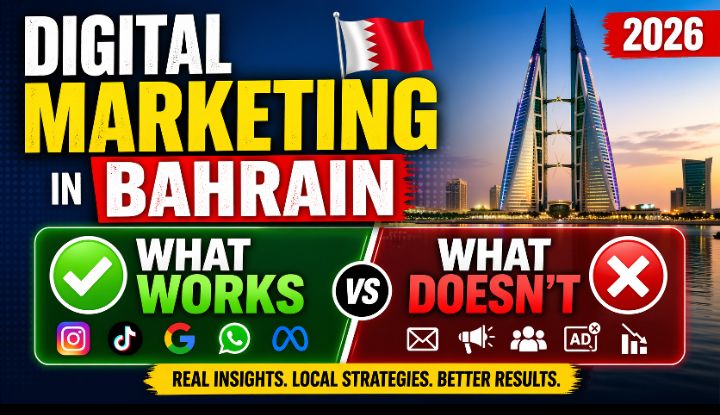
Most digital marketing guides are written for London, New York, or Sydney. They assume broad broadband penetration, mature e-commerce behaviour, high ad platform competition, and audiences who are accustomed to clicking on organic search results. They assume your competitors are already running sophisticated funnels and that your audience has been retargeted a hundred times before. Bahrain is different. The Gulf is different. And the businesses that copy the Western playbook without adapting it to this market consistently underperform — not because digital marketing doesn’t work here, but because they’re running the wrong version of it. This is the guide that should exist for Bahrain and the broader GCC. What works, what doesn’t, and what the data actually shows about digital behaviour in this market. The Bahrain Digital Landscape in 2026 Bahrain has one of the highest internet penetration rates in the Arab world — consistently above 98%. Smartphone usage is near-universal. Social media adoption is among the highest globally, with platforms like Instagram, Snapchat, and YouTube commanding significant daily attention. What this means: your audience is online. The question is not whether digital marketing works in Bahrain — it does. The question is which channels, which formats, and which messages actually move this specific audience. Key characteristics of the Bahrain digital market: Search behaviour leans heavily toward Arabic and bilingual queries. A business running only English keyword campaigns is invisible to a significant portion of the market. WhatsApp is not just a messaging app — it is a business communication channel. Buyers in Bahrain research online but frequently convert through WhatsApp. A marketing strategy that doesn’t account for this conversion path is leaking leads. Trust signals matter more here than in many Western markets. Personal referrals, visible client logos, and demonstrable local presence carry significant weight. A website without Arabic content, local case studies, or regional credentials loses deals to competitors who have these signals — regardless of ad spend. What Works in Bahrain Google Search Ads — High Intent, Lower Competition Than You Think Search intent in Bahrain is strong, and competition for many commercial keywords remains significantly lower than in comparable Western markets — meaning your cost per click is often lower and your quality score can be built faster. The key is keyword strategy. Generic English terms like “marketing agency” face moderate competition. But specific, intent-rich phrases — particularly those mixing English and Arabic service terms — are frequently underpriced and under-targeted. For service businesses, real estate, healthcare, and education, Google Search Ads at even modest budgets of $300–$600/month can generate qualified leads at a cost per acquisition that produces strong ROMI when the account is properly structured. The critical mistake most businesses make: running Google Ads without conversion tracking. Without knowing which keywords are generating actual leads — not just clicks — you are optimising blind. A proper analytics and Search Console setup is non-negotiable before spending a single dollar. Instagram and Snapchat — Not Optional for B2C Instagram and Snapchat are not secondary platforms in Bahrain. They are primary discovery channels — particularly for consumer brands, real estate, hospitality, and lifestyle services. Instagram’s visual format performs well for property showcases, product launches, and brand storytelling. Snapchat, which maintains unusually high penetration in the Gulf compared to most global markets, is effective for reaching younger audiences and driving awareness at low CPMs. The businesses winning on these platforms are not running generic ad creatives. They are producing content that reflects Gulf aesthetics, speaks to local aspirations, and uses Arabic alongside English — not as an afterthought but as the primary voice. WhatsApp Business Integration Any lead generation campaign in Bahrain that doesn’t connect to WhatsApp is leaving conversions on the table. The typical customer journey looks like this: a prospect sees your Instagram ad or Google result, visits your website, and then — rather than filling in a contact form — searches for your WhatsApp number. If they can’t find it within seconds, they leave. Embedding WhatsApp click-to-chat links in your ads, landing pages, and website is not a nice-to-have in this market. It is a fundamental conversion path. Arabic SEO — The Underutilised Advantage The vast majority of businesses in Bahrain with an English-only web presence are surrendering organic visibility to the portion of the market that searches in Arabic or bilingual terms. Arabic SEO requires more than running your English content through a translation tool. It requires understanding how Gulf Arabic speakers phrase search queries, which terms are used versus which are technically correct but never searched, and how to structure content for bilingual audiences. Businesses that invest in genuine Arabic SEO content — not machine-translated pages — consistently outrank larger competitors for high-value local queries. This is one of the clearest competitive advantages available in this market and one of the most underused. For a deeper look at local SEO principles that apply across the region, this guide to local SEO in 2026 is worth reading. What Doesn’t Work in Bahrain Copying Western Ad Creatives Directly Ad creative that performs in the US or UK frequently underperforms in the Gulf — not because the quality is poor, but because the cultural references, imagery, and tone don’t resonate. Stock photography featuring Western faces and settings in a Bahrain-targeted campaign signals inauthenticity to a local audience that is highly attuned to whether a brand understands their context. Gulf audiences respond to local imagery, regional case studies, and messaging that acknowledges their specific circumstances. Lead Forms Without WhatsApp Follow-Up Generating form fills and then following up only by email is a leak that costs most Bahrain businesses a significant proportion of their leads. Email open rates in the Gulf are lower than in Western markets. WhatsApp messages, by contrast, have near-universal open rates. If your CRM follow-up sequence relies on email only, you are losing leads to competitors who respond on WhatsApp within minutes. A well-configured HubSpot CRM with WhatsApp integration closes this gap. High-Budget Campaigns Without a Diagnostic Foundation The most expensive mistake in
Why I Charge $350/Hour — And Why My Clients Say It’s Worth It

I am going to tell you something that most consultants won’t. Pricing is not about what your time is worth. It is about what your client’s outcome is worth — and whether you can reliably deliver it. When I set my base rate at $350 per hour, I did not arrive at that number by calculating my living expenses or benchmarking against other consultants in my city. I arrived at it by working backwards from the outcomes I consistently produce for clients and asking: what is a fair exchange for that value? This post is the honest answer to a question I get regularly: why does it cost this much, and is it actually worth it? What $350/Hour Is Not Paying For Let me start with what you are not buying. You are not paying for my time sitting in meetings. You are not paying for deliverables that look impressive but don’t move revenue. You are not paying for a junior team member executing tasks under my name. Every engagement I take on is senior-level work. I do the analysis. I build the strategy. I interpret the data. When I deliver a Growth Intelligence Audit, every finding in that report came from my direct review of your accounts — not a templated tool output, not a junior analyst’s summary. That distinction matters more than most clients realise until they have worked with both. What 7 Years of Pattern Recognition Actually Costs I have been working in SEO, paid media, and revenue systems for over seven years — across e-commerce, healthcare, real estate, education, and corporate sectors in the Gulf, East Africa, and beyond. In that time, I have seen the same mistakes made by businesses at every size and stage. The Google Ads account with $40,000 in lifetime spend and no conversion tracking. The HubSpot CRM with 2,000 contacts and zero follow-up sequences. The website that ranks on page one for three keywords and converts at 0.4%. When I audit your business, I am not starting from scratch. I am pattern-matching against seven years of real engagements — which means I find the revenue leaks faster, prioritise the highest-impact fixes first, and build strategies that are tested against real market conditions rather than theoretical frameworks. That pattern recognition is what you are paying for. It cannot be replicated by a cheaper generalist, no matter how many hours they invest. The Real Cost of Cheap Marketing Here is the calculation most business owners don’t make until after the fact. A $500/month retainer with an agency that doesn’t move the needle costs you $6,000 per year — plus the opportunity cost of the revenue you didn’t generate while waiting for results that never came. A $2,000 SEO package that produces rankings for keywords nobody converts from costs you $2,000 plus the twelve months of traffic that didn’t translate into clients. A Facebook ad campaign managed by someone who doesn’t understand conversion tracking costs you whatever you spent — plus the decisions you made based on inaccurate data. I have inherited all of these situations from clients who came to me after the cheaper option failed. The first thing we do in every case is the same: find the revenue leaks and establish what is actually working before spending another dollar. Cheap marketing is not less expensive. It is expensive in a way that is harder to see on the invoice. How the Pricing Is Structured My base rate of $350 per hour applies to standalone consulting sessions — strategy calls, campaign reviews, advisory engagements. For most clients, the better entry point is the Growth Intelligence Audit — a fixed-fee diagnostic at $5,000, representing approximately 14–15 hours of senior-level work delivered in five business days. The fixed-fee structure removes ambiguity: you know exactly what you are getting and exactly what it costs before you commit. For ongoing engagements, I offer two structured packages: Growth Engine — $10,000/month. Approximately 28–30 hours of monthly execution across SEO, paid media, funnel optimisation, and CRM automation. At $350/hour, this represents $10,500 in hourly equivalent value, bundled for consistent execution. Revenue Growth System — $20,000/month. Approximately 55–60 hours of senior strategy and execution — full-system coverage across all channels, infrastructure, and revenue architecture. This is a partnership, not a service provider relationship. Every tier is anchored to the same $350/hour rate so clients can understand exactly what they are buying relative to the time and expertise invested. What Clients Have Said After working on Uganda’s Innovation Week in 2020 — a hybrid event during COVID-19 — the team at Talent Africa noted that SEO, data analytics, and targeted campaigns turned low registrations into over 1,000 participants within a month. After a CRM and Google Ads engagement with Consilium House in Bahrain, the feedback was that a data-driven approach significantly improved lead quality and conversion rates — and that the integration of Google Ads with structured HubSpot workflows ensured consistent client follow-up. Abdul Ahmed, CEO of Erabahrain, noted that SEO, A/B testing, and HubSpot CRM optimisation produced a measurable increase in high-quality leads, improved client engagement, and faster sales conversions. These are not traffic wins. They are revenue wins. That distinction is the point. The Question to Ask Yourself Before evaluating whether $350/hour is expensive, ask a different question: what is one additional qualified client worth to your business? If your average client is worth $5,000, $10,000, or $50,000 — then a single additional client acquired through better strategy more than justifies the investment in getting that strategy right. The Growth Intelligence Audit at $5,000 fixed fee has produced clients who closed $30,000–$60,000 in revenue within 90 days. The ROMI on that investment is not marginal — it is transformational. Expensive is relative. What is actually expensive is marketing that doesn’t work. Ready to See What This Looks Like for Your Business? If you want to understand exactly where your business is losing revenue — and what it would take to fix it — the Growth Intelligence Audit
What Does a Growth Intelligence Audit Actually Include?
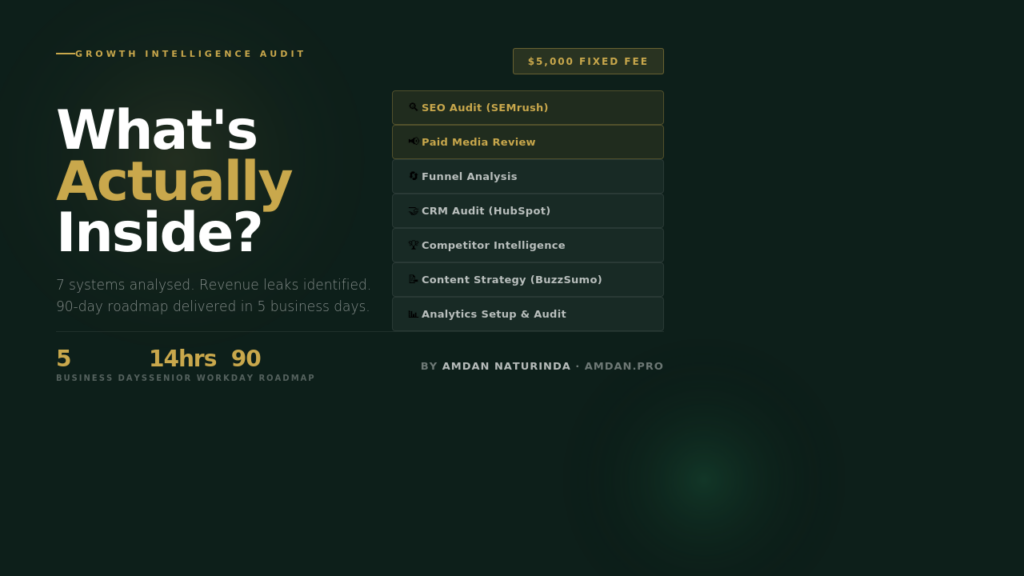
Most business owners who contact me have already tried something. They ran Google Ads that burned through budget with no leads. They hired an SEO agency that delivered a traffic report but no revenue. They built a website that looked good and converted nobody. The problem is almost never a lack of marketing activity. It is a lack of diagnostic clarity. Nobody sat down and mapped the actual system — where leads come from, where they drop off, what the data says versus what the team believes. That is exactly what the Growth Intelligence Audit is designed to fix. What the Growth Intelligence Audit Is Not Before explaining what is included, it is worth being clear about what this is not. It is not a generic SEO report generated by a tool and repackaged as strategy. It is not a surface-level website review. It is not a list of recommendations without data to support them. It is a multi-system diagnostic — covering SEO, paid media, funnels, CRM, and content — conducted by a senior consultant who has worked across Gulf, African, and international markets, using professional-grade tools and over seven years of pattern recognition. The output is a Revenue Leak Report and a 90-Day Growth Roadmap. Not a slide deck full of observations — a prioritised action plan tied to measurable revenue outcomes. What the Audit Covers 1. SEO Performance Analysis (via SEMrush) We begin with a full crawl of your website and a keyword position audit using SEMrush. This covers your current organic visibility — which keywords you rank for, which you should rank for but don’t, where your competitors are outranking you, and what technical issues are suppressing your performance. In 2026, SEO analysis also includes AI visibility — whether your content is being cited in Google AI Overviews, ChatGPT, and Perplexity. Ranking on page one is no longer sufficient if 60% of searches end without a click. We assess your AI citation presence and identify the gaps. Deliverable: Keyword gap report, technical SEO issue list, AI visibility assessment. 2. Paid Media Audit (Google Ads & Facebook/Instagram) If you are running paid ads, we audit the full account structure — campaign architecture, targeting, ad copy, landing page alignment, conversion tracking, and cost per acquisition. The most common finding: ad spend is generating clicks but the conversion tracking is broken or missing entirely, so the business has no reliable data on which campaigns are actually producing leads. We fix this before recommending any budget changes. If you are not yet running paid ads, we assess the opportunity — what a $300–$600/month Google Search and Facebook campaign could realistically return in your market, based on current CPA benchmarks and ROMI modelling. Deliverable: Ad account audit report, conversion tracking assessment, channel recommendation. 3. Funnel & Landing Page Review We map your full customer journey — from first touchpoint to closed deal — and identify where prospects are dropping off. This includes a review of your key landing pages, lead capture forms, follow-up sequences, and the alignment between your ad messaging and your on-page offer. Misalignment between what an ad promises and what a landing page delivers is one of the most common and costly revenue leaks we find. We also assess your offer clarity. Can a prospect who lands on your page immediately understand what you do, who it is for, and what to do next? If the answer requires more than five seconds, revenue is leaking. Deliverable: Funnel map, drop-off identification, landing page recommendations. 4. CRM & Lead Nurturing Audit (via HubSpot) If you use a CRM — particularly HubSpot — we audit how leads are being captured, segmented, and followed up. The most expensive revenue leak in most businesses is not at the top of the funnel. It is in the middle: leads that expressed interest, were never properly followed up, and went cold or chose a competitor. A well-configured CRM and nurturing sequence can recover a significant percentage of these leads at zero additional ad spend. If you are not using a CRM, we assess whether HubSpot or an alternative is appropriate for your volume and team structure, and what a basic implementation would look like. Deliverable: CRM audit, nurturing sequence review, lead recovery recommendations. 5. Competitor Intelligence Analysis We analyse your top three to five competitors — their keyword strategies, ad activity, content approach, and estimated traffic — to identify where they are winning and where the gaps are. This is not about copying competitors. It is about understanding the competitive landscape so your strategy is built with full visibility of the terrain. Markets where competitors have weak content or thin SEO coverage are opportunities. Markets where competitors have invested heavily in specific channels are signals to differentiate. Deliverable: Competitor matrix, opportunity identification. 6. Content Strategy Assessment (via BuzzSumo) We review your existing content — blog posts, social media, lead magnets — against what is actually performing in your category using BuzzSumo data. This identifies which topics your audience engages with, which content formats drive shares and backlinks, and whether your current content is aligned with the search intent of your target clients. Deliverable: Content gap analysis, topic opportunity list. 7. Google Analytics & Search Console Setup and Audit We verify that your measurement infrastructure is correctly configured — that Google Analytics and Search Console are tracking the right events, that conversion goals are set up, and that the data you are making decisions from is actually accurate. Businesses that have been running for years often discover during this audit that key pages were excluded from tracking, that form submissions were not counted as conversions, or that referral traffic was being misattributed. You cannot improve what you cannot measure accurately. Deliverable: Analytics audit report, configuration fixes if required. What You Walk Away With After five business days, you receive two documents: Revenue Leak Report — a prioritised list of where your business is losing revenue across every system we audited, with the data that supports each