
Why I Charge $350/Hour — And Why My Clients Say It’s Worth It

I am going to tell you something that most consultants won’t. Pricing is not about what your time is worth. It is about what your client’s outcome is worth — and whether you can reliably deliver it. When I set my base rate at $350 per hour, I did not arrive at that number by calculating my living expenses or benchmarking against other consultants in my city. I arrived at it by working backwards from the outcomes I consistently produce for clients and asking: what is a fair exchange for that value? This post is the honest answer to a question I get regularly: why does it cost this much, and is it actually worth it? What $350/Hour Is Not Paying For Let me start with what you are not buying. You are not paying for my time sitting in meetings. You are not paying for deliverables that look impressive but don’t move revenue. You are not paying for a junior team member executing tasks under my name. Every engagement I take on is senior-level work. I do the analysis. I build the strategy. I interpret the data. When I deliver a Growth Intelligence Audit, every finding in that report came from my direct review of your accounts — not a templated tool output, not a junior analyst’s summary. That distinction matters more than most clients realise until they have worked with both. What 7 Years of Pattern Recognition Actually Costs I have been working in SEO, paid media, and revenue systems for over seven years — across e-commerce, healthcare, real estate, education, and corporate sectors in the Gulf, East Africa, and beyond. In that time, I have seen the same mistakes made by businesses at every size and stage. The Google Ads account with $40,000 in lifetime spend and no conversion tracking. The HubSpot CRM with 2,000 contacts and zero follow-up sequences. The website that ranks on page one for three keywords and converts at 0.4%. When I audit your business, I am not starting from scratch. I am pattern-matching against seven years of real engagements — which means I find the revenue leaks faster, prioritise the highest-impact fixes first, and build strategies that are tested against real market conditions rather than theoretical frameworks. That pattern recognition is what you are paying for. It cannot be replicated by a cheaper generalist, no matter how many hours they invest. The Real Cost of Cheap Marketing Here is the calculation most business owners don’t make until after the fact. A $500/month retainer with an agency that doesn’t move the needle costs you $6,000 per year — plus the opportunity cost of the revenue you didn’t generate while waiting for results that never came. A $2,000 SEO package that produces rankings for keywords nobody converts from costs you $2,000 plus the twelve months of traffic that didn’t translate into clients. A Facebook ad campaign managed by someone who doesn’t understand conversion tracking costs you whatever you spent — plus the decisions you made based on inaccurate data. I have inherited all of these situations from clients who came to me after the cheaper option failed. The first thing we do in every case is the same: find the revenue leaks and establish what is actually working before spending another dollar. Cheap marketing is not less expensive. It is expensive in a way that is harder to see on the invoice. How the Pricing Is Structured My base rate of $350 per hour applies to standalone consulting sessions — strategy calls, campaign reviews, advisory engagements. For most clients, the better entry point is the Growth Intelligence Audit — a fixed-fee diagnostic at $5,000, representing approximately 14–15 hours of senior-level work delivered in five business days. The fixed-fee structure removes ambiguity: you know exactly what you are getting and exactly what it costs before you commit. For ongoing engagements, I offer two structured packages: Growth Engine — $10,000/month. Approximately 28–30 hours of monthly execution across SEO, paid media, funnel optimisation, and CRM automation. At $350/hour, this represents $10,500 in hourly equivalent value, bundled for consistent execution. Revenue Growth System — $20,000/month. Approximately 55–60 hours of senior strategy and execution — full-system coverage across all channels, infrastructure, and revenue architecture. This is a partnership, not a service provider relationship. Every tier is anchored to the same $350/hour rate so clients can understand exactly what they are buying relative to the time and expertise invested. What Clients Have Said After working on Uganda’s Innovation Week in 2020 — a hybrid event during COVID-19 — the team at Talent Africa noted that SEO, data analytics, and targeted campaigns turned low registrations into over 1,000 participants within a month. After a CRM and Google Ads engagement with Consilium House in Bahrain, the feedback was that a data-driven approach significantly improved lead quality and conversion rates — and that the integration of Google Ads with structured HubSpot workflows ensured consistent client follow-up. Abdul Ahmed, CEO of Erabahrain, noted that SEO, A/B testing, and HubSpot CRM optimisation produced a measurable increase in high-quality leads, improved client engagement, and faster sales conversions. These are not traffic wins. They are revenue wins. That distinction is the point. The Question to Ask Yourself Before evaluating whether $350/hour is expensive, ask a different question: what is one additional qualified client worth to your business? If your average client is worth $5,000, $10,000, or $50,000 — then a single additional client acquired through better strategy more than justifies the investment in getting that strategy right. The Growth Intelligence Audit at $5,000 fixed fee has produced clients who closed $30,000–$60,000 in revenue within 90 days. The ROMI on that investment is not marginal — it is transformational. Expensive is relative. What is actually expensive is marketing that doesn’t work. Ready to See What This Looks Like for Your Business? If you want to understand exactly where your business is losing revenue — and what it would take to fix it — the Growth Intelligence Audit
What Does a Growth Intelligence Audit Actually Include?
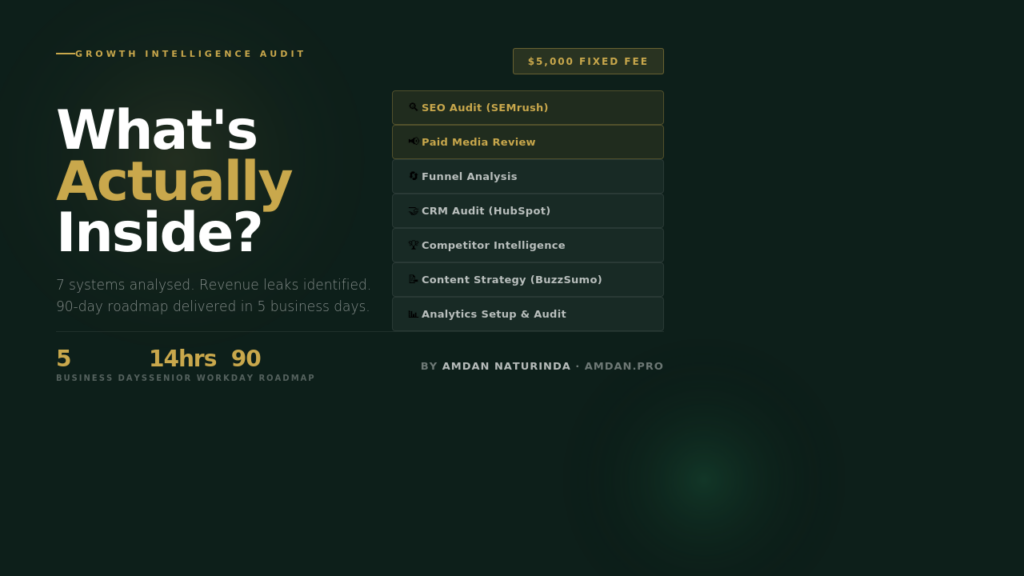
Most business owners who contact me have already tried something. They ran Google Ads that burned through budget with no leads. They hired an SEO agency that delivered a traffic report but no revenue. They built a website that looked good and converted nobody. The problem is almost never a lack of marketing activity. It is a lack of diagnostic clarity. Nobody sat down and mapped the actual system — where leads come from, where they drop off, what the data says versus what the team believes. That is exactly what the Growth Intelligence Audit is designed to fix. What the Growth Intelligence Audit Is Not Before explaining what is included, it is worth being clear about what this is not. It is not a generic SEO report generated by a tool and repackaged as strategy. It is not a surface-level website review. It is not a list of recommendations without data to support them. It is a multi-system diagnostic — covering SEO, paid media, funnels, CRM, and content — conducted by a senior consultant who has worked across Gulf, African, and international markets, using professional-grade tools and over seven years of pattern recognition. The output is a Revenue Leak Report and a 90-Day Growth Roadmap. Not a slide deck full of observations — a prioritised action plan tied to measurable revenue outcomes. What the Audit Covers 1. SEO Performance Analysis (via SEMrush) We begin with a full crawl of your website and a keyword position audit using SEMrush. This covers your current organic visibility — which keywords you rank for, which you should rank for but don’t, where your competitors are outranking you, and what technical issues are suppressing your performance. In 2026, SEO analysis also includes AI visibility — whether your content is being cited in Google AI Overviews, ChatGPT, and Perplexity. Ranking on page one is no longer sufficient if 60% of searches end without a click. We assess your AI citation presence and identify the gaps. Deliverable: Keyword gap report, technical SEO issue list, AI visibility assessment. 2. Paid Media Audit (Google Ads & Facebook/Instagram) If you are running paid ads, we audit the full account structure — campaign architecture, targeting, ad copy, landing page alignment, conversion tracking, and cost per acquisition. The most common finding: ad spend is generating clicks but the conversion tracking is broken or missing entirely, so the business has no reliable data on which campaigns are actually producing leads. We fix this before recommending any budget changes. If you are not yet running paid ads, we assess the opportunity — what a $300–$600/month Google Search and Facebook campaign could realistically return in your market, based on current CPA benchmarks and ROMI modelling. Deliverable: Ad account audit report, conversion tracking assessment, channel recommendation. 3. Funnel & Landing Page Review We map your full customer journey — from first touchpoint to closed deal — and identify where prospects are dropping off. This includes a review of your key landing pages, lead capture forms, follow-up sequences, and the alignment between your ad messaging and your on-page offer. Misalignment between what an ad promises and what a landing page delivers is one of the most common and costly revenue leaks we find. We also assess your offer clarity. Can a prospect who lands on your page immediately understand what you do, who it is for, and what to do next? If the answer requires more than five seconds, revenue is leaking. Deliverable: Funnel map, drop-off identification, landing page recommendations. 4. CRM & Lead Nurturing Audit (via HubSpot) If you use a CRM — particularly HubSpot — we audit how leads are being captured, segmented, and followed up. The most expensive revenue leak in most businesses is not at the top of the funnel. It is in the middle: leads that expressed interest, were never properly followed up, and went cold or chose a competitor. A well-configured CRM and nurturing sequence can recover a significant percentage of these leads at zero additional ad spend. If you are not using a CRM, we assess whether HubSpot or an alternative is appropriate for your volume and team structure, and what a basic implementation would look like. Deliverable: CRM audit, nurturing sequence review, lead recovery recommendations. 5. Competitor Intelligence Analysis We analyse your top three to five competitors — their keyword strategies, ad activity, content approach, and estimated traffic — to identify where they are winning and where the gaps are. This is not about copying competitors. It is about understanding the competitive landscape so your strategy is built with full visibility of the terrain. Markets where competitors have weak content or thin SEO coverage are opportunities. Markets where competitors have invested heavily in specific channels are signals to differentiate. Deliverable: Competitor matrix, opportunity identification. 6. Content Strategy Assessment (via BuzzSumo) We review your existing content — blog posts, social media, lead magnets — against what is actually performing in your category using BuzzSumo data. This identifies which topics your audience engages with, which content formats drive shares and backlinks, and whether your current content is aligned with the search intent of your target clients. Deliverable: Content gap analysis, topic opportunity list. 7. Google Analytics & Search Console Setup and Audit We verify that your measurement infrastructure is correctly configured — that Google Analytics and Search Console are tracking the right events, that conversion goals are set up, and that the data you are making decisions from is actually accurate. Businesses that have been running for years often discover during this audit that key pages were excluded from tracking, that form submissions were not counted as conversions, or that referral traffic was being misattributed. You cannot improve what you cannot measure accurately. Deliverable: Analytics audit report, configuration fixes if required. What You Walk Away With After five business days, you receive two documents: Revenue Leak Report — a prioritised list of where your business is losing revenue across every system we audited, with the data that supports each