
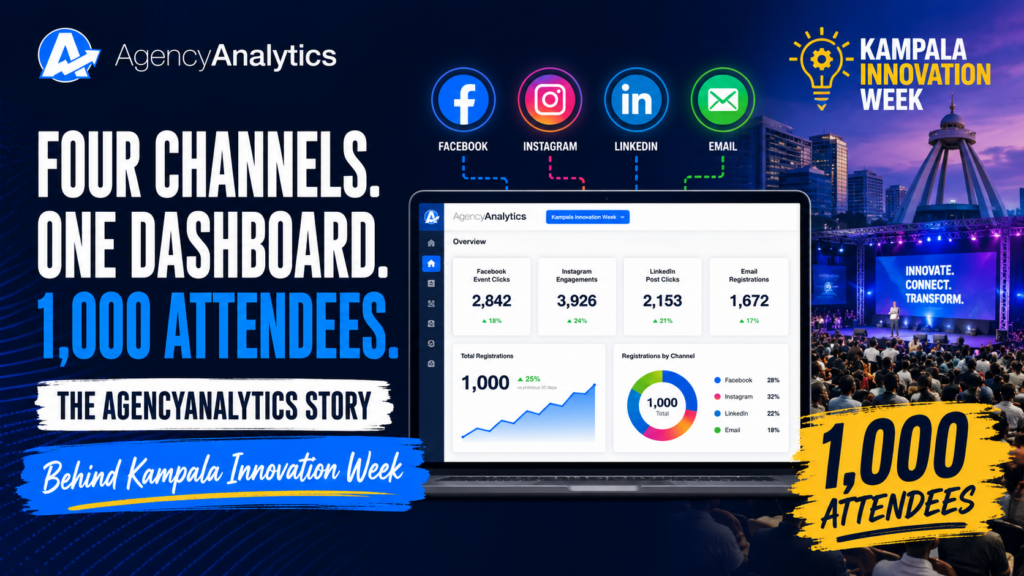
In 2020, I launched Kampala Innovation Week for Talent Africa Group — Uganda’s first hybrid event. The stack I used to run it was not simple: Facebook ads for awareness, MailChimp for email marketing, HubSpot for CRM and lead management, and Agency Analytics for reporting.
That last tool was not an afterthought. It was the layer that tied everything together — the platform that took data from four different systems and turned it into a single, coherent picture of what was working, what wasn’t, and where the next dollar of investment should go.
In a month, the event went from low registrations to over 1,000 participants. The Facebook ads drove awareness. MailChimp nurtured leads. HubSpot managed the pipeline. But AgencyAnalytics was what made the decision-making clear — showing in real time which channel was generating registrations, which email sequences were converting, and where the bottlenecks were.
That experience — managing a high-pressure, multi-channel campaign with clear measurement infrastructure — is the foundation of how I approach reporting for every client engagement today. And what I have learned since is that the reporting tool is not just an administrative function. It is a direct driver of ROI and ROMI improvement. Here is why — and here is the evidence.
The Reporting Problem That Is Costing Agencies and Consultants Their Clients
Let us start with an uncomfortable truth.
If you are still manually taking screenshots of Facebook Ads and pasting them into a slide deck, you are operating in 2018. In 2026, live data streams are the minimum standard.
The manual reporting process that most agencies and consultants still use is not just inefficient. It is commercially dangerous. Every hour spent compiling data from six different platforms is an hour not spent optimising campaigns. Every report delivered five days after month-end is five days of delayed decision-making. And every client who has to wait for their consultant to “pull together the numbers” before making a budget decision is a client who is silently questioning the value of the engagement.
According to the SoDA Report on agency efficiency, agencies with automated weekly or bi-weekly reporting dashboards retain clients 34% longer than those delivering monthly PDF reports manually.
Client retention is a direct ROMI driver. If your current reporting process is contributing to client churn — and manual, delayed reporting does — then the investment in a professional reporting platform is not an overhead cost. It is a revenue protection investment.
What AgencyAnalytics Actually Does
AgencyAnalytics is not a general analytics tool. It is built specifically for agencies — pulling in data from over 80 marketing channels, including Google Ads, Facebook, SEO platforms, and email tools, and turning them into customisable, client-ready reports with white-labelled dashboards, scheduled reporting, and built-in ROI tracking.
The platform makes it simple to manage dozens of clients from a single dashboard, with each client getting their own branded reporting portal. The white-label capabilities are comprehensive — you can customise everything from the dashboard interface to automated email reports with your agency’s branding.
The integrations that matter most for the Growth Intelligence Stack used in every amdan.pro audit:
- Google Analytics 4 — website traffic, conversion events, user behaviour
- Google Search Console — organic search performance, keyword positions, click-through rates
- Google Ads — paid search performance, cost per click, conversion tracking
- Facebook/Meta Ads — social campaign performance, CPM, CPA, ROAS
- SEMrush — SEO rankings, backlink authority, keyword movements
- HubSpot — CRM pipeline, lead flow, deal velocity
- MailChimp / Kit — email open rates, click rates, sequence performance
AgencyAnalytics integrations include over 80 platforms, with Google Analytics 4, Gravity Forms, and HighLevel among the strongest. It eliminates manual updates, ensuring clients receive timely, data-driven reports without extra effort. The client portal gives clients access to real-time dashboards with instant access to their data anytime.
When all of these data sources flow into a single dashboard — updated in real time, branded with your agency identity, accessible to clients 24/7 — the reporting function shifts from a backward-looking administrative task to a forward-looking strategic asset.
How AgencyAnalytics Directly Improves ROI
The connection between a reporting platform and improved ROI is not indirect. It operates through four specific mechanisms:
1. Faster Decision-Making Reduces Wasted Spend
The most expensive period in any marketing campaign is the period between when something stops working and when you find out about it.
A Facebook ad set whose cost per lead has doubled over 72 hours is burning budget. If you discover this on a weekly report review, you have lost three days of overspend. If your AgencyAnalytics dashboard is sending automated anomaly alerts — as it does with its AI summaries, anomaly detection, and metric alerts — you find out within hours and can pause or adjust before significant damage is done.
For a client spending $600/month on ads, catching a 72-hour CPL spike within hours versus days can represent the difference between a wasted $60 and a wasted $200. At scale, this single function pays for the platform many times over.
2. Attribution Clarity Moves Budget to What Works
The most common ROI problem in multi-channel marketing is not that the channels don’t work. It is that the business doesn’t know which channels are working — so it distributes budget based on assumption rather than evidence.
A business running Google Search Ads, Facebook campaigns, and organic SEO simultaneously, with no unified reporting layer, cannot answer the question: “Where did this client come from?” They might attribute it to Facebook because the client mentioned seeing an ad — without knowing that the client had also visited the website three times from organic search before clicking the Facebook ad.
AgencyAnalytics’ unified dashboard surfaces this multi-touch picture. By consolidating Google Analytics conversion data with Google Ads spend data and Facebook campaign performance, the platform allows genuine channel attribution — which channels are contributing leads, at what cost, and in what sequence.
The ROMI improvement from this clarity is direct and measurable. Shifting 20% of budget from a channel with a $120 CPL to one with a $45 CPL, based on attribution data that was previously unavailable, produces a ROMI improvement that compounds every month the reallocation is maintained.
3. Client Transparency Reduces Churn — and Churn Is a ROMI Killer
The most underestimated ROMI drain in service businesses is client churn.
Acquiring a new client at a $350/hour consulting rate, with a 20% close rate from paid leads at $50 CPA, means spending $250 in acquisition costs for each new client. If that client churns after one month because they feel they don’t have visibility into what their money is doing, the acquisition investment is unrecovered and the full acquisition cost must be spent again for the replacement.
Agencies with automated weekly or bi-weekly reporting dashboards retain clients 34% longer than those delivering monthly PDF reports manually. Applied to a consulting practice with an average client value of $5,000 per engagement, a 34% improvement in retention represents thousands of dollars in recovered lifetime value per client — from a platform that starts at $59/month.
The ROI on the reporting tool is not just the time saved building reports. It is the revenue retained by not losing clients who felt uninformed.
4. White-Label Reporting as a Competitive Differentiator
In a crowded consulting and agency market, the ability to deliver professional, branded, real-time reporting dashboards to clients is a genuine competitive differentiator — and a justification for premium pricing.
A client who logs into a branded portal showing their SEO rankings, Google Ads performance, HubSpot pipeline, and Facebook campaign ROAS — updated in real time, with AI-generated summaries of what the data means — is experiencing a level of service that most consultants and agencies cannot provide.
That experience has a price premium attached to it. And it has a retention premium — the client who feels they have full visibility into their marketing investment is not actively looking for alternatives.
The AgencyAnalytics Stack in Practice — The Talent Africa Case
The Kampala Innovation Week campaign in 2020 demonstrated every one of these mechanisms in a compressed, high-stakes environment.
The campaign ran across four channels simultaneously: Facebook ads for awareness and registration, MailChimp for email nurturing of interested leads, HubSpot for pipeline and attendee management, and AgencyAnalytics as the reporting layer that unified all four.
Without the unified reporting layer, managing this campaign would have required logging into four separate platforms, manually extracting data, and compiling it into a report — a process that in a fast-moving event campaign could mean acting on data that was 24–48 hours old.
With AgencyAnalytics, the dashboard showed in real time: which Facebook ad sets were generating registrations at the lowest cost, which email sequences were converting interest to confirmed attendance, where the HubSpot pipeline was stalling, and what the total cost per attendee was across all channels combined.
The decisions made as a result — pausing underperforming ad sets, doubling down on the email sequences with the highest open-to-click conversion rates, adjusting the HubSpot pipeline stages — were made with current data, not delayed data. The result: 1,000+ attendees within one month.
That is the practical ROI of real-time reporting. Not the report itself — the decisions the report enables.
Calculating the ROI of AgencyAnalytics Itself
AgencyAnalytics plans start at $59/month. At that price point, the ROI calculation is straightforward:
Time saved on manual reporting: Most agencies spend 3–6 hours per client per month on manual report compilation. At $350/hour equivalent consulting rate, 4 hours of manual reporting per client = $1,400 in time cost per client per month.
AgencyAnalytics automates that process. Across five clients, the time saving alone = $7,000/month in recovered consulting capacity — against a platform cost of $59–$200/month.
Client retention improvement: If AgencyAnalytics’ real-time reporting improves client retention by even 20% — conservative relative to the 34% SoDA benchmark — and average client value is $5,000, retaining one additional client per quarter who would otherwise have churned = $20,000 in annual retained revenue from a $708–$2,400/year platform subscription.
ROMI on AgencyAnalytics at $59/month:
- Monthly platform cost: $59
- Monthly time saved (4 hrs × $350): $1,400
- Quarterly retention value (1 client × $5,000 ÷ 3): $1,667
- Total monthly value: $3,067
- AgencyAnalytics ROMI: ($3,067 − $59) ÷ $59 × 100 = 5,098%
Most agencies see full ROI within 60 days of implementation. At these numbers, the ROI case for AgencyAnalytics is clearer than almost any other tool in the growth stack.
AgencyAnalytics in the Full Growth Intelligence Stack
AgencyAnalytics does not replace the other tools in the growth stack. It unifies them. The value of each individual tool — SEMrush’s keyword data, HubSpot’s CRM pipeline, Google Ads’ conversion tracking, Facebook’s audience performance — is multiplied when all of it is visible in a single dashboard, updated in real time, and presented in a format that both you and your client can act on immediately.
In a world where clients are bombarded by agencies making empty promises, transparency is your most lethal weapon. If you don’t have a real-time mirror showing the client their ROI, you are replaceable.
The full stack — SEMrush for visibility intelligence, HubSpot for CRM and pipeline, Google Analytics and Tag Manager for measurement, Hotjar for conversion behaviour, and AgencyAnalytics as the reporting layer that unifies all of it — is not a collection of individual tools. It is an integrated revenue intelligence system.
Each component is only as useful as the clarity it produces. AgencyAnalytics is the tool that turns data into clarity — and clarity into decisions that improve ROI and ROMI.
The Bottom Line
Reporting is not a deliverable. It is a decision-making system.
The consultants and agencies that understand this — that treat their reporting infrastructure as a strategic investment rather than an administrative obligation — are the ones that retain clients longer, justify premium pricing, and make faster, more accurate decisions that compound into measurably better campaign performance.
AgencyAnalytics is the platform I used to manage the Kampala Innovation Week campaign in 2020. It is the reporting layer in every Growth Intelligence Audit I run today. And it is, at $59/month, one of the highest-ROI tools in any service business’s stack.
If you want to understand how to build a reporting infrastructure that proves your value in real time — and how the full growth intelligence stack fits together to drive measurable ROI and ROMI improvement — a Growth Intelligence Audit maps your current measurement setup and delivers a 90-day roadmap in five business days.
Related reading: