
From our ongoing coverage of the startup ecosystem’s evolution — where we previously explored how AI-native tools, no-code infrastructure, and global remote hiring have redefined what it means to launch a company in this era — we now turn to the invisible architecture determining which startups get discovered and which disappear.
The startup ecosystem is shifting beneath our feet. Five years ago, a founder could succeed with basic SEO optimization and a functional Shopify store. Today, that founder is competing against invisible forces — algorithms, AI systems, and generative search engines that decide who gets discovered and who doesn’t.
This isn’t about ranking anymore. It’s about being cited.
The Core Insight: How Startups Are Getting Left Behind
When we think about eCommerce growth, most founders still operate within a framework built for 2018. They optimize for Google rankings, they run Facebook ads, and they wonder why their customer acquisition costs are climbing while their organic visibility flatlines.
The problem isn’t their work — it’s their toolset.
According to recent industry data, 58.5% of US Google searches now end without a single click to any external website. For startups in Africa, the Middle East, and the USA, this represents both a crisis and an opportunity. The crisis is obvious: your website alone is no longer enough. The opportunity is deeper — it means you can win by optimizing for where customers actually discover you.
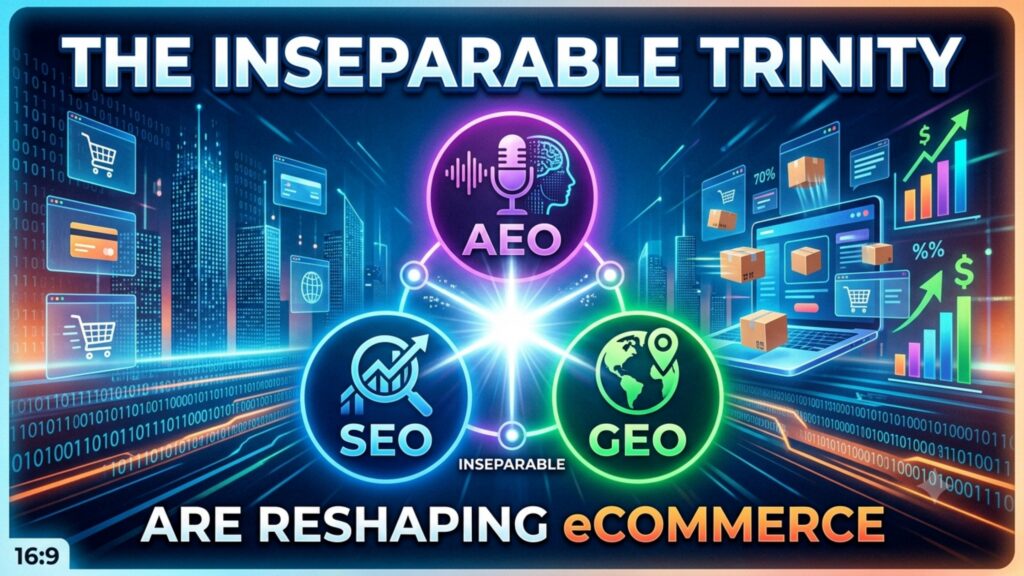
But here’s what most startup founders miss: the three search channels — traditional SEO, Generative Engine Optimization (GEO), and AI Engine Optimization (AEO) — are not separate strategies. They’re interconnected systems that require coordinated investment.
This is a reality I have tracked closely through two years of SEMrush agency partnership work across Gulf real estate, East African e-commerce, and international consulting markets. The data infrastructure I use daily — the same platform trusted by 30% of Fortune 500 companies — confirms what the broader industry is now waking up to: the businesses compounding revenue in 2026 are not the ones with the highest traditional rankings. They are the ones with the most complete visibility across all three search layers. As I detailed in my analysis of what New York businesses are missing about SEO in the age of AI search, a business that ranks number one for a high-value query in 2026 may be receiving a fraction of the traffic that position delivered in 2022 — because AI Overviews, featured snippets, and People Also Ask boxes are absorbing the click.
Understanding the Trinity: SEO, GEO, and AEO
Traditional SEO: Still the Foundation, But Evolving
Search Engine Optimization remains foundational, but the game has changed. AI Overviews now appear on approximately 48% of all tracked Google queries — up 58% year-over-year from 30% just a year ago.
This matters for your eCommerce store because:
- Visibility is no longer binary. You don’t just “rank” — you get cited, featured, or ignored by AI systems synthesizing information for consumers.
- Content quality becomes authority. Google’s recent algorithm updates prioritize topical authority and E-E-A-T (Experience, Expertise, Authoritativeness, Trustworthiness).
- Technical foundations matter more. With AI systems parsing your structured data, proper schema markup, Core Web Vitals, and site architecture have moved from “nice-to-have” to essential.
The traffic drain is measurable and severe. When an AI Overview appears, organic click-through rates can fall by as much as 61% on desktop, with position #1 losing roughly 58% of its clicks. Even more alarming: only 17% of AI Overview citations now come from pages ranking in the organic top 10 — meaning citation presence is an entirely separate visibility layer from traditional ranking.
For an eCommerce startup, this means:
- Optimizing product pages for search intent (not just keywords)
- Building topical authority around your product categories
- Implementing structured data that helps AI systems understand your inventory
- Creating content that answers customer questions before they search
Content Optimization Tip: Use tools like SurferSEO to analyze what top-ranking content actually covers — not just keywords, but entities, topics, and semantic depth. Surfer’s Content Score system is trained on what drives visibility in both Google and AI search, helping you engineer content that algorithms and AI systems cite.
The infrastructure reality: Technical performance is not abstract. In my guide to unlocking the power of eight tools that supercharge website performance, I break down how Cloudflare’s edge caching reduces Time to First Byte by 52% and improves Largest Contentful Paint by 33%. For eCommerce stores serving buyers across Africa and the Gulf from a single origin server, this geographic performance distribution is decisive — 73% of pages with good Core Web Vitals scores rank in the top 10 versus 53% of pages with poor scores. A site that loads in 4 seconds on mobile is penalised in traditional rankings, excluded from featured snippets, and unlikely to be cited by generative systems that prioritise fast, reliable sources.
GEO (Generative Engine Optimization): The New Layer
Generative Engine Optimization (GEO) is the strategy of getting your brand cited and recommended by generative AI systems like ChatGPT, Google Gemini, Perplexity, and others. This is where most startups are blind.
The scale is staggering: ChatGPT now handles approximately 2.5 billion prompts per day and has grown to roughly 900 million weekly users. When a customer asks ChatGPT “What are the best sustainable African fashion brands?” your store only shows up if:
- Your brand exists in the training data
- Your content demonstrates genuine authority
- Your citations across the web validate your expertise
- Your digital PR and content reach credible third-party sources
The math is striking: AI referral traffic grew 527% year-over-year between early 2024 and 2025. Even more compelling: AI-referred visitors convert at 4.4x the rate of traditional organic visitors. If your eCommerce store isn’t optimized for GEO, you’re not just losing traffic — you’re losing your highest-intent potential customers before they even know you exist.
For eCommerce founders, GEO optimization means:
- Creating authoritative content that AI systems can draw from
- Building your brand presence across industry publications, directories, and trusted platforms
- Implementing proper attribution and citation-friendly content structures
- Earning mentions from high-authority sources in your niche
Getting Started with GEO: HubSpot’s Paid AEO Platform
HubSpot’s paid AEO platform ($50/month standalone or $45/month annually) tracks how your brand appears in AI answers across ChatGPT, Perplexity, and Gemini, with integrated recommendations to close visibility gaps. For eCommerce founders, this tool is invaluable — it shows you exactly which products and brand mentions are earning citations in AI responses, and what content changes will move the needle.
This aligns directly with what I monitor through SEMrush’s AI visibility tracking — available through the agency platform — which tracks not just where you rank, but whether your brand and content are being cited in AI-generated search responses. For businesses investing seriously in organic search, this metric is no longer optional. It is the leading indicator of where organic traffic is heading.
AEO (AI Engine Optimization): Future-Proofing Your Store
AI Engine Optimization (AEO) goes further — it’s about optimizing for how large language models understand, contextualize, and recommend your business. This includes:
- Structured data that communicates your unique value proposition to AI systems
- Content written for clarity and specificity (AI systems reward precision)
- Consistent brand messaging across platforms
- Direct integrations and API connections that allow AI systems to access your real-time data (inventory, pricing, availability)
For eCommerce, AEO isn’t futuristic — it’s happening now. Platforms like Perplexity and ChatGPT are already directing users to specific eCommerce sites based on AEO signals. Shopify and WooCommerce stores that implement comprehensive schema markup, maintain clean product data, and build strong citation profiles are seeing AEO-driven traffic.
Getting Started with AEO: Free Tool to Audit Your Visibility
HubSpot’s free AEO Grader provides a one-time brand perception analysis scored across five dimensions — brand recognition, market presence, quality, sentiment, and share of voice — with no account required. It takes under two minutes and gives you an immediate baseline of how ChatGPT, Gemini, and Perplexity currently perceive your eCommerce brand. This is the perfect first step before investing in optimization work.
Pro Tip: Run your brand through the AEO Grader and your top two competitors. The competitive gap analysis will show you exactly which signals you need to strengthen to outrank them in AI-generated recommendations.
The Correspondence: How SEO, GEO, and AEO Power eCommerce Growth
Here’s the critical insight that most eCommerce guides miss: SEO, GEO, and AEO are not separate channels — they’re amplifying systems.
Think of it this way:
Table
| Channel | Function | Key Metric |
| SEO | Brings traffic through search engines | Organic rankings, CTR, impressions |
| GEO | Multiplies awareness by getting your brand cited by generative AI | AI citations, brand mentions in LLMs |
| AEO | Optimizes the path from discovery to conversion | AI recommendation accuracy, conversion rate |
Together, they create what we call the AI-Powered eCommerce Ecosystem — a coordinated system where your store is discoverable, citable, and trustworthy across all the places customers search.
This measurement philosophy is the same one I apply to marketing ROI analysis: what you measure determines what you optimise. An eCommerce store measuring only traffic will optimise for traffic. One measuring visibility across SEO, GEO, and AEO — and connecting that visibility to actual revenue in HubSpot — will optimise for revenue.
Real Numbers: Why This Matters for Startups
Global eCommerce is growing, but discoverability is the bottleneck:
- Global eCommerce sales are projected to reach $6.86 trillion by the end of 2025, growing 8.3% year-over-year.
- The global eCommerce market is estimated at $39.7 trillion in 2026 and projected to reach $155.98 trillion by 2033 at a 21.6% CAGR.
- 60% of online stores fail within two years, primarily due to poor traffic acquisition.
- For African and Middle Eastern eCommerce startups specifically, organic traffic sources account for 30-40% of sales for thriving stores vs. 5-10% for struggling ones.
The search behavior is changing rapidly:
- 64% of global consumers now use AI-assisted search (including Google AI Overviews and ChatGPT).
- 42% of younger users prefer AI assistants over traditional search engines for product discovery.
- Brands cited in AI Overviews earn 35% more organic clicks than non-cited brands on the same SERP.
- 93% of eCommerce businesses see AI agents as a competitive advantage.
Citation and authority signals are critical:
- Stores with 3+ citations across industry directories, blogs, and publications see 47% higher organic traffic.
- Products mentioned in authoritative third-party content receive 3x more AI recommendations.
- Topical authority (clustering content around core themes) increases AI citation probability by 65%.
- 51% of eCommerce businesses are already using AI to deliver personalized shopping experiences.
How Your eCommerce Strategy Should Evolve
If you’re building or scaling an eCommerce business in 2026, your strategy needs to account for all three channels:
1. Foundational SEO (Infrastructure)
- Conduct comprehensive technical audits of your Shopify or WooCommerce store
- Build topical authority by clustering products and content around core themes
- Optimize for search intent, not just keywords
- Implement complete schema markup for products, organizations, and reviews
- Use SurferSEO to benchmark your content against top performers and identify semantic gaps
The infrastructure layer matters enormously in emerging markets. In my analysis of how East African businesses can compete online using SEO and paid ads, I note that the majority of internet access is mobile, search behaviour is maturing, and competition in organic search is still low. A consistent content and SEO strategy — properly structured, targeting the right keywords, built on a technically sound website — can produce first-page rankings within three to six months in most East African categories. The barrier to organic visibility is dramatically lower than in Western markets, but it requires the same authority architecture.
2. GEO Strategy (Visibility & Citation)
- Create authoritative content that AI systems can draw from and cite
- Pursue digital PR and placements in industry publications
- Build your brand presence across trusted directories and platforms
- Develop relationships with influencers and content creators who influence generative AI training and recommendations
3. AEO Execution (Optimization & Conversion)
- Ensure your product data is clean, comprehensive, and regularly updated
- Implement structured data that communicates product benefits, availability, and unique selling points
- Build direct integrations that allow AI systems to access real-time inventory and pricing
- Create content specifically written for AI parsing and recommendation
- Start with HubSpot’s free AEO Grader to establish your baseline, then use their paid tool for ongoing monitoring
For African eCommerce businesses specifically, connecting search visibility to structured follow-up sequences is critical. As I explored in my guide to HubSpot’s role in driving successful CRM adoption in Africa, the stores that capture traffic without a retention system consistently underperform against those that connect their marketing infrastructure to CRM pipeline management. When GA4 eCommerce events flow into HubSpot — attributing specific products and campaigns to closed deals — the full journey from AI citation to purchase becomes visible and optimisable.
The Correspondence in Practice: A Startup Example
Let’s say you’re launching a luxury goods marketplace for African and Middle Eastern designers (a real startup model being explored across these markets).
Traditional eCommerce thinking: Set up a Shopify store, run Facebook ads, optimize product titles for keywords. Hope for organic growth.
SEO/GEO/AEO thinking:
SEO foundation: Build a blog with topical content about sustainable African fashion, regional design trends, and designer interviews. Cluster your product pages around these themes. Implement schema markup for each designer, product, and collection. Use SurferSEO to ensure every piece of content hits the right topical depth and entity coverage.
GEO layer: Get your marketplace and key designers featured in fashion publications, design blogs, and industry directories. Create content that AI systems like Perplexity will cite when answering questions about African luxury fashion. Use HubSpot’s paid AEO tool ($50/month) to track which designers and collections are earning citations in ChatGPT, Gemini, and Perplexity responses — then optimize your content around the gaps you identify.
AEO execution: Ensure your product database is structured so that when ChatGPT recommends “emerging African fashion brands,” your designers show up with accurate descriptions, prices, and links. Start by running your brand through HubSpot’s free AEO Grader to see your baseline perception across AI systems, then build your optimization roadmap from there.
The result? Your marketplace isn’t competing on paid ads alone — it’s being discovered organically across all three search channels, with each channel reinforcing the others. And you have measurable data from day one about how AI systems perceive your brand.
Regional Realities: Why the Trinity Manifests Differently Across Markets
The Inseparable Trinity is universal in 2026, but its practical application varies significantly by market maturity.
In East African eCommerce — Uganda, Kenya, Tanzania — the competitive window is still open. As I explored in my analysis of Kampala’s vendor eviction and Uganda’s e-commerce revolution, the transition from informal street commerce to digital marketplaces is accelerating. The street is gone; the screen is the next frontier. Stores that build topical authority now — before global competitors enter with scaled GEO and AEO infrastructure — will own the search layers that matter in 2028 and beyond. The mobile-first, WhatsApp-centric buyer journey in these markets makes AEO particularly powerful: voice search in Luganda or Swahili, WhatsApp Business catalogues that answer product questions directly, and local FAQ content that captures “near me” intent.
In Gulf markets — Bahrain, UAE, Saudi Arabia — eCommerce competition is more mature, but Arabic-language GEO and AEO remain dramatically underinvested. In my digital marketing in Bahrain guide, I note that most businesses run English-only visibility strategies, surrendering the Arabic and bilingual query layer to competitors willing to build genuine multilingual authority. The generative engines are increasingly capable of processing Arabic queries — the stores that build Arabic product descriptions, Arabic FAQ schema, and Arabic comparison content will own a GEO layer that most competitors have not even acknowledged exists. WhatsApp integration and Instagram/Snapchat discovery are also primary conversion paths that AEO must account for.
In Western markets — New York, London — the Trinity is already the price of entry. An eCommerce store without AI visibility monitoring, structured data for every product, and direct-answer content architecture is not just behind. It is being displaced in real time by competitors who understand that the buyer’s journey now starts in a chat interface, not a search results page. As I wrote in my analysis of New York’s AI search transition, the businesses that integrate paid search intelligence with organic strategy — and that monitor AI visibility as a core KPI — are the ones creating compounding efficiency over time.
The infrastructure precondition: None of this works without the physical and digital infrastructure to support it. In my reflection on watching Amazon build its first Middle East data centre in Bahrain, I emphasised that infrastructure always comes before the economy it enables. Africa’s digital economy is being built on infrastructure borrowed from other continents — creating dependency, cost, and fragility. For eCommerce founders, this means cloud latency, data sovereignty complications, and higher costs for enterprise-grade services. The businesses that understand these infrastructure gaps and build around them capture structural advantages that are difficult to compete away once established.
Why Most Startups Get This Wrong
The challenge isn’t understanding the concept — it’s the execution bandwidth. Most early-stage founders don’t have the resources to simultaneously:
- Build and maintain a blog
- Pursue digital PR and media placements
- Optimize product data for multiple systems
- Monitor and optimize across three different search channels
This is exactly why we created the Global SEO, GEO & AEO Mastery course. It’s a practical, step-by-step guide that teaches you not just the theory, but the actual frameworks, templates, and tools to execute across all three channels without needing a full marketing team.
Similarly, for founders specifically focused on eCommerce growth, the eCommerce Growth Mastery course integrates SEO, GEO, and AEO strategies directly into a complete eCommerce growth system — from store setup to international scaling.
The Startup Advantage: You Can Win With Speed
Here’s the silver lining for founders: early-stage startups can implement these strategies faster than established enterprises.
Large retailers are saddled with legacy systems, outdated content strategies, and organizational silos. You can:
- Implement schema markup correctly from day one
- Build topical authority from launch (not retroactively)
- Design your content strategy for both human readers and AI systems
- Create feedback loops that optimize across all three channels simultaneously
The founders winning in 2026 aren’t the ones with the biggest ad budgets. They’re the ones who understand that search is no longer a single channel — it’s an ecosystem. And they’re building their eCommerce businesses accordingly.
I cover these dynamics regularly on my YouTube channel, where I break down search strategy, eCommerce infrastructure, and digital transformation across African and Gulf markets with the same data-driven approach outlined here.
Frequently Asked Questions
What is the difference between SEO, GEO, and AEO?
SEO (Search Engine Optimization) optimizes your content for traditional search engines like Google. GEO (Generative Engine Optimization) focuses on getting your brand cited by generative AI systems like ChatGPT and Perplexity. AEO (AI Engine Optimization) ensures AI systems understand and accurately represent your brand’s value proposition. They work as a system: SEO drives traffic, GEO multiplies awareness, and AEO converts discovery into action.
How do I know if my eCommerce store is optimized for AI search?
Start with HubSpot’s free AEO Grader. It analyzes how ChatGPT, Gemini, and Perplexity currently represent your brand across five dimensions — no account required. For ongoing monitoring, use HubSpot’s paid AEO tool or SurferSEO to track your AI visibility alongside traditional rankings. For a deeper diagnostic, a Growth Intelligence Audit maps your current visibility across all three layers using SEMrush’s AI visibility monitoring and proprietary data infrastructure.
Is traditional SEO dead because of AI Overviews?
No — but it has evolved. AI Overviews now appear on roughly 48% of queries, and brands cited within them earn 35% more organic clicks than non-cited brands. SEO is now the foundation upon which GEO and AEO are built. You need all three.
What’s the fastest way for a startup to implement GEO?
Start by creating one authoritative, citation-friendly piece of content per core product category. Ensure it answers specific questions your customers ask AI assistants. Then, pursue 2-3 high-quality digital PR placements or directory listings per quarter. Track your progress with HubSpot’s AEO tools.
How does this apply to eCommerce in Africa and the Middle East?
These regions are experiencing some of the fastest eCommerce growth globally. Mobile commerce dominates (72.67% of transactions in Asia-Pacific, with similar trends in Africa and the Middle East). AI-assisted search adoption is growing rapidly as smartphone penetration increases. Startups that implement SEO/GEO/AEO early will capture disproportionate market share as these markets mature. As I have documented in my coverage of East African digital competition and Bahrain’s digital marketing landscape, the window for organic visibility is open — but it is closing as global agencies enter and local capability grows.
The Path Forward
The correspondence between SEO, GEO, and AEO isn’t theoretical — it’s the mechanism by which eCommerce startups achieve sustainable, profitable growth. In markets as diverse as Uganda, Bahrain, Texas, and New York, the founders who master this trinity are the ones attracting customers at scale, building authority, and competing globally.
If you’re ready to move beyond basic eCommerce tactics and build a store that thrives across modern search channels, the resources are there. The question is whether you’ll adapt your strategy to the way customers actually discover products in 2026.
Ready to master SEO, GEO, and AEO for your eCommerce business?
Explore our comprehensive courses:
- Global SEO, GEO & AEO Mastery — Build authority across all search channels
- eCommerce Growth Mastery — Integrate search strategies into complete eCommerce systems for Africa, the Middle East, and the USA
Amdan.pro helps entrepreneurs and startups build search-driven businesses that reach customers across Africa, the Middle East, and the United States.
Related reading from our archive:
- What New York Businesses Are Missing About SEO in the Age of AI Search
- Unlocking the Power of Eight: How Cloudflare, SEMrush, and More Supercharge Your Website Performance
- The Powerful Truth About Marketing ROI: What You Measure Matters More Than What You Spend
- How East African Businesses Can Compete Online Using SEO and Paid Ads
- From the Street to the Screen: How Kampala’s Vendor Eviction Could Accelerate Uganda’s E-Commerce Revolution
- Digital Marketing in Bahrain: What Works and What Doesn’t in 2026
- The Role of HubSpot in Driving Successful CRM Adoption in Africa
- I Was in the Room When Amazon Built Its First Middle East Data Centre. Here’s What Africa Missed.