
For three years I lived and worked in Bahrain. I sat in majlis rooms in Manama, attended corporate events at the Financial Harbour, walked through the malls of Adliya, and watched how people in this part of the world dressed — and how seriously they took it. Fashion in the GCC is not vanity. It is identity. It is family pride. It is how you show up for Eid, for a wedding, for a business meeting that matters. It is cultural language.
And in those same three years, I kept meeting African professionals — Nigerians, Kenyans, Ugandans, Ghanaians — who were navigating the same city I was, but carrying an additional weight. They had two fashion worlds to dress for. Their GCC professional life demanded one wardrobe. Their community — the church on Friday, the Eid celebration with their Muslim colleagues, the wedding of a friend flying in from Lagos — demanded another. They wanted to wear their Ankara. Their Kente. Their Agbada. But there was nowhere to buy it that felt premium enough for who they had become.
I grew up in Uganda. I understand what it means to carry your heritage into rooms that were not designed with you in mind.
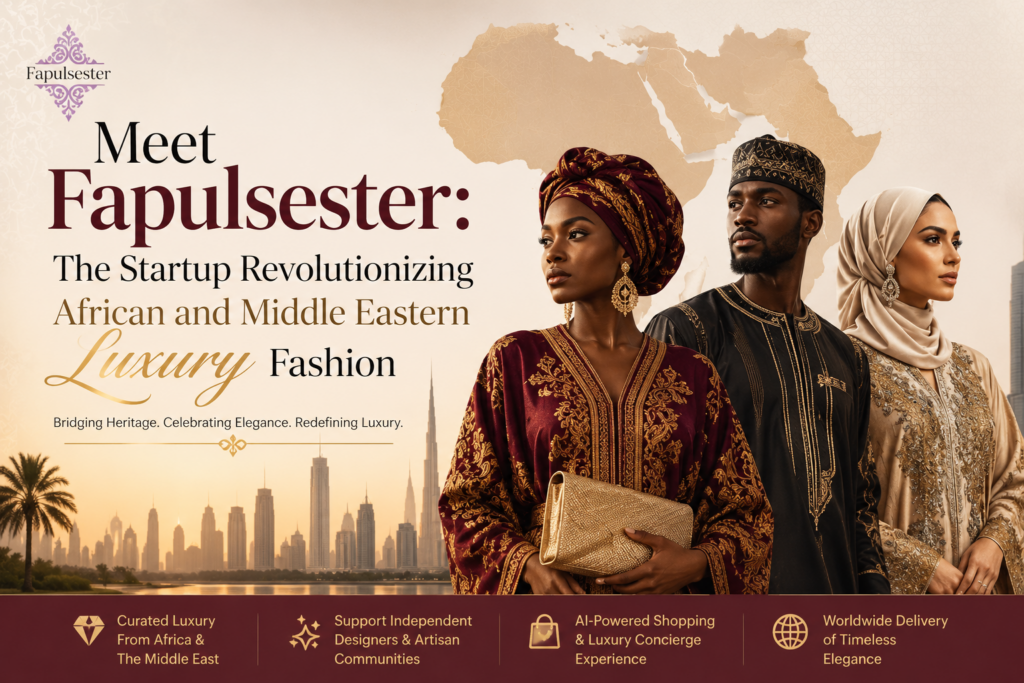
That tension — between two worlds, two aesthetics, two occasions — is exactly what Fapulseter was built to resolve.
The Gap I Could Not Unsee
I have spent over seven years working in SEO, paid media, and revenue growth. I have worked across e-commerce, real estate, healthcare, events, and corporate sectors in the Gulf and in Africa. I have helped businesses generate millions in revenue and reach millions of people.
But when I looked at the global luxury fashion market — a $1.7 trillion industry — I kept seeing the same blind spot.
Farfetch. Net-a-Porter. Mytheresa. These are extraordinary platforms. They have changed how luxury fashion is bought globally. But they were built for a specific consumer: broadly Western, broadly secular, broadly one-dimensional in their cultural needs. The GCC woman shopping for Ramadan was an afterthought. The African professional in Dubai looking for a bespoke Agbada for his brother’s wedding in Accra was invisible.
Modanisa understood one part of this — the modest fashion market — and built a billion-dollar business on that insight alone. Afrikrea understood African designers needed a marketplace. But nobody had connected both worlds. Nobody had built for the woman in Riyadh who wants a luxury abaya for Eid and an Ankara kaftan for her Nigerian colleague’s baby naming ceremony. Nobody had built for the man in Bahrain who wants a tailored Emirati kandura and a hand-embroidered Agbada shipped from Lagos.
That consumer exists. I know her. I know him. I have had dinner with them.
So I built Fapulseter.
What Fapulseter Actually Is
Fapulseter is not an online store. I want to be precise about that, because the distinction matters.
We are building the digital infrastructure that powers African and Middle Eastern luxury fashion globally. The platform today combines intelligent fashion discovery, an AI styling concierge, voice shopping, image-based product search, designer onboarding, and custom luxury order management — all inside a single premium shopping experience.
At the heart of it is Layla — our AI stylist.
Layla is not a chatbot. She is not a recommendation algorithm dressed up in conversational language. Layla understands your occasion. She knows the difference between dressing for a Saudi wedding and dressing for a Kuwaiti ghabga. She understands what full modest coverage means in Qatar versus what it means in Bahrain. She knows that if you are attending a Yoruba naming ceremony in Dubai, you may need complementary aso-ebi accessories, not just a dress.
She speaks the cultural language of our customers. And when what you need does not exist in our catalogue, Layla connects you directly to an artisan who will make it for you.
That is bespoke commissioning built into the discovery journey. No major luxury platform offers this. Farfetch cannot. Net-a-Porter cannot. It would require them to rebuild their entire operating model. We designed for it from day one.
Why Bahrain. Why Now.
People ask me why I chose Bahrain as our headquarters.
The answer is both strategic and personal.
Strategically, Bahrain sits at the centre of the GCC’s $300 billion luxury market. It is one of the most progressive business environments in the Gulf — progressive legislation, zero personal income tax, free trade agreements, and an increasingly international professional class that is exactly the consumer Fapulseter serves. The Bahrain Economic Development Board has been explicit about its ambition to attract digital and creative economy businesses. We intend to be part of that story.
We are establishing a physical headquarters in Manama — a minimal but intentional retail presence. Not a warehouse. Not a pop-up. A curated space where clients can experience Fapulseter in person, where designers can meet customers, and where bespoke commissions can be managed locally with speed and care. Local fulfilment for GCC customers. That matters in a market where trust is built through proximity.
Personally, Bahrain is where I built my professional credibility. My client relationships in the Gulf — in real estate, corporate services, motor industry — taught me how this market thinks, what it trusts, and what it demands from a premium brand. You cannot learn that from a market report. I lived it.
And from Bahrain, we scale through ambassadors — not branches. Nigeria. Kenya. The UAE. The United Kingdom’s African diaspora. Each market has community leaders, influencers, and cultural connectors who understand their fashion ecosystem better than any central office ever could. We bring them into the Fapulseter family and give them the infrastructure. They bring the trust.
The Technology Is the Differentiator
I come from a background in web intelligence. I have built SEO and paid media systems for businesses across Gulf markets and African businesses. I understand how platforms are found, how they convert, and how they retain.
Fapulseter is built on that understanding from the ground up.
Our platform uses Algolia for intelligent, real-time product search and recommendation — so when Layla suggests a piece, she is pulling from live inventory that can be filtered by occasion, coverage preference, heritage, size, and delivery window. Not a static catalogue. A dynamic one.
We have visual search — upload a photo of a piece you love and find its closest equivalent from our designers. We have voice search — tell Layla what you need in the same casual language you would use with a friend. We have geo-detection — the moment you land on Fapulseter.com, the platform reads your location and switches to your language and your currency automatically. Arabic for GCC visitors. English for diaspora. French for West African markets. The experience begins before you have clicked anything.
The backend connects through Shopify for seamless commerce and fulfilment, Supabase for data infrastructure, HubSpot for customer relationship management, and Klaviyo for the kind of post-purchase communication that luxury customers expect — not a generic order confirmation, but a personal note, a dispatch preview, a styling follow-up from Layla after your piece arrives.
We built this on Lovable, which allowed us to move fast and stay focused on the product experience rather than getting lost in engineering overhead at the prototype stage. The architecture is designed to migrate to a full production-grade Next.js stack as we scale — the foundation is right, the pace is right.
Who This Is For
Let me be direct about our customer, because she is not everyone and we are not trying to serve everyone.
She is a woman in Riyadh or Dubai or Manama or Lagos or London who takes fashion seriously. She has a cultural occasion coming up — Eid, a wedding, a ghabga, a church service, a naming ceremony — and she wants to dress in a way that honours where she comes from without compromising on quality, modernity, or luxury. She may be Arab. She may be African. She may be both. She may be a Kenyan Muslim professional in Bahrain who is dressing for Eid Al-Fitr and then for a colleague’s Nigerian wedding two weeks later.
She exists in the millions. She is completely underserved by every major platform currently in existence. She is Fapulseter’s customer.
And the designers we serve are the craftspeople whose work she deserves to be wearing — artisans and fashion houses from across Africa and the Middle East whose quality rivals anything on Farfetch, but whose global distribution has been limited by the lack of a platform that understands their work in the cultural context it was created for.
We are building that bridge.
What I Have Learned Building This
Building Fapulseter has confirmed something I believed but needed to prove to myself: that the things that look like niches from the outside are often the largest untapped markets in the world.
The GCC luxury market alone exceeds $18 billion today and is growing at over 10% annually. The African fashion diaspora spends billions annually on heritage fashion with no premium platform to serve them. Global luxury e-commerce is on its way to $135 billion by 2035. The intersection of Arabic and African luxury fashion, served with AI intelligence and cultural depth, is not a niche. It is a category that does not yet have a name because nobody has built the platform that defines it.
We are defining it.
I also learned that founder-market fit is not a buzzword. It is the thing that determines whether you understand your customer deeply enough to build something they actually want, versus something you think they should want. I grew up in Uganda. I lived in Bahrain. I have sat at the intersection of these two worlds for years. I did not read my way into understanding this market. I lived my way into it. That is why Layla speaks the right language. That is why the platform’s occasion intelligence is specific rather than generic. That is why our designer vendor model is built around trust and cultural credibility rather than just commercial terms.
You cannot fake that understanding. You can only earn it.
What Comes Next
Fapulseter is currently at the prototype stage — a live, functional MVP with our core systems integrated and Layla operational. We are onboarding our first wave of designer vendors: both African heritage designers and GCC-based artisans who will power the bespoke commissioning pipeline.
We are preparing our Bahrain headquarters. We are activating our first ambassador markets. We are in the final build stages before our first real customers arrive.
We are raising our pre-seed round to accelerate product development, deepen Layla’s cultural intelligence, and reach the first 10,000 customers across the GCC and African diaspora markets.
If you are a designer who creates African or Middle Eastern luxury fashion and you want global distribution — we want to hear from you.
If you are an investor who sees what I see in this market — a $135 billion industry with a category that does not yet exist and a founder who has lived on both sides of it — let us talk.
And if you are the customer I described above — the woman in Manama, in Dubai, in London, in Lagos, who has been waiting for a platform that actually understands what she is dressing for — Fapulseter is being built for you.
Come find us at Fapulseter.com.
And tell Layla what occasion you are dressing for.
Amdan Naturinda is the founder of Fapulseter.com and principal of Amdan.pro, a revenue growth consultancy operating across the GCC, Africa, and the United States. He has over 7 years of experience in SEO, paid media, and digital revenue systems, with an active presence in Bahrain and roots in Uganda.
Connect: amdan.pro · hello@amdan.pro